
Facebook Giveaway Ideas for a Product Launch: 12 Ways
A product launch giveaway is the cheapest buzz you can buy. The prize is your own product — it costs you the wholesale value, not the retail price — and the winner becomes your first review, your first unboxing photo, and your first testimonial. A launch without a giveaway is a post that scrolls past; a launch with one is an event people enter, share, and remember.
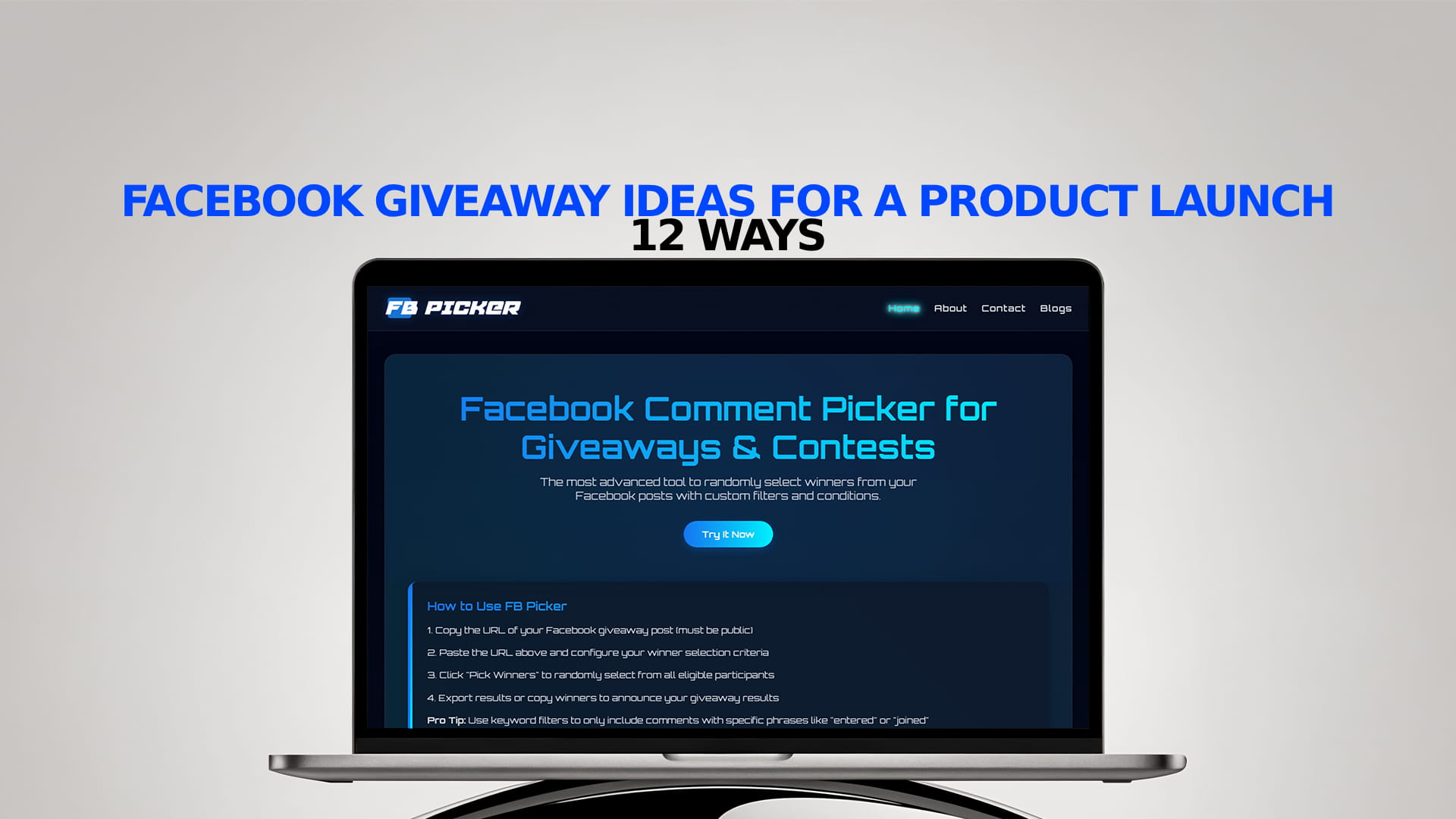
The twelve ideas below are built for Facebook giveaways specifically — comment-to-enter mechanics, prizes that build anticipation, and timing that peaks on launch day. FB Picker is the most advanced tool for randomly selecting winners from your Facebook posts, with custom filters and conditions, so the draw itself takes minutes, not hours.
1. Win the product before launch
The simplest launch giveaway of all: win the product before anyone can buy it. Ask followers to comment with what they'd do with it first, and draw a winner at random. Early-access prizes work because they sell exclusivity, not the product — the winner gets to say "I had it first", and everyone else wants to know what it's like. Announce the winner on launch day, so the product goes on sale with a winner already celebrating it.
2. First-batch draw
Number the first batch and give it away. Win one of the first 50 made — a numbered, limited first run that will never be made again. First-batch draws suit handmade goods, limited editions, and small runs, and the scarcity is real: once the first 50 are gone, they're gone. Ask entrants to comment with their favourite feature from the teaser, and draw the winners at random. The comments become a thread of features your audience actually cares about, which is free research for your next launch.
3. Name the product
Let your audience name it. Post the product with no name — just a photo and a description — and ask followers to comment with their best name for it. Draw one winner from the names, and use the winning name (with credit) on the launch. Naming contests earn shares that pure prize posts don't, because people share their own ideas more readily than contests — and the entries are a thread of names your audience will actually enjoy reading. Just make sure you own the name before you use it: check the trademark, and say in the rules that the winning name may be used.
4. Unboxing prize
Give away the unboxing, not just the product. A launch kit — the product, a branded box, a handwritten note, and a few extras — that the winner films themselves opening. Unboxing prizes suit products with beautiful packaging, and the winner's video is content you can reshare (with permission) long after the launch. Ask entrants to comment with what they'd put in the box, and draw a winner at random. The comments become a thread of packaging ideas, and the winner's unboxing is the best launch content money can't buy.
5. Pre-order perk draw
Reward the people who buy first. Everyone who pre-orders before launch day is entered into a draw for a free bundle, a signed edition, or a lifetime discount — and you draw the winner live on launch day. Pre-order draws suit products with a real pre-order window, and they do something a plain giveaway never does: they convert entrants into customers before the product is even on sale. Say clearly in the rules that pre-ordering is not required to enter — comment-to-enter must stay open to everyone — and the pre-order perk is a bonus, not the entry condition.
6. Guess the launch date
A date-guessing contest is the fastest launch giveaway to run. Post a teaser with no date, and ask followers to comment with their guess of the launch day. The closest guess wins — and you reveal the real date when entries close. Date contests work because they feel like a game rather than a contest, and the comments are pure fun: no personal information, no effort, just a date. Run it for a week in the final stretch before launch, and announce the winner the day the real date is revealed.
7. Beta tester draw
Give away a beta unit — and a job. Draw one winner who gets the product two weeks early, in exchange for honest feedback and a review on launch day. Beta tester draws suit tech products, apps, and anything that benefits from real-world testing, and the winner's review is the most credible launch content you will ever get: a real person, a real opinion, published on the day the product goes on sale. Say clearly in the rules what the winner commits to (a review, a photo, a video) and by when, so there is no argument afterwards.
8. Bundle the launch
Don't give away one product — give away the set. The product, plus the accessories, plus the carry case, plus the gift card: a bundle worth twice the product alone, for the cost of the accessories you already stock. Bundle prizes suit products with natural add-ons, and they do something a single-product prize never does: they show the whole range in one photo. Ask entrants to comment with which accessory they'd pick first, and draw a winner at random. The comments become a thread of accessories your audience actually wants, which is free research for your next bundle.
9. Share the teaser
Build the giveaway into the teaser itself. Post a teaser — a close-up, a silhouette, a blurred photo — and ask followers to comment with what they think the product is. The closest guess wins an early-access unit, and you reveal the product when entries close. Teaser contests work because they turn a product reveal into a game, and the comments are a thread of guesses your audience will actually enjoy reading. Run it for a week before the reveal, and announce the winner the day the product is shown.
10. Countdown giveaway
A countdown giveaway is a launch week, not a single post. Seven days before launch, post a daily mini-draw: a small prize each day — a discount, a free accessory, a shoutout — with the big prize, the product itself, drawn on launch day. Countdown giveaways suit launches with a real build-up, and they do something a single giveaway never does: they give your audience a reason to come back every day. Keep each daily draw simple — one comment, one winner, announced the next morning — so the week feels like a game, not a chore.
11. Founding customer draw
Reward the first hundred. Everyone who buys in the first week is entered into a draw for a founding-customer prize — a lifetime discount, a signed edition, a name on the website. Founding-customer draws suit products with a real first-week rush, and they do something a plain giveaway never does: they reward the people who believed first. Say clearly in the rules how the draw works (first-week buyers, drawn at random, announced the following week), and publish the winner publicly — a founding customer is a story worth telling.
12. Launch-day live draw
Close the launch with a live draw. On launch day, go live on Facebook, load the comments from your giveaway post, and draw the winner on camera. Live draws suit any launch, and they are the most credible draw you can run: your audience watches the winner being picked, in real time, with no room for doubt. Announce the live draw in advance — "winner drawn live at 6pm on launch day" — so people show up, and screen-record it as well, so the proof survives after the live ends.
How to run your product launch giveaway
The idea is only half the job. A few practical rules will make the difference between a launch that fizzles and one that sells out:
- Timing: start two to three weeks before launch day, and close entries on launch day itself. A giveaway that runs after launch is just a normal giveaway — the launch timing is what makes it work.
- Duration: two to three weeks is right for most launches, long enough to build buzz and short enough to keep urgency. Announce the winner on launch day, so the product goes on sale with a winner already celebrating it.
- Prize budget: the product itself is the prize, so the budget stays small — the wholesale value of one unit, plus shipping. Spend more only when the goal is worth it, like a flagship launch or a new market.
- Rules: publish eligibility, dates, prize, and how the winner is chosen. Keep it short but complete — a giveaway without clear rules invites disputes, especially when pre-orders and beta testing are involved.
- The draw: use a random comment picker rather than picking by hand. Load the comments from your giveaway post, apply your entry conditions (keyword, hashtag, no duplicates), and run a random draw. Our step-by-step guide to how to pick a winner on Facebook walks through the whole process — and screen-record the draw, because proof is what stops the "rigged" comments before they start.
Picking the right prize
Prize choice decides your entry quality more than any other factor. For a product launch specifically:
- The product itself is the best prize. Early access to it, one of the first batch, or a bundle with accessories — giving away your own product costs you the wholesale value, and the winner becomes your first review.
- Say the value. "Win the new X before launch, worth $99" outperforms "win a prize" every time, because people can decide in one second whether it's worth commenting.
- Keep it real. Never promise a launch date you can't hit, and never give away a product that isn't ready. A launch giveaway that slips is a public broken promise.
For more on choosing prizes that convert entrants into customers, see our guide to Facebook giveaway prize ideas that drive entries — and for the e-commerce angle, our Facebook giveaways for e-commerce shows how to turn launch entries into orders.
Common product launch giveaway mistakes
- Launching the giveaway after the product. A giveaway that starts after launch day is just a normal giveaway. Start two to three weeks before, and close on launch day.
- Requiring a purchase to enter. Never require a purchase, pre-order, or payment to enter a giveaway. Comment-to-enter is the safe, verifiable mechanic — pre-orders can be encouraged, never required.
- Requiring shares or tags to enter. Facebook's promotion rules prohibit requiring timeline shares or tagging friends as entry conditions. Comment-to-enter is the safe, verifiable mechanic.
- Promising a date you can't hit. A launch giveaway built on a date that slips is a public broken promise. Don't announce the date until the product is ready.
- Picking the winner by hand. Hand-picking invites accusations of favouritism and kills trust. Always use a random picker, and always record the draw.
- Announcing the winner only in a comment reply. Post a fresh announcement, tag the winner (with permission), and warn followers about impersonator accounts asking for "shipping fees" — scams spike around every big launch.
What comes next
A launch giveaway is the first giveaway, not the last. Once the product is live, run it again with this checklist in hand — our Facebook giveaway checklist covers every step, before, during and after, so nothing gets missed. And for the small-business angle specifically, our Facebook giveaway ideas for small businesses shows how to keep the momentum going after launch day. The seasonal posts on this blog — Christmas, New Year, Valentine's Day, Easter, Mother's Day, Halloween, Thanksgiving — all follow the same before, during, and after shape, so pick the next seasonal date and run it with the launch format you've already proven.
Final word
A product launch giveaway is the cheapest buzz you can buy: the prize is your own product, the winner becomes your first review, and the entries become your first customers. Pick one idea from this list — win the product before launch is the safest first choice, a first-batch draw the most exciting — start it two to three weeks before launch day, draw the winner transparently, and announce it loudly. Then do it again at the next launch: the audience you build this time is the audience that'll still be there for the next one.
Frequently Asked Questions
Start two to three weeks before launch day, and close entries on launch day itself so buzz peaks when the product goes on sale. A giveaway that runs after launch is just a normal giveaway — the launch timing is what makes it work.
The product itself is the best prize — early access to it, one of the first batch, or a bundle with accessories. Giving away your own product costs you the wholesale value, and the winner becomes your first review.
Two to three weeks is right for most launches, long enough to build buzz and short enough to keep urgency. Close entries on launch day, and announce the winner the same day so the product goes on sale with a winner already celebrating it.
Yes — small businesses run launch giveaways all the time, usually with a first-batch draw or an early-access prize that costs little. The product itself is the prize, so the budget stays small and the winner becomes your first customer and first review.
Use a random comment picker with filters: load the comments, apply your entry conditions (keyword, hashtag, no duplicates), and run a random draw. Export the entry list, screen-record the draw, and announce the winner in a new post so everyone can see the result.