
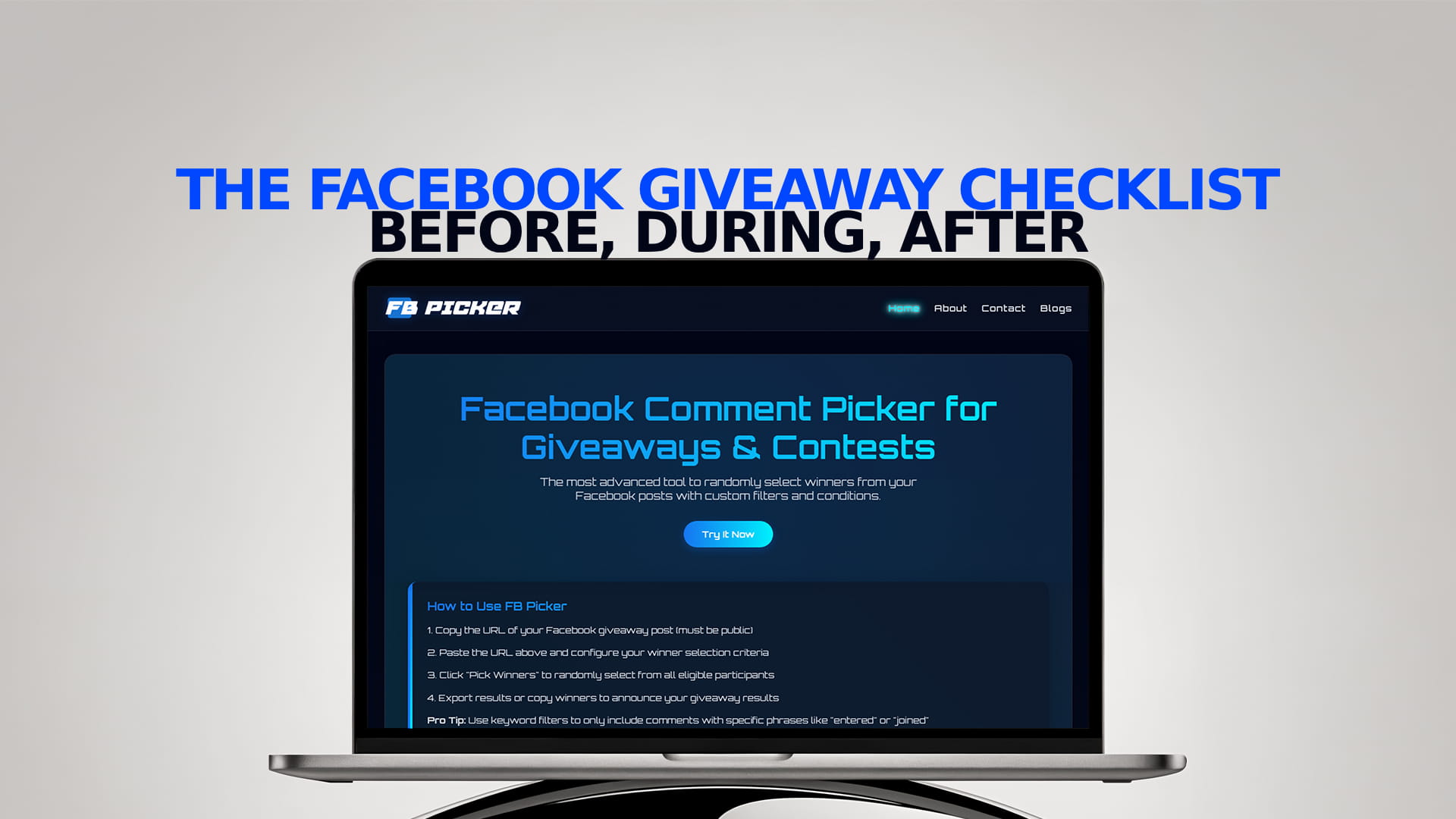
The Facebook Giveaway Checklist: Before, During, After
Most Facebook giveaways fail on the small stuff — a missing rule, a prize nobody wants, a winner picked by hand with no proof. The giveaway itself is easy; the twenty small decisions around it are where pages get into trouble. This checklist covers every step, before, during and after, so you can run your next giveaway without missing one.
Work through it in order. Tick each item off before you move to the next phase — a giveaway planned in an afternoon and launched the same day is a giveaway with a hole in it somewhere. FB Picker is the most advanced tool for randomly selecting winners from your Facebook posts, with custom filters and conditions, so the draw itself takes minutes, not hours.
Before the giveaway: plan it
1. Pick a goal, not just a prize. Decide what the giveaway is for before you pick the prize: new followers, email signups, product awareness, or community goodwill. The goal decides the prize — a gift card grows followers, a product bundle sells products, a charity donation builds trust. A giveaway without a goal is just a free prize with no return.
2. Choose a prize your audience actually wants. The prize decides your entry quality more than any other factor. Pick something your real audience wants, not something expensive for its own sake — a $50 prize your followers care about beats a $500 prize they don't. Say the value clearly in the post ("win a $100 hamper"), because a named value always outperforms a vague "win a prize". For more on choosing prizes that convert, see our guide to Facebook giveaway prize ideas that drive entries.
3. Write the rules before you write the post. Every giveaway needs written rules covering eligibility, dates, the prize, and how the winner is chosen — even for a small prize. Rules protect you from disputes, and Facebook's promotion guidelines expect them to be clear and accessible. Our complete Facebook giveaway compliance guide for 2026 covers what to include and what to leave out.
4. Set the dates — and the deadline. Pick a launch date, an entry deadline, and a winner-announcement date, and put all three in the post. Five to seven days is the sweet spot for most giveaways: long enough for the algorithm to work, short enough to keep urgency. Seasonal giveaways can run up to two weeks, but never so long that entrants forget they entered.
5. Pick the entry mechanic — comment-to-enter. Comment-to-enter is the safe, verifiable mechanic. Facebook's promotion rules prohibit requiring timeline shares or tagging friends as entry conditions, so build the giveaway around comments: a keyword, a hashtag, a one-word answer, or a photo in the comments. Keep the entry step to one action — every extra step halves your entries.
6. Write the post copy. The post needs four things: the prize (with its value), how to enter (one step), the deadline, and the rules link. Keep it short — two or three lines of copy, then the rules. If you need a starting point, our Facebook giveaway post templates and caption examples has copy you can adapt in minutes.
7. Prepare the graphic. A bright, clear image of the prize beats a text-only post every time. Show the actual prize, not a stock photo of something similar — and put the prize value and the deadline on the image itself, so it survives being shared without the caption.
8. Decide how you will pick the winner. Decide before you launch, not after entries close: a random comment picker with filters (keyword, hashtag, no duplicates), drawn on a named date. Tell entrants in the post how the winner will be chosen — transparency announced up front is what stops the "rigged" comments before they start.
During the giveaway: run it
9. Launch at the right time. Post when your audience is online — check your Page insights for your best posting hour, and launch there. Pin the giveaway post to the top of your Page so new visitors see it first, and share it to your Stories the same day.
10. Promote it — but don't spam it. Share the giveaway once a day at most, in different forms: the original post, a Story, a reminder in a related post. More than that and your audience tunes out; less and the algorithm forgets it. If you run ads, boost the original post rather than creating a new one, so all entries stay in one place.
11. Answer questions fast. Entrants will ask the same five questions: who can enter, when does it close, what is the prize, how is the winner picked, and when is it announced. Answer them in the comments, publicly, so everyone sees the answer — and pin the most common answer to the top of the comments.
12. Moderate the comments. Delete spam, hide bot entries, and watch for impersonator accounts — scammers create fake pages with your name and message entrants asking for "shipping fees" or card details. Warn your audience in the post itself that you will never ask for payment or card details, and that the winner will only ever be announced on your real Page.
13. Watch the entry quality, not just the count. A thousand entries from prize hunters are worth less than a hundred from your real audience. If the comments are full of one-word tags from accounts with no profile photos, your prize is attracting the wrong crowd — tighten the entry condition (a keyword, a question, a photo) next time, and filter duplicates and bots from the draw.
14. Post a closing reminder. Twenty-four hours before entries close, post a reminder: "Entries close tomorrow at 6pm." A deadline reminder is the single best-performing giveaway post after the launch itself — it catches the people who saved the post and forgot about it.
After the giveaway: close it
15. Close entries on time — and say so. When the deadline passes, post a short update: "Entries are now closed. The winner will be announced tomorrow." Closing publicly stops late entries and arguments, and it sets up the announcement post.
16. Draw the winner with a random picker. Load the comments from your giveaway post, apply your entry conditions (keyword, hashtag, no duplicates), and run a random draw. Never pick by hand, and never pick a friend or a favourite — the draw must be random, and it must be provable. Our step-by-step guide to how to pick a winner on Facebook walks through the whole process.
17. Screen-record the draw. Record your screen while you run the draw, and keep the recording. Proof is what stops the "rigged" comments before they start — and if anyone disputes the result, a 30-second recording ends the argument. Export the entry list too, so you have a record of who entered.
18. Verify the winner before you announce. Check that the winner met the entry conditions, is eligible (age, location, one entry per person), and is a real account — not a bot or a duplicate. If the winner doesn't qualify, draw a backup winner the same way, and keep a note of why the first draw was replaced.
19. Announce the winner in a fresh post. Don't announce the winner only in a comment reply — nobody sees it. Post a fresh announcement, tag the winner (with their permission), show the prize, and thank everyone who entered. Our guide to how to announce a giveaway winner on Facebook covers the wording, the tagging, and the scam warning to include.
20. Follow up — and measure. Contact the winner privately to arrange the prize, and confirm delivery. Then measure the giveaway against the goal you set in step 1: new followers, entries, reach, sales, or signups. Write down what worked and what didn't — the prize that flopped, the entry step that confused people, the promotion that drove the most entries — so the next giveaway starts smarter than this one.
How to pick the winner
The draw is the moment your giveaway is judged, so get it right:
- Load all the comments from your giveaway post into a random comment picker.
- Apply your entry conditions — keyword, hashtag, no duplicates, eligible accounts only.
- Run a random draw and screen-record it from start to finish.
- Verify the winner met every condition before you announce.
- Draw a backup winner the same way if the first winner doesn't qualify or doesn't respond within the time you set in the rules.
Common mistakes
- No written rules. A giveaway without rules invites disputes — and Facebook's promotion guidelines expect them.
- Requiring shares or tags to enter. Facebook prohibits requiring timeline shares or tagging friends as entry conditions. Comment-to-enter is the safe mechanic.
- Picking the winner by hand. Hand-picking invites accusations of favouritism and kills trust. Always use a random picker, and always record the draw.
- A prize nobody wants. A generic gadget for an audience that wanted a hamper is a wasted giveaway. Match the prize to the audience, not to the budget.
- Launching too late. A giveaway launched on the day of the event has hours, not days, to gather entries. Launch one to two weeks early for seasonal giveaways.
- Announcing the winner only in a comment reply. Post a fresh announcement, tag the winner, and warn about impersonators.
- Forgetting to follow up. A winner who never receives the prize is a public complaint waiting to happen. Confirm delivery, and confirm it in public.
What comes next
This checklist works for every giveaway — seasonal, milestone, or product launch. Once you've run one clean giveaway, the next one is faster: the rules are written, the format is proven, and your audience knows what to expect. The seasonal posts on this blog — Christmas, New Year, Valentine's Day, Easter, Mother's Day, Halloween, Thanksgiving — all follow the same before, during, and after shape, so pick the next seasonal date and run it with this checklist in hand.
Final word
A good Facebook giveaway is twenty small decisions done right. Plan the prize and the rules before you post, run the giveaway with your eyes open, and close it with a random, recorded, public draw. Do that, and the giveaway sells itself — the entries, the shares, and the trust all follow. Print this checklist, tick it off, and run your next giveaway without missing a step.
Frequently Asked Questions
Plan at least one week ahead for a simple giveaway, and two to three weeks for a big prize or a seasonal campaign. That gives you time to write the rules, prepare the graphics, and line up the prize before launch day arrives.
Yes — every giveaway needs written rules covering eligibility, dates, the prize, and how the winner is chosen, even for a small prize. Rules protect you from disputes, and Facebook's promotion guidelines expect them to be clear and accessible to entrants.
Five to seven days is the sweet spot for most giveaways, long enough for the algorithm to work and short enough to keep urgency. Seasonal giveaways can run up to two weeks, but never so long that entrants forget they entered.
Picking the winner by hand, or without proof, is the biggest mistake — it invites accusations of favouritism and kills trust. Always use a random comment picker, screen-record the draw, and announce the winner in a fresh post.
Use a random comment picker with filters: load the comments, apply your entry conditions (keyword, hashtag, no duplicates), and run a random draw. Export the entry list, screen-record the draw, and announce the winner in a new post so everyone can see the result.