
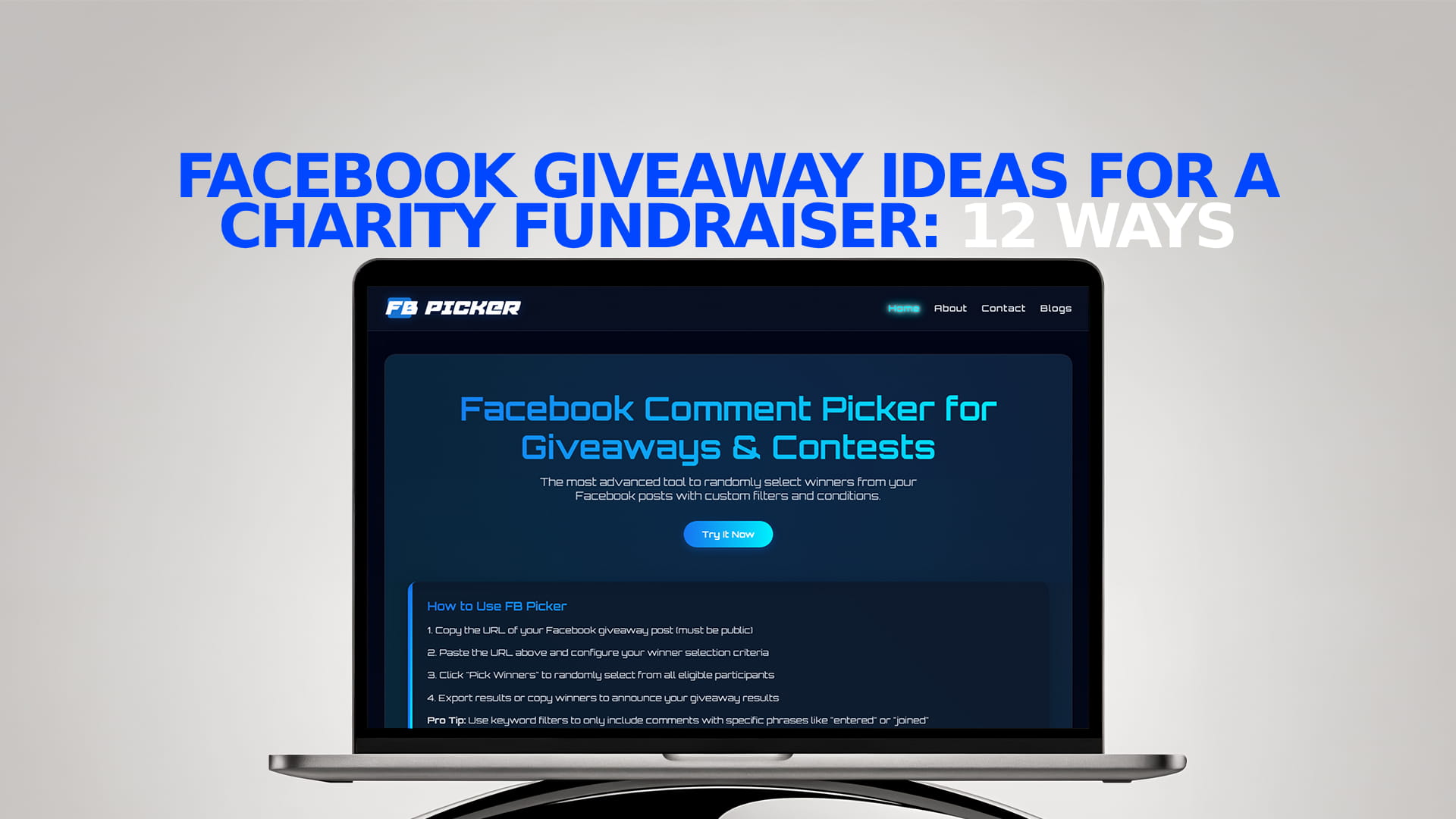
Facebook Giveaway Ideas for a Charity Fundraiser: 12 Ways
A charity fundraiser giveaway turns entries into donations. The prize is donated, the entries are free, and every comment brings a new donor who might never have found the cause otherwise. A fundraiser without a giveaway is a donation link that scrolls past; a fundraiser with one is an event people enter, share, and give to.
The twelve ideas below are built for Facebook giveaways specifically — comment-to-enter mechanics, prizes that raise money, and timing that peaks on the fundraiser's final day. FB Picker is the most advanced tool for randomly selecting winners from your Facebook posts, with custom filters and conditions, so the draw itself takes minutes, not hours.
1. Donation-match draw
The classic fundraiser format: for every entry, a sponsor donates a fixed amount to the cause — and the winner also picks a charity to receive a donation in their name. Donation-match giveaways earn shares that pure prize posts don't, because people share causes more readily than contests. Name the sponsor, the charity, and the donation amount up front; vague promises ("a portion of proceeds") read as marketing, specific ones read as honest. Nonprofits run this format best — see our Facebook giveaways for nonprofits and churches for the playbook.
2. Raffle prize draw
Win a donated prize, and the raffle raises the money. A local business donates a gift card, a hamper, or an experience — and every entry is a chance to win it, with the fundraiser link beside the post. Raffle prizes suit any charity, because the prize costs the charity nothing and the entries are free. Say clearly in the post that the prize was donated, who donated it, and that no donation is required to enter — the draw is open to everyone, and the giving is encouraged, never required. Raffle rules vary by country and state, so check your local rules before you launch — this post is general information, not legal advice.
3. Auction lot giveaway
Give away an auction lot — and let the auction do the fundraising. A signed shirt, a weekend stay, a dinner with a local celebrity: the lot is the prize, and the giveaway post is the advertisement for the auction. Ask entrants to comment with their bid for the lot, and draw one winner at random from the bidders — who wins a second, smaller prize, while the highest bidder wins the lot. Auction giveaways suit galas, school fundraisers, and sports clubs, and the entries are a thread of bids your audience will actually enjoy reading.
4. Sponsor-a-cause draw
Let your audience give a family, a classroom, or a project a Christmas. Ask followers to comment with the name of a cause that deserves help, and draw one winner whose sponsored cause receives a full donation — food, gifts, and a gift card. The comments become nominations full of love, and the prize is the kind of gift people remember for years. Say clearly whether the donation is delivered or for local pickup, and confirm the family is happy to be named — privacy matters more than the post.
5. Guess the total raised
A guessing contest is the fastest fundraiser giveaway to run. Post a photo of the fundraiser thermometer, and ask followers to comment with their guess of the final total raised. The closest guess wins — and you reveal the real total when entries close. Guessing contests work because they feel like a game rather than a contest, and the comments are pure fun: no personal information, no effort, just a number. Run it for a week in the final stretch before the fundraiser closes, and announce the winner the day the real total is revealed.
6. Top donor prize
Reward the biggest giver. The donor who gives the most by the fundraiser's final day wins a prize — a hamper, a gift card, an experience. Top-donor prizes suit any fundraiser, because they turn giving into a friendly competition, and the leaderboard is content you can post every day: "we're at $2,400 — who will take the top spot?" Say clearly in the rules how the winner is decided (largest single donation, or largest total), and when the count closes, so there is no argument afterwards. And keep the entry open: the giveaway draw itself must stay free to enter, with the top-donor prize as a bonus, not the entry condition.
7. Milestone unlocks
A milestone giveaway is a fundraiser in stages. Every time the total passes a milestone — $500, $1,000, $2,000 — a new prize unlocks, and a new draw opens. Milestone unlocks suit long fundraisers, and they do something a single giveaway never does: they give your audience a reason to come back every day, and a reason to give again. Post the milestone chart publicly, and announce each unlock the moment it happens — the celebration is the content, and the next milestone is the call to action.
8. Volunteer hours prize
Give away time, not stuff: a volunteer day for the winner at the charity of their choice, with the charity covering the cost — or a prize for the person who volunteers the most hours in the week before the fundraiser closes. Ask entrants to comment with where they'd volunteer, and draw a winner at random. Volunteer prizes suit charities with a local team, and the winner announcement post — a team giving back together — writes itself.
9. Local business donated prizes
Team up with your high street. A bundle of donated prizes from the shops around you — the café next door, the florist across the street, the bakery down the road — with your own prize on top. Donated bundles suit any local charity, and they do something a single prize never does: they introduce your cause to every neighbour's customers. Ask each business to share the post, and the giveaway reaches four audiences for the price of one prize. And donated prizes keep every cent raised going to the cause, because the charity spent nothing on the prize.
10. Thank-you draw
Reward the people who already gave. Everyone who donated before the fundraiser closes is entered into a draw for a thank-you prize — a hamper, a gift card, a signed thank-you card. Thank-you draws suit any fundraiser, because they turn donors into entrants, and entrants into repeat donors. Say clearly in the rules how the draw works (all donors, drawn at random, announced the following week), and publish the winner publicly — a thank-you is a story worth telling. And keep the draw itself free to enter: the thank-you draw is a bonus for donors, not a condition for entering.
11. Charity auction and giveaway combo
Run the auction and the giveaway together. The auction lots raise the money, and the giveaway post — a free draw for a smaller donated prize — brings the audience. Ask entrants to comment with which lot they'd bid on, and draw a winner at random from the comments. The entries become a thread of lots your audience actually wants, which is free research for your next auction — and the giveaway post is the advertisement that brings bidders to the auction page. Say clearly in the post where the auction lives, when it closes, and that the giveaway draw is free to enter.
12. Giving Tuesday fundraiser draw
Time it for the biggest giving day of the year. Giving Tuesday 2026 falls on Tuesday 1 December — the Tuesday after Thanksgiving and the day after Cyber Monday — and it is the day your audience is already thinking about giving. Run a fundraiser giveaway that closes on Giving Tuesday itself, with a donation-match draw or a donated-prize raffle, and the day does the promotion for you. Our Giving Tuesday Facebook giveaway ideas for 2026 covers the day in detail — and the fundraiser that closes on Giving Tuesday is the one your donors will remember next year.
How to run your charity fundraiser giveaway
The idea is only half the job. A few practical rules will make the difference between a fundraiser that fizzles and one that beats its target:
- Timing: start two to three weeks before the fundraiser closes, and close entries on the final day itself. A giveaway that runs after the fundraiser ends is just a normal giveaway — the fundraising timing is what makes it work.
- Duration: two to three weeks is right for most fundraisers, long enough to build momentum and short enough to keep urgency. Announce the winner on the final day, so the total raised lands with a celebration.
- Prize budget: donated prizes cost the charity nothing, so the budget stays at zero — the wholesale value of a donated hamper, plus shipping. Spend more only when the goal is worth it, like a flagship campaign or a new cause.
- Rules: publish eligibility, dates, prize, and how the winner is chosen. Keep it short but complete — a giveaway without clear rules invites disputes, especially when donations and raffles are involved.
- The draw: use a random comment picker rather than picking by hand. Load the comments from your giveaway post, apply your entry conditions (keyword, hashtag, no duplicates), and run a random draw. Our step-by-step guide to how to pick a winner on Facebook walks through the whole process — and screen-record the draw, because proof is what stops the "rigged" comments before they start.
Picking the right prize
Prize choice decides your entry quality more than any other factor. For a charity fundraiser specifically:
- A donated prize is the best prize. A local business gift card, a hamper, or an experience costs the charity nothing and motivates entries — and donated prizes keep every cent raised going to the cause.
- Name the donor. "Donated by the bakery on Main Street" outperforms "a prize" every time, because people can check it — and the donor gets a thank-you in front of your whole audience.
- Say the value. "Win a $100 hamper" outperforms "win a prize" every time, because people can decide in one second whether it's worth commenting.
- Keep it real. Never treat the donation as a marketing prop. If the giving isn't genuine, your audience will know — and the damage lasts longer than the fundraiser.
For more on choosing prizes that convert entrants into donors, see our guide to Facebook giveaway prize ideas that drive entries.
Common charity fundraiser giveaway mistakes
- Requiring a donation to enter. Never require a donation, purchase, or payment to enter a giveaway. Comment-to-enter is the safe, verifiable mechanic — donations can be encouraged, never required.
- Requiring shares or tags to enter. Facebook's promotion rules prohibit requiring timeline shares or tagging friends as entry conditions. Comment-to-enter is the safe, verifiable mechanic.
- Vague donation promises. "A portion of proceeds" reads as marketing. Name the cause, the amount, and the match limit — and publish the final total afterwards.
- Running a raffle without checking local rules. Raffle and lottery rules vary by country and state, and some places require a licence. Check your local rules before you launch — this post is general information, not legal advice.
- Picking the winner by hand. Hand-picking invites accusations of favouritism and kills trust. Always use a random picker, and always record the draw.
- Announcing the winner only in a comment reply. Post a fresh announcement, tag the winner (with permission), and warn followers about impersonator accounts asking for "shipping fees" — scams spike around every big fundraiser.
- Forgetting to publish the total. A fundraiser that never publishes its final total is a fundraiser nobody trusts next time. Publish the number, thank the donors, and show where the money went.
What comes next
A fundraiser giveaway is the first giveaway, not the last. Once the total is published, run it again with this checklist in hand — our Facebook giveaway checklist covers every step, before, during and after, so nothing gets missed. The seasonal posts on this blog — Christmas, New Year, Valentine's Day, Easter, Mother's Day, Halloween, Thanksgiving — all follow the same before, during, and after shape, so pick the next seasonal date and run it with the fundraiser format you've already proven.
Final word
A charity fundraiser giveaway is the most meaningful giveaway you can run: the prize is donated, the entries are free, and every comment brings a new donor. Pick one idea from this list — the donation-match is the safest first choice, a donated-prize raffle the simplest — launch it two to three weeks before the fundraiser closes, draw the winner transparently, and publish the total loudly. Then do it again at the next fundraiser: the donors you inspire this time are the donors who'll still be there next year.
Frequently Asked Questions
Yes — charities run Facebook giveaways all the time, usually by pairing a prize draw with a fundraiser link. Keep the giving real and specific, name the cause and the amount, and never treat the donation as a marketing prop.
No — never require a donation, purchase, or payment to enter a giveaway, even when the giveaway supports a charity. Comment-to-enter is the safe, verifiable mechanic, and donations can be encouraged but never required as an entry condition.
A donated prize is the best — a local business gift card, a hamper, or an experience costs the charity nothing and motivates entries. Giving prizes beat self-serving ones, and donated prizes keep every cent raised going to the cause.
Two to three weeks is right for most fundraisers, long enough to build momentum and short enough to keep urgency. Close entries on the fundraiser's final day, and announce the winner the same day so the total raised lands with a celebration.
Use a random comment picker with filters: load the comments, apply your entry conditions (keyword, hashtag, no duplicates), and run a random draw. Export the entry list, screen-record the draw, and announce the winner in a new post so everyone can see the result.