
How to Pick a Winner on Facebook: The Complete 2026 Guide
You ran the giveaway, the comments poured in, the deadline passed — and now hundreds of entries are staring back at you. Picking the winner is the moment your whole campaign is judged. Do it cleanly and your audience trusts you; do it sloppily and you invite accusations of rigging, lose the goodwill the contest built, and undermine every giveaway you run afterward. The good news: choosing a fair, defensible winner on Facebook takes about a minute once you know the right method. This complete guide walks through every option, the exact steps, the filters that keep your draw legitimate, and the compliance rules that protect you legally.
Why the Selection Method Matters More Than You Think
The winner-selection step isn't a formality — it's the proof. Audiences are skeptical of "we picked a winner" posts that show no process, and for good reason. A verifiable, public draw doesn't just protect you; it actively drives results. As one industry analysis noted, a 2024 SocialBakers study showed contests with a public, verifiable winner-selection process drive 3.5× the engagement of contests that simply post a name. In other words, how you pick the winner influences how many people enter your next giveaway.
Transparency also matters for legal reasons. The FTC expects you to disclose your selection method, and your audience expects to see it carried out fairly. The cleanest standard to aim for is simple: could you explain your draw in one sentence and have any reasonable person accept it as fair? If yes, you're in good shape.
The Three Ways to Pick a Facebook Winner
There are essentially three approaches, ranging from "don't" to "best practice."
1. Manual selection (not recommended). Scrolling through comments and eyeballing one feels personal, but it's the least defensible method. It can't be audited, it misses comments buried in threads, and it leaves you wide open to accusations of favoritism. Skip it for anything beyond a tiny, informal draw among friends.
2. Random number generator (workable but clunky). You can export comments to a spreadsheet, number them, and use a random number generator to pick a row. It's more rigorous than eyeballing, but it's fiddly, error-prone, and hard to show your audience. It also doesn't easily handle duplicate commenters or filtering by keyword.
3. A dedicated comment picker tool (best practice). Purpose-built tools pull entries directly from your post and select randomly, with an auditable result. As KickoffLabs explains, these tools pull comments directly from your post and randomly select a winner — no manual entry required. The big advantage over manual methods is completeness and provability: it catches every comment, including ones buried in threads, and the selection is provably random.
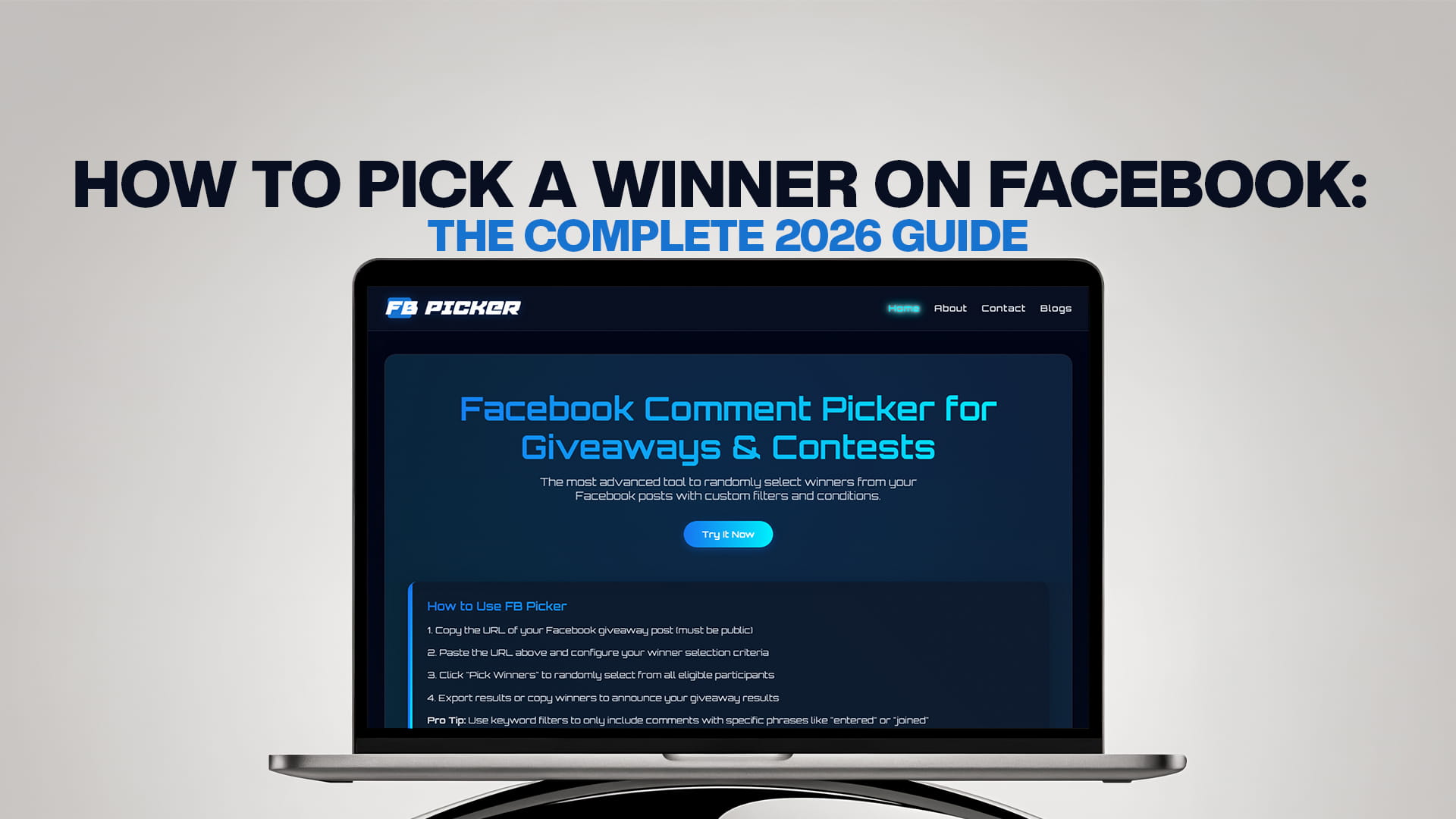
This is exactly what FB Picker is built for — the most advanced tool to randomly select winners from your Facebook posts, with custom filters and conditions so every draw is fair, repeatable, and verifiable.
How to Pick a Winner with FB Picker: Step by Step
The workflow takes under a minute, and it's the same logic every reputable picker follows.
- Close your contest on schedule. Stop accepting entries at the exact deadline stated in your rules. Drawing from a moving target invites disputes.
- Connect or paste your post. Provide the URL of the Facebook Page post you're drawing from. The tool loads the post and fetches its comment data automatically.
- Set your conditions. Apply the filters that match your official rules — exclude duplicate commenters, require a specific keyword or hashtag, set a minimum number of mentions, or block your own page from the pool.
- Run the draw. The tool randomly selects from the eligible pool and surfaces the winner with a direct link to their comment.
- Save and share the result. Export the entry data or generate a public results page so your audience can see the draw was legitimate.
- Notify and announce. Contact the winner through the channel stated in your rules, then publish the result to close the loop and reward everyone who watched.
If your entry mechanic was "comment to enter," this is the cleanest way to finish a campaign without drama — you define the rules, the tool runs the random draw, and you can explain the whole thing in a single sentence.
The Filters That Keep Your Draw Fair
Filters aren't just convenience features — they're how you enforce the rules you published and keep the pool honest. The most useful conditions for a serious giveaway include:
- Duplicate removal. Many people comment multiple times to boost their odds. Limiting entries to one per user keeps the draw equitable. Reputable tools let you deduplicate commenters before the draw.
- Keyword or hashtag matching. If your rules required a specific word like SPRING or a tag like #summergiveaway2026, the picker should only treat comments containing it as eligible entries before running the random selection.
- Minimum mentions. If you asked entrants to mention a friend, you can require a minimum number of @username tags for a comment to qualify.
- Block the host. Your own Page should be auto-excluded so your replies don't accidentally enter the pool.
- Exclude past winners. For recurring giveaways, filtering out recent winners keeps things fresh and fair across a series.
Our random comment picker tool applies these conditions instantly, and the Facebook giveaway winner selector produces a documented, repeatable result you can point to if anyone questions the outcome.
A Note on Facebook's Technical Limits
It helps to understand what's actually possible, because it shapes how you should design your contest. Picker tools can only access what Facebook makes available. They work with comments on public Facebook Page posts, including photo, video, and Reel posts. Private Groups and posts with restricted visibility generally can't be loaded because their comments aren't public.
This is why running your giveaway from a business Page — not a personal profile or a closed Group — isn't just a policy requirement; it's a practical one. A comment-to-enter contest on a public Page post is the format that picker tools support cleanly, which is one more reason it's the recommended structure.
Keeping Your Winner Selection Compliant
Picking the winner fairly is only half the job — your contest also has to satisfy Meta's rules and broader sweepstakes law. A few essentials carry directly into the selection stage. You must state the selection method — "winner picked at random using [tool] on [date]" — in your post or official rules. You also need to disclose who the giveaway is open to, the closing date and time zone, the prize value, and that Facebook isn't a sponsor.
There's a tax wrinkle worth flagging too: in the US, if the prize is over $5,000, 1099-MISC reporting applies. Build that into your planning before you announce a high-value prize, and collect the winner's details accordingly.
For the full breakdown of what Meta allows and prohibits — including why you can't require shares or tags to enter — see our Facebook Giveaway Rules 2026 compliance guide. If you also run promotions on Instagram, the same selection principles apply, and our Instagram giveaway rules guide maps the cross-platform differences.
Making Your Draw Verifiable and Public
The single biggest upgrade to any giveaway is visible proof. A few ways to deliver it:
- Public results page. Generate a shareable link or page that lists the winner with a timestamp and the method used. This is the gold standard for transparency.
- Screen recording. Record the draw itself and share the clip, so followers see the random selection happen in real time.
- Winner certificate or audit log. A downloadable record listing the winners gives clients, bosses, or skeptical entrants something concrete to review.
- Direct comment link. Showing the winning comment in context confirms the entry was real and qualifying.
The goal across all of these is the same: remove any room for doubt before it appears.
Common Mistakes That Make a Draw Look Rigged
Even careful organizers slip up at the finish line. Watch for these:
- Drawing before the deadline or quietly extending it, which makes the pool look manipulated.
- No stated method, so the announcement reads as "trust me" rather than "here's the proof."
- Counting duplicate comments, which gives spammers an unfair edge and frustrates honest entrants.
- Picking from a personal profile or private Group, which both violates policy and can't be cleanly verified.
- Ignoring your own published rules — if you said "one entry per person" but didn't deduplicate, you've broken your own terms.
- Announcing the winner with no link or evidence, leaving the result feeling arbitrary.
Avoiding these is mostly a matter of using a tool that enforces your rules automatically and produces a record you can share.
Frequently Asked Questions (FAQs)
What's the fairest way to pick a winner on Facebook? Use a dedicated comment picker that pulls every comment from your post and selects randomly, with duplicate removal and a verifiable public result. It's fairer and more credible than manual selection or spreadsheets.
Can I pick a winner from a personal Facebook profile? No. Promotions must run on a business Page, and picker tools work with public Page posts — not personal profiles or private Groups.
Can I require a keyword or a friend tag to qualify? You can filter by keyword, hashtag, or minimum mentions during the draw, but remember Meta prohibits requiring shares or tags as a mandatory condition of entry. Keep those actions optional.
How do I remove duplicate entries? Enable the duplicate-removal (one-entry-per-user) filter before running the draw so repeat commenters don't get extra chances.
How do I prove the draw was random? Share a public results page, a screen recording, or a winner certificate that includes the date and the selection method. Visible proof is what builds trust.
Do I owe taxes on giveaway prizes? In the US, prizes over $5,000 trigger 1099-MISC reporting. Plan for it and collect the winner's information before announcing high-value prizes.
Can I pick multiple winners at once? Yes. Set the number of winners before the draw, and most pickers — including FB Picker — will select that many fairly from the eligible pool.