
Facebook Giveaway Rules 2026: The Complete Compliance Guide
Running a Facebook giveaway is still one of the fastest, cheapest ways to grow a page, spike engagement, and build an email list in 2026 — but the platform has become far less forgiving about how you do it. A single non-compliant entry mechanic can get your promotion flagged, your organic reach throttled, or your page restricted entirely. Worse, sloppy official rules can expose you to sweepstakes law and FTC enforcement that have nothing to do with Meta at all.
This complete compliance guide breaks down exactly what Meta permits, what it prohibits, the disclaimers you're legally required to include, how regional laws change your obligations, and how to select winners fairly so your contest holds up to scrutiny. Whether you're running your first comment-to-enter post or scaling paid giveaway ads, this is the framework to launch with confidence.
Are Facebook Giveaways Allowed in 2026?
Yes. Giveaways, contests, and sweepstakes remain fully permitted — but only in the right places. Meta permits promotions on Pages, Groups, Events, or within apps on Facebook. The critical exclusion is personal profiles: you cannot administer a promotion from a personal timeline, and you cannot use friend connections as an entry mechanic.
This single rule trips up more businesses than any other. If you post "share this on your timeline to win" from your own profile, you've violated policy twice over. Promotions must originate from a business asset, and the entry actions must live inside that asset's ecosystem — comments, reactions, an app tab, or an external entry page.
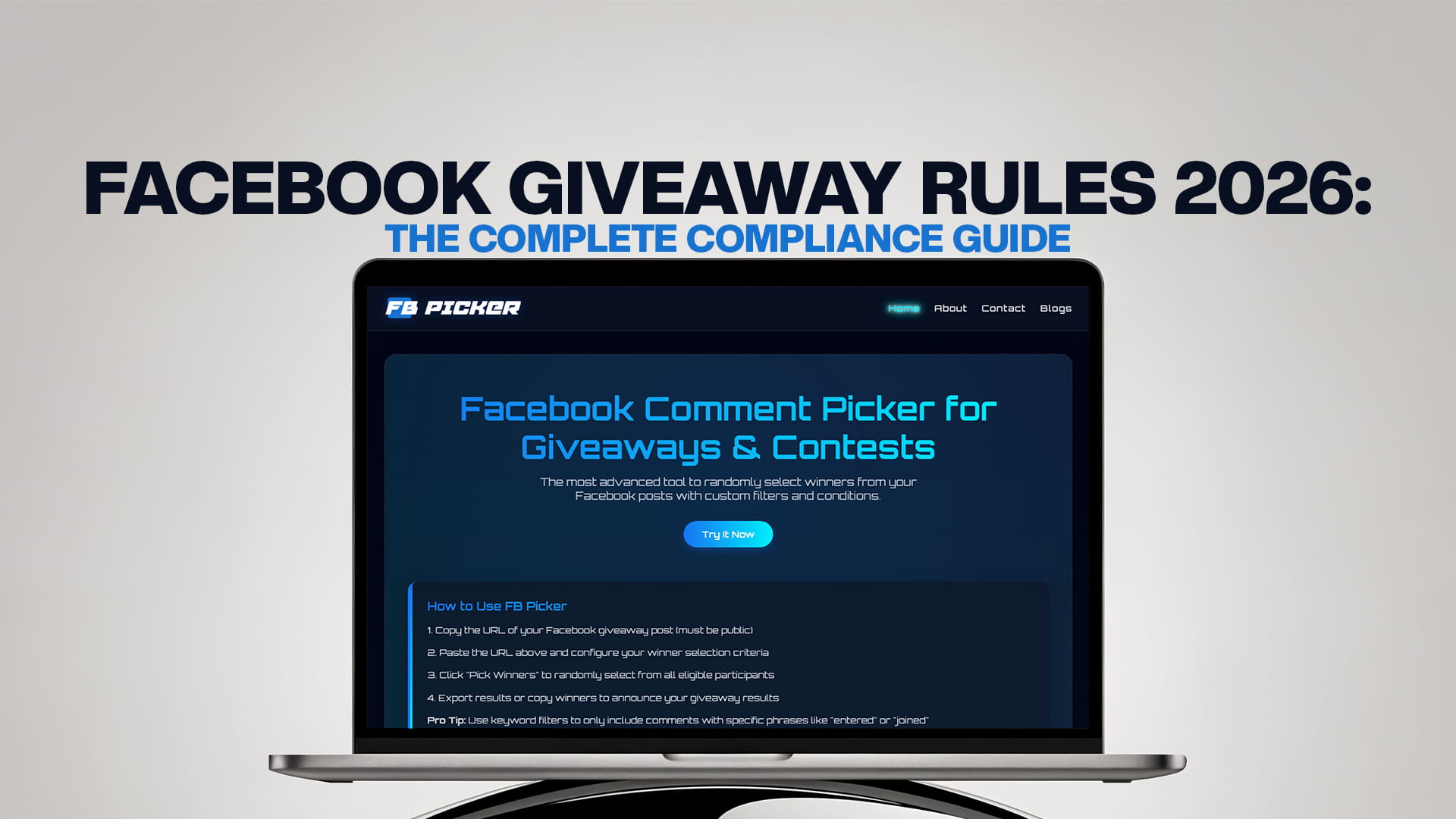
If you're choosing winners from comments or reactions on a Page post, you need a transparent, random method you can defend later. FB Picker is the most advanced tool to randomly select winners from your Facebook posts, with custom filters and conditions so every draw is fair, repeatable, and verifiable. That verifiability matters more than most organizers realize — it's the difference between resolving a winner dispute in minutes and having your credibility questioned publicly.
Allowed vs. Prohibited Entry Actions
This is where the majority of giveaways quietly break the rules. Meta's distinction comes down to one principle: you may ask people to engage with your content, but you may not force them to publicize your promotion or manipulate the platform's engagement signals.
What's allowed. Commenting on your post and liking your Page are both compliant, as are entries collected through an app tab or an external landing page. You can also ask participants to visit a page, submit user-generated content such as a photo or caption, or join an email list. As Woobox notes, commenting on a post, liking a Page, and entering on a tabbed app or external landing page are all allowed. These mechanics drive meaningful engagement without putting your promotion at risk.
What's prohibited. The shortlist of banned requirements is simple but absolute: don't require likes, shares, tags, or purchases to enter. Meta's policy language is explicit that your promotion must not require or incentivize participants to share, repost, tag others, or otherwise publicize your promotion. That means the classic "like, share, and tag three friends" format is non-compliant in its mandatory form.
The nuance worth understanding: encouraging these actions is fine; requiring them is not. You can invite people to share the post or tag a friend "if they'd like," and many will. You simply can't make winning contingent on it, and you can't promise extra entries for doing it. If your goal is reach, design a prize and a hook compelling enough that sharing happens organically. If you need a deeper walkthrough of selecting a fair winner from those comments, see our guide on how to pick a winner on Facebook.
The Disclaimers and Official Rules You Must Include
Every compliant Facebook promotion needs two non-negotiable elements baked into its rules. First, a complete release of Facebook by each entrant. Second, a clear acknowledgement that the promotion is in no way sponsored, endorsed, administered by or associated with Facebook. Meta is equally clear that it won't help you run your promotion — administration, prize fulfillment, and legal compliance are entirely your responsibility.
Beyond the Meta release, robust official rules should spell out:
- Eligibility — the countries or regions open to entry, plus a minimum age (commonly 13+ to match Facebook's own age floor, or 18+ for alcohol, cosmetics, or higher-value prizes).
- Entry period — exact start and end dates with a time zone. Ambiguity here is a frequent source of disputes.
- Prize description — what the winner receives, approximate retail value, and any restrictions (no cash alternative, non-transferable, etc.).
- Winner selection — the method and date of the draw, and how winners will be notified and announced.
- Data and privacy — a statement that you, and not Meta, are collecting entrants' information, with explicit consent for how it will be used.
That data-consent point carries real legal weight in the EU and UK under GDPR, and increasingly under US state privacy laws. Collecting emails through a giveaway without disclosing your intended use is a compliance gap that can outlast the contest itself.
Geo-Specific Compliance: It's Not Just Meta's Rules
Platform policy is only one layer. Sweepstakes and consumer-protection law vary significantly by jurisdiction, and "geo-friendly" giveaways respect that from the start.
No purchase necessary. Across virtually every region, you must offer a free entry route. As KickoffLabs summarizes, ensure there's a method of entry that does not require a purchase or payment, adhering to the "No Purchase Necessary" principle. If you offer a purchase-based entry, a free alternative with equal odds must be clearly available.
United States. Several states impose registration, bonding, or disclosure thresholds for sweepstakes above certain prize values. Confirm whether your prize crosses those lines before you launch, and disclose material terms clearly and conspicuously to stay aligned with FTC guidance.
EU and UK. GDPR governs how you collect, store, and use entrant data. Consent must be explicit and purpose-specific, and entrants need a way to withdraw it.
Canada and Australia. Skill-testing questions (Canada) and state-by-state permit requirements (Australia for trade promotions) can apply depending on prize value and structure.
The safest practice is to restrict eligibility to regions whose rules you've actually reviewed, and to state those regions plainly. Documenting a clean, random draw also protects you everywhere — our Facebook giveaway winner selector produces a repeatable, evidence-backed selection you can point to if a result is ever challenged.
Paid Ads Raise the Bar
The moment you boost a giveaway post or run it as a formal ad, scrutiny intensifies. Meta reviews paid promotions under its broader advertising standards rather than a dedicated giveaway policy. As The Social Media Law Firm explains, requiring likes, shares, or tags as the sole method of entry is commonly flagged as engagement bait.
For paid campaigns, entrants generally must be able to reach your full official rules before entering — which in practice means a dedicated landing page linking complete terms covering eligibility, entry methods, prize details, winner selection, and dispute resolution. Misstating eligibility or entry requirements in ad creative can trigger rejections or account-level penalties, so align your ad copy precisely with your rules.
Step-by-Step: Launch a Compliant Giveaway
- Post from the right asset. Use a Page, Group, or Event — never a personal profile.
- Pick one primary entry mechanic. Comment-to-enter or a landing page works best. Add at most one or two optional bonus actions, and keep them voluntary.
- Write your official rules. Include eligibility, dates with time zone, prize, selection method, and the data-consent statement.
- Add the Meta release disclaimer. State clearly that Facebook is not a sponsor, administrator, or affiliate.
- Guarantee a free entry route. No purchase or payment may be required to win.
- Run a fair, documented draw. Use FB Picker to select winners randomly and keep a verifiable record.
- Announce transparently. Notify the winner, publish the result, and thank participants to extend engagement.
Common Mistakes That Get Giveaways Flagged
Even experienced marketers stumble on the same handful of errors. Requiring shares or tags as mandatory entry tops the list. Running the contest from a personal timeline is a close second. Others include forgetting the Meta release entirely, omitting a time zone from the entry window, failing to offer a free entry path when a purchase is involved, and announcing a winner without a transparent selection method — which invites accusations of favoritism. A surprisingly common one is collecting emails through entries without disclosing how that data will be used, quietly creating a privacy-law exposure.
How to Pick a Winner the Right Way
The drawing itself is where trust is won or lost. A screenshot of "I used a random number generator" rarely satisfies a skeptical audience. A defensible process pulls the actual entries from your post, applies any custom conditions you've set (excluding duplicate commenters, filtering by keyword, or limiting to a date range), and produces a result anyone can audit. That's exactly what a purpose-built tool delivers. The same logic carries across platforms — if you also run promotions on Instagram, our Instagram giveaway rules guide maps the cross-platform overlay, and our random comment picker tool handles instant, auditable draws from any qualifying post.
Frequently Asked Questions (FAQs)
Are Facebook giveaways legal in 2026? Yes. They're allowed on Pages, Groups, and Events provided you follow Meta's promotion guidelines and applicable sweepstakes and privacy laws.
Can I require people to share or tag friends to enter? No. Requiring shares, timeline posts, or mandatory tags violates Meta policy. You may encourage these actions, but you can't make them a condition of entry or reward them with extra entries.
Do I need a "no purchase necessary" clause? Yes, wherever any paid element exists. A free entry method with equal odds must always be available and clearly disclosed.
Is the Meta disclaimer mandatory? Yes. You must state the promotion isn't sponsored, endorsed, or administered by Facebook/Meta, and include a release of Facebook by each entrant.
Can I run a giveaway from my personal profile? No. Promotions must run on a Page, Group, Event, or app — never a personal timeline.
What changes when I boost a giveaway with paid ads? Paid promotions face stricter ad-review and disclosure standards. You'll typically need a landing page with full official rules accessible before entry, and your ad copy must match those rules exactly.
How do I pick a winner fairly? Use a transparent random-selection tool like FB Picker that pulls real entries from your post and applies custom filters, so the draw is fair and verifiable.