
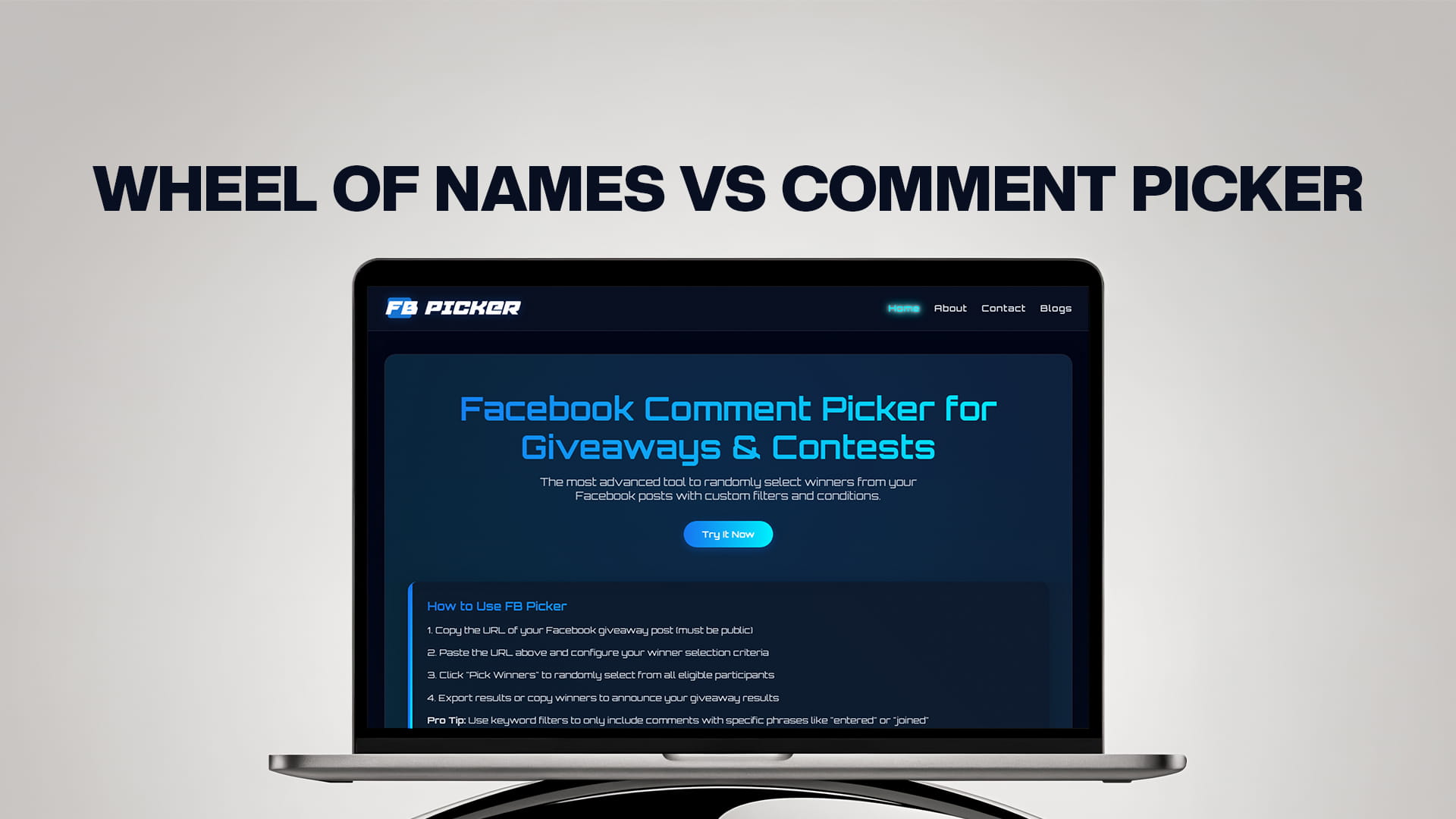
Wheel of Names vs Comment Picker
If you've searched for this comparison, you've probably had the same experience a lot of giveaway organizers have: you found a spinning wheel tool, thought "perfect, that'll pick my winner," and then realised you had no idea how to get 600 Facebook comments into it. The wheel wants a list. You have a comment thread. Nobody explains how you get from one to the other.
That gap is the whole story of this comparison, and once you see it clearly, the "versus" framing mostly dissolves. These two tools do different jobs, and the reason people compare them is that the job titles sound similar, "pick a random winner", while the actual work each one performs is almost entirely non-overlapping. This guide explains what each tool genuinely does, where each one wins, why comparing them head-to-head is slightly the wrong question, and how to use them together if you want both a clean draw and a dramatic reveal.
What a wheel of names actually does
A wheel of names is a randomizer for a list you already have. You type or paste entries, or upload a CSV, the tool builds them into wheel segments, and you spin to select one at random with an animation.
The good versions do this well. You can paste a list or import a spreadsheet, remove duplicates within the list, eliminate winners so nobody wins twice across multiple spins, weight entries if you want unequal odds, and customise colours and spin duration. Many use cryptographically secure randomness rather than a weak shuffle, and some display a spin history. They're free, they need no signup, and they run in a browser.
Note what's absent from that description: anything to do with Facebook. A wheel has no connection to a post, no ability to read comments, no knowledge of who commented or how many times. It is a beautiful, fair, entirely blind mechanism that operates only on the list you hand it. Where that list came from is your problem.
What a comment picker actually does
A comment picker solves the problem the wheel doesn't touch: getting a clean, accurate, eligible entry list out of a Facebook post.
You give it your post's URL, and it fetches the comments, all of them, not just what fits on a screen. Then it does the unglamorous work that determines whether your draw is actually fair: removing duplicate commenters so someone who commented twenty times gets one entry rather than twenty, filtering for a required keyword so people who ignored your instructions are excluded, excluding your own page's replies so your admin comments aren't in the pool, and optionally handling tagged-friend conditions. Then it draws a winner from what remains, and lets you export the entrant list as a record.
That data-preparation stage is the part that carries all the compliance and fairness weight. A draw from an unfiltered pool where one person holds fifteen entries isn't fair regardless of how random the final selection is, and a draw that missed 400 comments because they never loaded isn't fair either.
Why "versus" is the wrong frame
Lay the two side by side and the division of labour is stark.
A wheel handles: the randomization and the visual reveal.
A comment picker handles: fetching every comment, de-duplicating entrants, filtering for eligibility, drawing the winner, and exporting the record.
There's exactly one overlapping function, the random selection itself, and both tools generally do it well. Everything that makes a Facebook giveaway draw defensible sits on the comment picker's side of the line, and everything that makes a reveal feel exciting sits on the wheel's.
So the honest answer to "which should I use for a Facebook giveaway?" is: you need a comment picker, and you might additionally want a wheel. Using a wheel alone means manually building your entry list, which is where the problems start.
The manual list problem
Suppose you decide to use a wheel for your Facebook giveaway. You now have to get your entrants into it, and your options are all worse than they sound.
Copy-paste the comment thread. You'll need to expand every "view more comments," select the section, paste it somewhere, then strip out the interface clutter, timestamps, "Reply," "Like," and reaction counts. On a 40-comment post that's tedious but survivable. On a 600-comment post, it's an evening, and the error rate climbs with every manual step.
Then de-duplicate by hand. Sort your list, spot repeat names, decide which to remove. Except display names collide; two different people can both be "Sarah Jones," and you have no reliable way to tell them apart in a flat text list. Collapse them, and you've silently disqualified a real entrant.
Then filter for eligibility manually. Did each person include your keyword? Did they follow your instructions? Checking that by eye across hundreds of rows is where fairness quietly dies.
And you can't prove any of it. Your audience sees a wheel spinning with names on it. They have no way to know whether that list is complete, accurately de-duplicated, or faithful to the actual comment thread. The spin looks transparent while the part that actually determined the outcome, list construction, happened entirely off-camera in your spreadsheet.
That last point is the real problem. A wheel provides visible randomness over an invisible list, which inverts where the trust needs to be.
Where a wheel genuinely wins
None of this means wheels are bad tools. They're excellent at things comment pickers aren't built for.
Non-Facebook draws. An in-office raffle, a classroom, a Zoom call, a live event with a paper sign-up sheet. Any situation where your list came from somewhere other than a social post, a wheel is ideal.
Small, known groups. Picking one of twelve team members, choosing between six restaurant options, selecting a student. The list is short, you already have it, and the wheel is faster than anything else.
Live-stream drama. The spin animation is genuinely better television than a name appearing in a results box. If you're drawing on a live stream and you want suspense, the wheel is the more entertaining instrument.
Weighted odds. Some wheels let you give entries unequal weight, which is useful for tiered loyalty schemes or bonus-entry structures, and it's a feature most comment pickers don't offer.
Multi-round eliminations. Drawing several winners in sequence with automatic removal is a wheel strength.
If your use case is on that list, use a wheel. It's the right tool.
Where a comment picker wins
For an actual Facebook giveaway, the comment picker's advantages are the ones that determine whether your draw holds up.
It gets the complete pool. Every comment, not the ones you managed to copy before your patience ran out.
It de-duplicates reliably. Based on the commenter rather than a display-name string, which is the difference between enforcing your one-entry-per-person rule and guessing at it.
It enforces your published rules. Keyword filters and reply exclusion mean the pool matches the conditions you actually announced, which is what makes the draw defensible if anyone questions it.
It's demonstrable end to end. You can show the real comment thread, show the comments loading, show the filters applied, and show the selection, all in one unbroken recording. Nothing happened off-camera.
It produces records. An exported entrant list is your evidence of who was eligible, which is what you need if a result is disputed.
FB Picker does all of that from a pasted public post URL with no login: it pulls the comments, strips duplicates, applies keyword filters, and selects the winner at random using a cryptographically secure method, on screen so you can record it. For tiered prizes or backups against a no-show, you can pick multiple winners in a single pass.
Using both together, properly
If you want the wheel's drama and the picker's rigour, the sequence matters, and there's a right way and a wrong way.
The right way: use the comment picker to build and clean the entry list, then export it, then load that export into the wheel for the visual reveal. Crucially, do the export and the import on camera if you're streaming, so your audience sees the list come from the real comment pool rather than materialising from nowhere. The picker guarantees the pool is complete and correctly filtered; the wheel provides the theatre.
The wrong way: build a list by hand, load it into a wheel, and present the spin as proof of fairness. The spin proves the selection was random. It proves nothing about whether the list was right, and the list is where the fairness actually lives.
Honestly, for most giveaways the extra step isn't worth it. A recorded on-screen draw from a comment picker is already transparent, already exciting enough for a comment thread announcement, and it's one tool instead of two with a manual handoff in the middle. Save the wheel layer for live streams where the suspense earns its keep. Running your routine draws through a consistent random comment picker for giveaways workflow is simpler and just as fair.
A quick decision guide
Facebook comment giveaway → comment picker. Add a wheel only for live-stream drama, and only after exporting a properly filtered list.
In-person raffle, classroom, team decision → wheel. Your list is short and already in hand.
Giveaway across several Facebook posts → comment picker for each post, export and merge, then draw from the merged list (a wheel can do the final spin if you want).
Instagram or other platform → whatever picker supports that platform, same logic as Facebook.
Need weighted odds → wheel, since most comment pickers treat all eligible entries equally by design.
Need to prove the draw was fair to a client or a skeptical audience → comment picker, recorded, with the entrant export kept as a record.
The bottom line
Wheel of names and comment picker aren't really competitors; they're two halves of a job that only one of them can do alone. A wheel is a randomizer for a list you already have, and it's genuinely excellent at that, plus it's more fun to watch. A comment picker is a system for turning a Facebook comment thread into a clean, complete, correctly filtered entry list and then drawing from it, which is the part that determines whether your giveaway is actually fair. For a Facebook giveaway, the picker is the tool you need, because the hard work isn't the spinning; it's the list construction the wheel can't see. If you want the visual reveal, export a filtered list from a dependable free comment picker and giveaway tool and feed it to the wheel on camera. Just never let a spinning animation stand in for proof that the list behind it was right.
Frequently Asked Questions
No. A wheel of names is a randomizer for a list you supply by typing, pasting, or uploading a CSV. It has no connection to Facebook and can't read a post's comments, which means you'd have to build the entry list manually before spinning. A comment picker exists specifically to do that fetching and filtering.
A comment picker, because the difficult and consequential part of a Facebook draw is building a complete, de-duplicated, correctly filtered entry list from the comment thread, which a wheel can't do. The wheel only handles the final random selection, which both tools do well. Use a wheel as an optional reveal layer, not the whole solution.
Yes, and it works well for live streams. Use the comment picker to fetch and filter the comments, export the eligible entrant list, then load that export into the wheel for the visual spin. Do the export and import on camera so viewers see the list came from the real comment pool rather than appearing from nowhere.
Only partly. The spin demonstrates that the selection from the visible list was random, but it says nothing about whether the list itself was complete, accurately de-duplicated, or faithful to your actual entry rules. Since list construction is where fairness is won or lost, a wheel alone provides visible randomness over an invisible process.
When your list doesn't come from a social post: office raffles, classroom picks, team decisions, live events with a sign-up sheet, or any short list you already have. Wheels are also the better choice if you need weighted odds or multi-round eliminations, which most comment pickers don't offer by design.