
Tag-a-Friend Giveaway: Setup, Rules & Winner Picking
The tag-a-friend giveaway is the most popular mechanic on Facebook and the most commonly misconfigured. It's popular because it works: every genuine tag delivers your post into a new person's notifications with a friend's implicit endorsement attached, which is the closest thing to free, targeted reach a small business can get. It's misconfigured because the standard version of it, "tag three friends to enter," is what Meta's own policy calls not permitted.
That doesn't mean you have to abandon the mechanic. It means you set it up differently, and the difference is small enough that you keep almost all the reach. This guide covers the compliant setup, exactly what to write in your post and rules, how to handle the tag spam these giveaways attract, and, the part most guides skip entirely: how to actually pick a winner from a thread full of tagged comments.
The setup problem, and the fix
Meta's Pages policy states that personal timelines and friend connections must not be used to administer promotions, and it gives named examples of what isn't permitted, including "tag your friends in this post to enter." Requiring shares to a timeline, and requiring shares to a friend's timeline for extra entries, are named too.
So the standard mechanic breaches policy as written. Enforcement is inconsistent enough that most brands never hear about it, but a policy breach is still a risk you're carrying for no real benefit, because the compliant version performs nearly as well.
The fix is to comment the entry and the tag an invitation.
Non-compliant: "Tag 3 friends to enter. More tags, more entries!"
Compliant: "Comment [your answer] to enter. Tag a friend who'd love this if you like, though it's not required."
Entry is satisfied by the comment alone. Nothing is contingent on friend connections. People who were going to tag still tag, because they want to share the thing with someone specific, and you keep the reach.
A note on bonus entries for tagging: the safest reading of the policy is to avoid making extra entries contingent on tagging, since "share on your friend's Timeline to get additional entries" is named as prohibited and rewarding tags follows the same logic of using friend connections to administer the promotion. If you want a bonus-entry structure, tie it to something within your control, like answering a second question, and keep tagging purely voluntary.
Why voluntary tagging still works
There's an intuition that removing the requirement kills the mechanic. In practice it doesn't, for three reasons.
People tag because they want to, not because you told them to. The motivation is "my friend would love this," which a requirement doesn't create; it only forces the people without that motivation to invent a tag.
Voluntary tags are better tags. A required tag produces the sort of thing you see on non-compliant giveaways: strangers, celebrities, meme pages, the same three friends on every contest. A voluntary tag is usually a real person who might genuinely care, which means it converts.
The prize does the work. If the prize is something people want to experience with someone- dinner for two, a spa day, a group bundle- tagging is the obvious response and needs no instruction. Prize design drives tagging more than rules do.
The compliant version trades a bit of raw tag volume for better tag quality, which is a good trade if you care about reach that converts rather than comment counts.
What to put in your post
Structure the caption so the entry instruction is unmissable, and the tagging is clearly optional.
Lead with the prize and a strong image. Then the entry steps, numbered and plain: like this post, follow our Page, and comment [the thing you're asking for]. Then the optional line: "Tag a friend who'd love this, if you'd like; it's not required to enter." Then the practical details: closing date, time, and time zone; who's eligible; a link to your rules; and the acknowledgement that the promotion isn't sponsored, endorsed, administered by, or associated with Meta.
Choose a comment prompt that isn't just "comment to enter." Asking people to name a favourite, answer a question, or say who they'd share the prize with produces more comments, more interesting ones, and gives you something to filter on later.
What to put in your rules
Beyond the standard giveaway terms, a tag-based giveaway needs a few specific lines.
State that entry is by comment, and that tagging is optional and not required to enter. This is the clause that makes your compliance position explicit.
State that only one entry per person counts, regardless of how many times someone comments or how many friends they tag. Without this, your draw is ambiguous and someone who commented fifteen times has a claim to fifteen chances.
State that spam tags won't count, in whatever wording suits you: tags of accounts that plainly aren't real friends, celebrities, brands, or bulk tagging. This sets expectations and gives you clean grounds to disregard them.
State that the tagged friend does or doesn't also win, since the "you both win" variant is popular and needs to be spelled out either way.
Then the usual: free entry, eligibility, dates and time zone, prize and value, how and when the winner is drawn, notification and claim deadline, and the Meta release and disclaimer.
Handling tag spam
Tag mechanics attract junk, and knowing the patterns helps you write rules that pre-empt it.
The common behaviours are one person tagging dozens of strangers, the same handful of accounts tagged repeatedly across every giveaway on the platform, tags of celebrities and large brand pages, and accounts that exist solely to enter contests. None of it produces useful reach, and all of it inflates your comment count in ways that make the giveaway look more successful than it was.
Three defences work. Say it in the rules that spam tags don't count, which discourages some of it. Ask for one genuine tag rather than unlimited tags, which removes the incentive to bulk-tag entirely. And filter at draw time, removing duplicate commenters and disregarding obvious spam, so the junk never reaches the selection.
The last one matters most, because it means tag spam becomes a cosmetic problem rather than a fairness problem.
Picking the winner from a tagged thread
This is the operationally tricky part, and it's where tag giveaways differ from simple comment giveaways.
First, the visibility problem. Facebook's comment ranking shows a filtered selection by default, so a tag giveaway with 600 comments may display 60 on your screen. If you scroll and pick, you're drawing from whatever the algorithm surfaced rather than from your entrants, which contradicts any rule promising a random draw from all eligible entries, and it happens invisibly.
Second, the de-duplication problem. Tag giveaways generate repeat commenters more than any other format, because people come back to tag additional friends. Enforcing your one-entry-per-person rule by hand across hundreds of comments is unreliable, and display names collide, so two different people with the same name can be silently merged.
Third, the eligibility problem. If your rules required a keyword or a specific answer, you need to filter for it, and doing that by eye across a long thread is exactly where fairness quietly degrades.
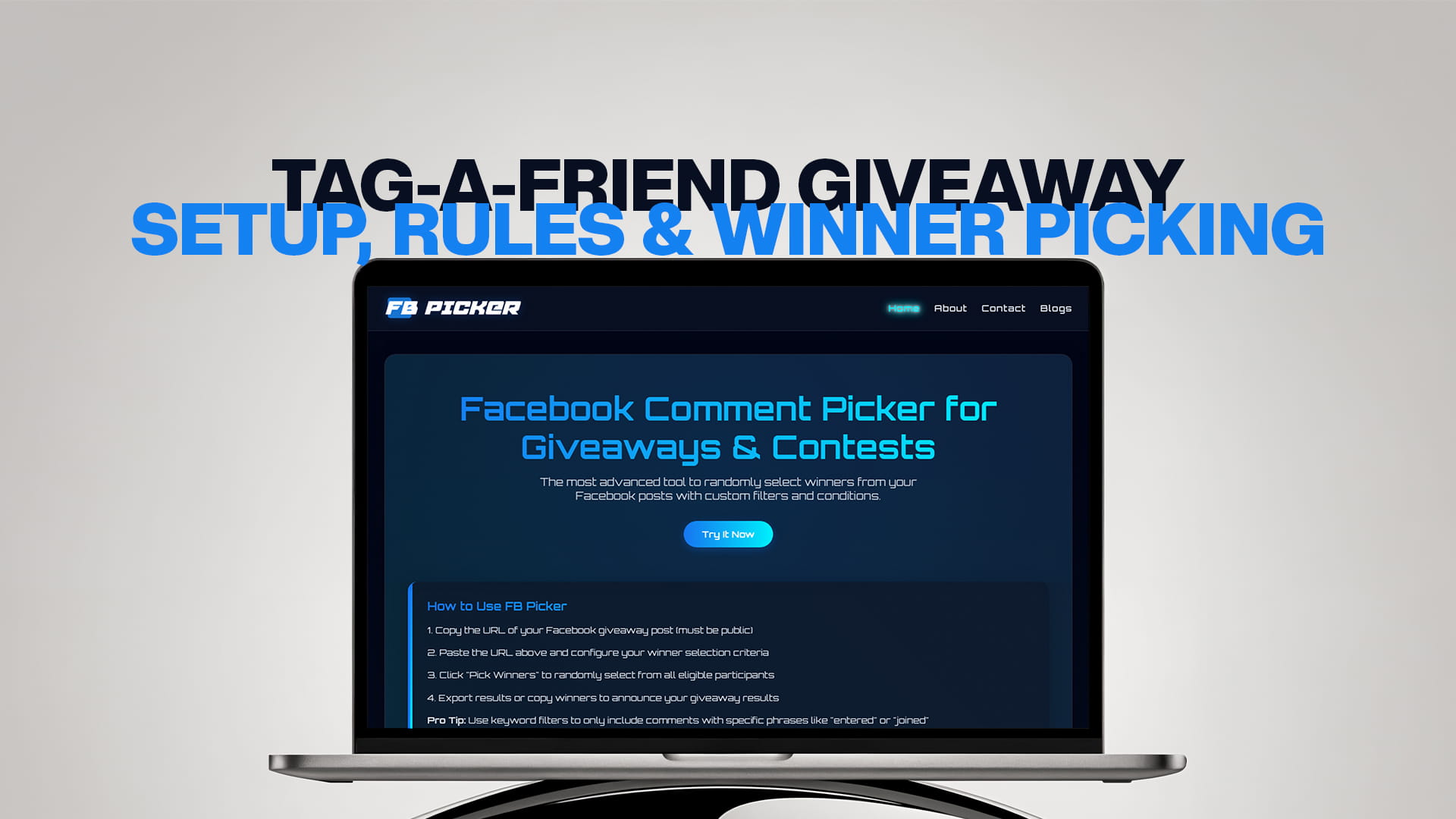
The reliable approach is to use a tool that reads the comments from the post rather than from the rendered view. FB Picker works from a pasted public post URL with no login, pulls in the full comment set regardless of what the ranking filter is displaying, removes duplicate commenters so your one-entry-per-person rule is actually enforced, and filters by keyword so only qualifying entries stay in the pool. Then it selects the winner at random from what remains, on screen, so you can record the draw.
If you're running the "you both win" variant, or want backups ready in case your winner doesn't claim, you can pick multiple winners in a single pass, which also means the backup was drawn by the same process at the same moment rather than in a separate draw later.
The "you both win" variant
Worth a section, because it's the strongest version of the tag mechanic.
The structure: the winning commenter and the friend they tagged both receive the prize. It roughly doubles the motivation to tag genuinely, because people tag the person they'd actually want to share a win with rather than whoever comes to mind. It produces the warmest reactions of any giveaway format, and it delivers your prize into two households instead of one, which doubles your chance of converting a new customer.
Practically: budget for two prizes, state clearly in your rules that both the commenter and their tagged friend win, decide what happens if the tagged friend is ineligible or unreachable, and confirm both people before announcing. Since the tagged friend didn't opt into anything, contact them privately before naming them publicly.
Common mistakes
A few errors recur in tag giveaways. Requiring tags, which breaches Meta's policy for no meaningful gain over inviting them. Asking for unlimited tags, which generates spam and inflates comment counts without adding reach. Failing to state a one-entry-per-person rule, which leaves your draw ambiguous. Scrolling the default comment view to pick a winner, which silently excludes most entrants. Not de-duplicating, so serial taggers get multiple chances nobody agreed to. And announcing a tagged friend publicly without checking they're happy to be named.
All of them are avoided by a compliant setup, clear rules, and a filtered draw.
The bottom line
Tag-a-friend giveaways work, and you can run them properly with one small change: comment the entry and the tag an invitation rather than a requirement, because Meta's policy explicitly names required tagging as not permitted. You'll keep nearly all the reach, and the tags you do get will be more genuine, since voluntary tags come from people who actually wanted to share the prize with someone. Publish rules covering one entry per person, spam tags not counting, and whether the tagged friend also wins. Then draw from the real comment pool rather than the filtered view on your screen, de-duplicating and keyword-filtering first, using a dependable free comment picker and giveaway tool and the same repeatable random comment picker for giveaways workflow every time. Compliant setup, clean draw, real reach.
Frequently Asked Questions
No. Meta's policy names "tag your friends in this post to enter" as an example of what isn't permitted, because personal timelines and friend connections must not be used to administer promotions. Make commenting the entry and invite tagging as an optional extra, which keeps you compliant while preserving most of the reach.
Less than you'd expect. People tag because they genuinely want to share the prize with someone, not because they were instructed to, and voluntary tags tend to be real friends rather than the strangers and celebrities that required tagging produces. Prize design drives tagging far more than entry rules do.
Ask for one genuine tag rather than unlimited tags, state in your rules that spam tags won't count, and filter at draw time by removing duplicate commenters and disregarding obvious spam. Since tags aren't what you draw from anyway, spam becomes a cosmetic issue rather than a fairness one.
Draw from the comments, not the tags. Use a picker that reads the post directly so Facebook's comment ranking doesn't hide most entrants; remove duplicate commenters to enforce one entry per person, filter for any required keyword, then select at random and record the draw. Draw backups in the same pass.
The "you both win" variant is popular and effective because it motivates genuine tagging and puts your prize in two households. If you run it, budget for two prizes, state it clearly in your rules, decide what happens if the tagged friend is ineligible, and contact them privately before announcing, since they never opted in.