
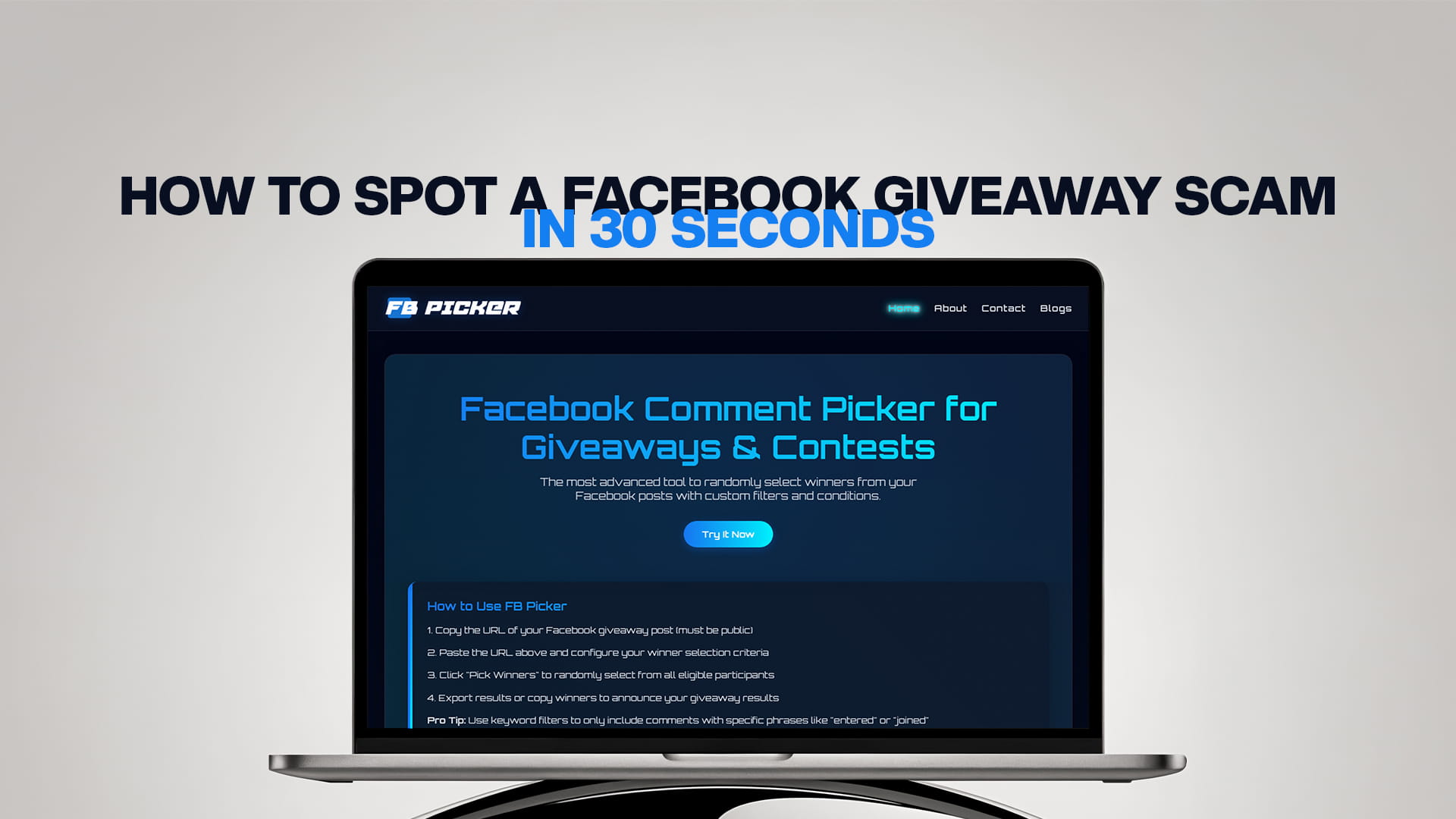
How to Spot a Facebook Giveaway Scam in 30 Seconds
The uncomfortable thing about giveaway scams is that they don't look like scams. They look like the dozens of legitimate giveaways scrolling past you every week: a nice prize, an enthusiastic caption, a comment section full of hopeful people. That's the entire design. A scam that announced itself would catch nobody, so the successful ones borrow the exact format of the real thing and change only the parts you're not looking at.
The good news is that they still leave fingerprints, and once you know where to look, identifying one takes about half a minute. This guide is built for speed: first the two questions that expose almost every giveaway scam instantly, then the anatomy of a fake post so you can recognize the pattern, then the psychological tricks that make people fall for them even when the evidence is right there. US consumers reported losing around $145 million to prize, sweepstakes, and lottery scams in 2024, and the FTC has found that one in four people who reported losing money to fraud since 2021 said it started on social media, so the thirty seconds is worth spending.
The two questions that expose almost every scam
Before examining anything else, run these two. Between them, they defuse the overwhelming majority of giveaway scams without any technical checking at all.
Question one: am I being asked to pay anything?
If a "win" requires you to pay taxes, shipping, handling, processing, customs, insurance, or a release fee before the prize arrives, it is a scam. There is no ambiguity here and no legitimate exception. Real prizes are free. Real sponsors do not collect money from winners, and in the US any prize taxes are settled between the winner and the IRS at tax time, never wired to the company that ran the contest. Any request for payment to release a prize is theft, whatever else the message contains.
Question two: did I actually enter this?
If you have no memory of entering the giveaway, you didn't win it, because you cannot win a contest you never entered. A congratulations message for a competition you don't recognize is a scam with near-perfect reliability. Scammers blast these messages at thousands of people precisely because a few will assume they entered something and forgot.
Either question failing means you can stop immediately. Don't reply, don't click, don't pay. Everything below is for the cases where you're evaluating a giveaway post before it gets that far.
The anatomy of a fake giveaway post
Scam giveaway posts share a recognizable structure, and it's a structure driven by their economics: they need maximum spread, minimum verifiability, and a reason for you to act fast.
The prize is disproportionate. Ten laptops, a car, several thousand in cash, offered by a page with a few hundred followers and no visible business. Real giveaways are marketing spend, and the prize is proportionate to the business behind it. A prize that makes no commercial sense is the loudest single signal.
Entry requires sharing. "SHARE this post to enter!" Requiring shares breaches Meta's own promotion rules, so a share-gated giveaway is simultaneously telling you it isn't a legitimate promotion and revealing exactly how it plans to spread. Legitimate organizers ask for comments and follows, and treat tagging as an optional bonus.
There are no real rules. No start and end dates, no eligibility criteria, no explanation of how the winner will be chosen, no "not sponsored by Facebook" disclaimer. Real giveaways publish these because platform policy and promotion law require them; scams skip them because there's no actual draw to describe.
The page has no past. Scroll back. A legitimate business page has a boring history: product photos, opening hours, customer questions, ordinary posts stretching back months or years. A scam page has the giveaway, some stock images, and nothing else.
The engagement is one-directional. Thousands of comments, and no replies from the page. Real businesses answer questions in their giveaway threads. Scam operators don't, because engaging individually doesn't scale for them.
Urgency does the arguing. "Claim within 24 hours or forfeit." Pressure exists to prevent you from checking, and it's a hallmark the FTC calls out directly.
Checking the page itself
If the post passes a glance but something feels off, two minutes on the page settles it.
Open Page transparency. This section shows when the page was created, whether it has changed names, and where its administrators are located. A page created three weeks ago running a five-figure giveaway is not a business. Name-change history is even more revealing: a page that was "Daily Puppy Videos" in March and "Official Electronics Giveaway" in April was bought or repurposed to exploit an existing follower count. Admin locations that make no sense for a supposedly local business are another giveaway.
Look for a real business. A website, an address, actual products, a history of ordinary posts. Legitimate businesses exist outside their giveaway.
Check the name carefully. Impersonators trade on near-misses: an added word, a period, an underscore, "Official," a swapped or doubled letter. Business impersonation is enormous; the FTC logged over 330,000 reports of it in 2023 alone, with impersonation losses overall exceeding $1.1 billion, and a fake giveaway is one of its favorite costumes.
Verify through the real brand. If a giveaway claims to be from a company you know, go to that company's genuine page or website yourself, never through a link in the message, and look for the same promotion. Real campaigns almost always appear on the brand's other channels too. Often you'll find the brand has already posted a warning about the exact scam you're looking at.
What they're actually after
Understanding the payoff helps you recognize the setup, because not every scam wants money directly.
Advance fees are the classic: you "won," now pay a fee to release it, and the prize never existed.
Your personal data is the quieter version. Some fake giveaways never mention money at all, they ask for your address, date of birth, ID, or bank details "to verify the winner." That's identity theft with a ribbon on it. No legitimate giveaway needs your Social Security number or bank account to send you a prize.
Your account credentials. A "confirm your win" link leads to a fake Facebook login page. You enter your password, and your account becomes theirs, typically to run the same scam against everyone who trusts you.
Fake checks. They send a check, ask you to deposit it and wire back a portion for fees. The check bounces weeks later; the wired money is long gone.
Pure engagement farming. The gentlest version has no prize at all. The page simply wants a viral post and a large follower count it can later rename, sell, or use to push other scams. That's why the winner is never announced, and the page quietly changes its name a month later.
Why smart people still fall for them
It's worth naming the psychology, because "I'd never fall for that" is exactly the belief scammers rely on.
Giveaway scams run on hope rather than greed, which lowers everyone's defenses. Entering costs nothing, so there's no felt risk at the moment of engagement, and by the time money is requested, you've already invested attention and excitement. The messages arrive with manufactured urgency that discourages checking. They borrow the format of the legitimate giveaways you see constantly, so nothing pattern-matches as unusual. And they're now often AI-polished: consumer protection agencies have specifically warned about AI-generated prize and lottery messages that read far more convincingly than the typo-riddled versions of a decade ago. Professionalism is no longer evidence of legitimacy.
The defense isn't cleverness, it's process. Run the two questions every time, regardless of how legitimate something looks, and the psychology can't get traction.
What legitimate giveaways look like by contrast
Knowing the genuine article makes fakes obvious. A real giveaway has published rules with dates, eligibility, and a stated selection method. It includes the disclaimer that the promotion isn't sponsored by or associated with Facebook. It asks for comments and follows rather than mandatory shares. It comes from a page with a real business history and other channels you can cross-check. It announces the winner publicly on the original post rather than only via private message. And, increasingly, it shows its work: a recorded draw proving the winner was picked at random, which is exactly what a random comment picker for giveaways makes straightforward to produce.
That last point is worth noting if you run giveaways yourself, because your best protection against impersonators is being visibly, checkably real. Announcing winners publicly, stating clearly in every post that you will never ask anyone to pay to claim a prize, and posting a recorded draw all give your audience a genuine version to compare fakes against. FB Picker supports that: it works from your public post URL with no login, strips duplicate entries, selects the winner at random on screen so the proof clip is a byproduct of the draw, and lets you pick multiple winners and export the entrant list in one pass.
If you spot one
Don't engage, don't click any links, and screenshot the post, the profile, and the message before anything disappears. Report the page or message to Facebook through its report option. In the US, file with the FTC at ReportFraud.ftc.gov, and with IC3.gov plus your state attorney general if money changed hands; elsewhere, your national fraud reporting body (Action Fraud in the UK, the Canadian Anti-Fraud Centre, Scamwatch in Australia) is the equivalent. If it's a public fake giveaway rather than a private message, a brief warning comment or a share to your own network genuinely helps, since these spread through people who trust you.
And if you've already paid, contact your bank or payment provider immediately; speed is the single biggest factor in whether money can be recovered, then change any passwords you shared and watch for identity theft.
The bottom line
Spotting a Facebook giveaway scam comes down to two questions you can ask in seconds: am I being asked to pay anything, and did I actually enter this? Real prizes are free, and you can't win a contest you never entered, so a "yes" to the first or a "no" to the second ends the matter immediately. Beyond that, the pattern is consistent: prizes disproportionate to the page behind them, share-to-enter demands that breach platform rules, missing rules and disclaimers, pages with no history or a suspicious name-change record, no replies to commenters, and urgency designed to stop you checking. Two minutes in Page Transparency and a look at the brand's real channels settles nearly everything else. Run that process every time regardless of how polished the post looks, and if you run giveaways yourself, make your own legitimacy easy to verify with public winner announcements and a recorded draw through a dependable free comment picker and giveaway tool, so your audience always has a real version to compare against.
Frequently Asked Questions
Ask two questions. First, am I being asked to pay anything- taxes, shipping, or fees- to claim a prize? If yes, it's a scam, because real prizes are free. Second, did I actually enter this giveaway? If you don't remember entering, you didn't win. Those two questions expose the overwhelming majority of fakes instantly.
Open the page's "Page transparency" section to see its creation date, name-change history, and admin locations. A brand-new page, a page that recently changed names, or admins in unexpected countries are strong warning signs. Then look for a real business behind it: a website, products, ordinary posts, and cross-check the giveaway on the brand's other channels.
It's a significant red flag. Requiring shares to enter breaches Meta's own promotion rules, so legitimate organizers avoid it, asking for comments and follows instead and treating tagging as an optional bonus. A share-gated giveaway is both signalling that it isn't a compliant promotion and revealing how it intends to spread.
Because data is valuable too. Requests for your address, date of birth, ID, or bank details "to verify the winner" are identity theft attempts, and links to "confirm your win" often lead to fake login pages that steal your Facebook password. No legitimate giveaway needs sensitive financial or identity details to send you a prize.
Don't engage or click anything, screenshot the evidence, then report the page or message to Facebook. In the US, also report to the FTC at ReportFraud.ftc.gov (and IC3.gov if money was lost); elsewhere, use your national fraud body. If it's a public post, a warning comment helps protect others, and if you've already paid, contact your bank immediately.