
How to Promote a Facebook Giveaway: 2026 Timeline Guide
Most giveaway promotion advice is a list of tactics: pin it, share to Stories, post a reminder. All true, all useful, and all missing the thing that actually determines results, which is when you do each of them. A reminder posted on day two does almost nothing. The same reminder posted at the halfway mark rescues a stalling campaign. A final-hours push often produces the single biggest entry spike of the whole contest, and organizers who don't know that simply never send one.
So this guide is organized as a timeline rather than a checklist. It walks through the five phases of a giveaway campaign, what to do in each, and why the sequencing matters, because giveaway promotion is fundamentally about feeding a distribution loop at the right moments. Get the timing right, and a modest prize outperforms a generous one that was posted and forgotten.
Why timing beats tactics
Facebook's distribution rewards early engagement, and a giveaway is unusually good at producing it. Comments are among the strongest signals the algorithm responds to, and a giveaway post generates them at a rate normal content can't touch. That creates a self-reinforcing loop: the first wave of entries tells Facebook the post deserves wider distribution, which brings more entries, which extends reach further.
The practical consequence is that promotion effort is not equally valuable at all moments. Effort spent before and at launch primes the loop. Effort spent in the dead middle restarts it when it stalls. Effort spent at the deadline harvests the procrastinators. Effort spent after the draw converts everything you built. Spread the same work evenly across a week and you'll get worse results than someone who concentrates it at those four pressure points.
Phase 1: Before you post (the week before)
Promotion starts before the giveaway exists publicly, and this is the phase people skip entirely.
Warm your audience. If you know a giveaway is coming, spend the preceding week posting normally and engaging with your community, so the algorithm already sees your page as active when the contest lands. A page that posts once a month and then drops a giveaway starts from a standing stop.
Tease it. A simple "something's coming on Monday" post, or a Story, builds a small pool of people actively watching for the launch. Those people comment early, which is exactly what the loop needs.
Line up your partners. If you're co-hosting with a complementary business, or you want other pages to share it, arrange that now. Partner reach is the single most powerful free promotion available, and it requires lead time.
Prepare the assets. Write the post, the mid-window reminder, and the final-hours reminder all at once, and have your images ready. Campaigns die in the middle because nobody had the energy to write a reminder on day four; pre-writing removes that failure point entirely.
Decide your close time. Pick a deadline in a peak engagement window (midweek, late morning to mid-afternoon works for most audiences) so the final surge lands when people are actually online.
Phase 2: Launch day
The first few hours matter disproportionately, because they determine whether the distribution loop catches.
Post at your peak window. Aim for a midweek day and a time when your audience is genuinely active. Your Page insights beat any generic chart here.
Pin it immediately. The giveaway should sit at the top of your Page for its entire run. Anyone who lands on your profile from any source sees it first. It takes ten seconds and is the most-skipped free tactic there is.
Share to Stories right away. Stories sit above the feed and reach a different slice of your audience than the post itself does.
Push it to your other channels the same day. Email list, Instagram, website banner, physical signage if you have a premises. These audiences already like you, which makes them the most likely to enter and to tag someone.
Reply to the first wave of comments. Every reply is another engagement signal, and early replies are worth more than later ones because they're feeding the loop while it's forming. This is the highest-leverage half hour of the whole campaign.
Ask for the tag properly. Make tagging an optional bonus entry rather than a requirement, in line with platform rules, and each genuine tag delivers your post into a new person's notifications with a friend's implicit endorsement attached. That's the closest thing to free viral reach a giveaway has.
Phase 3: The mid-window push
Every giveaway sags in the middle. Entries slow, the post drops out of feeds, and momentum leaks away. This phase is about restarting the loop.
Post a fresh reminder, not a repost. A new image, a short clip of the prize, or a different angle gives the algorithm new content to distribute rather than resurfacing something people have already scrolled past. Mention how many people have entered so far, since visible momentum encourages participation.
Share to Stories again. Different day, different slice of your audience.
Reply to any comments that arrived since launch. Keep the engagement signals flowing.
Consider your first paid push here, if you're going to. This is the moment where boosting makes the most sense, because the post has now proven itself organically (or not). Boosting something that's already earning comments amplifies validated content; boosting a flop just pays to distribute something your audience already ignored. If you do spend, target warm audiences, people who engage with your page, your customer list, a local radius, since they're cheaper to reach and far likelier to be real prospects than cold prize hunters.
Share into relevant groups, carefully. Local community groups and niche interest groups can be excellent, but only where self-promotion is genuinely welcome. Read the rules, contribute normally first, and don't spam, because a giveaway dumped into a hostile group costs you reputation rather than gaining reach.
Phase 4: The final hours
This is the phase most organizers underuse, and it reliably produces the largest single spike of the campaign.
Post a closing-soon reminder. "Entries close at 8 pm tonight" creates genuine urgency, and urgency converts the large group of people who saw your giveaway, meant to enter, and forgot. Scarcity and deadlines are why Black Friday works, and the same psychology applies to a comment giveaway.
Story it, with a countdown. Stories are built for this kind of time-limited nudge.
Reply to everything. The final rush is also your last chance to squeeze engagement signals out of the post.
Don't spend money here. Paid promotion in the final hours buys impressions with no time left to snowball through the organic loop. Budget spent early compounds; budget spent at the deadline just buys a few impressions.
Close on time. Whatever deadline you published, honor it exactly. Extending a giveaway because entries were disappointing teaches your audience that your deadlines are soft, which weakens every future final-hours push you ever run.
Phase 5: After the draw (the payoff phase)
Promotion doesn't end at the deadline. The announcement is the highest-attention moment of the entire campaign, and it's where the reach you built converts into something valuable.
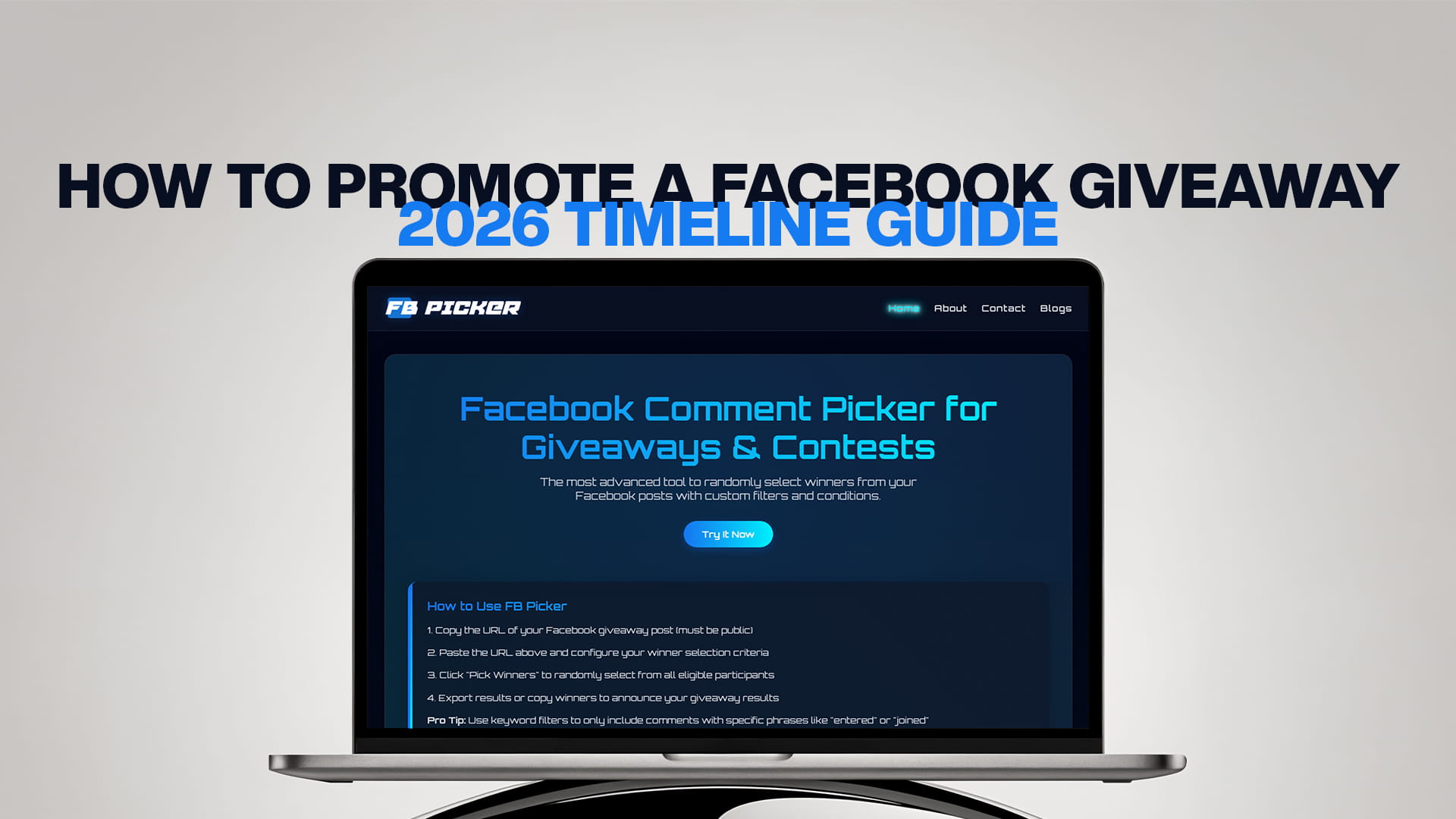
Draw transparently and show it. Pick the winner with a tool rather than by hand, and record the selection so your audience can see it was genuinely random. FB Picker works from your post's public URL with no login, removes duplicate entries so nobody wins by spamming, and selects the winner at random on screen so recording proof is effortless. If you need backups against a no-show, you can pick multiple winners in the same pass.
Announce publicly, and make it a real post. Name the winner, confirm the prize, include the proof clip, state the claim deadline, and thank everyone who entered. Post it as a new post and reply on the original giveaway post so people checking back find it.
Convert the non-winners immediately. This is where the ROI actually lives. Everyone who entered raised their hand to say they want what you offer, so give them a reason to buy while interest is hot: a time-limited discount, a free add-on, an offer pointed at the specific product involved. A giveaway with no consolation offer leaves most of its value unclaimed.
Retarget the engagers. Everyone who interacted with the giveaway is now a warm audience that costs a fraction of cold traffic to reach again with ads.
Ask them to stay. Invite entrants to follow for the next giveaway, and tease when it's coming, so each campaign compounds the audience for the next rather than resetting to zero.
A note on paid promotion in 2026
Since the boost question comes up constantly: paid promotion earns its place in specific situations, not as a default. Boost when the post is already performing organically, when you need to reach beyond your existing followers, when the prize carries real commercial weight, or when a deadline demands speed your organic reach can't deliver. Don't boost a generic prize (you'll buy prize hunters), a post that's flopping organically (money won't fix a weak offer), or a giveaway with no plan for the entrants afterward.
On budget, the mechanical minimum is around $1/day but that's not useful; practical testing starts around $5–$10/day, with $10–$20/day for a few days being a common real-world test. Facebook CPM benchmarks commonly land in the $8–$14 range depending on source and industry, with wide variance by audience, timing, and creative, and Q4 and Black Friday periods running significantly higher. Treat any single quoted figure with suspicion; the ranges matter more than the decimals.
The bottom line
Promoting a Facebook giveaway well is less about knowing tactics than about applying them at the right moments. Prime the loop before launch by warming your audience, teasing, lining up partners, and pre-writing your reminders. Feed it hard on launch day with a peak-window post, an immediate pin, Stories, cross-posting, and fast replies. Restart it at the halfway mark with fresh creative and, if the post has earned it, a modest boost aimed at warm audiences. Harvest the procrastinators with a final-hours urgency push, and close exactly when you promised. Then convert everything you built with a transparent recorded draw through a dependable free comment picker and giveaway tool, a public announcement, and an offer to everyone who didn't win. Run that sequence consistently, closing each contest with a repeatable random comment picker for giveaways workflow, and your giveaways will outperform bigger prizes promoted carelessly.
Frequently Asked Questions
Aim for a midweek day (Tuesday to Thursday) in a window when your audience is genuinely active, often late morning to mid-afternoon, and check your own Page insights rather than relying on generic charts. Also, time your closing deadline for a peak window so the final-hours entry surge lands when people are online.
Pin the post for the whole entry window, share to Stories multiple times, post a fresh mid-window reminder and a final-hours urgency reminder, reply to comments to keep engagement signals flowing, cross-post to your email list and other channels, use optional tag-a-friend bonuses, and co-host with a complementary business to borrow their audience.
Boost only with a reason: when the post is already performing organically, when you need to reach beyond your followers, when the prize has commercial weight, or when a deadline demands speed. Spend early to mid-campaign so the entries it generates can compound through organic reach, and target warm audiences rather than cold ones.
Because a large share of people see a giveaway, intend to enter, and forget. A clear "closing at 8 pm tonight" post converts that group through urgency, and it frequently produces the single biggest entry spike of the entire campaign. It costs nothing and takes two minutes to write.
Draw the winner transparently and record it, announce publicly with the proof clip and a claim deadline, then immediately give every non-winner a reason to buy with a time-limited offer. Retarget everyone who engaged, since they're now a cheap warm audience, and invite entrants to follow for your next contest.