
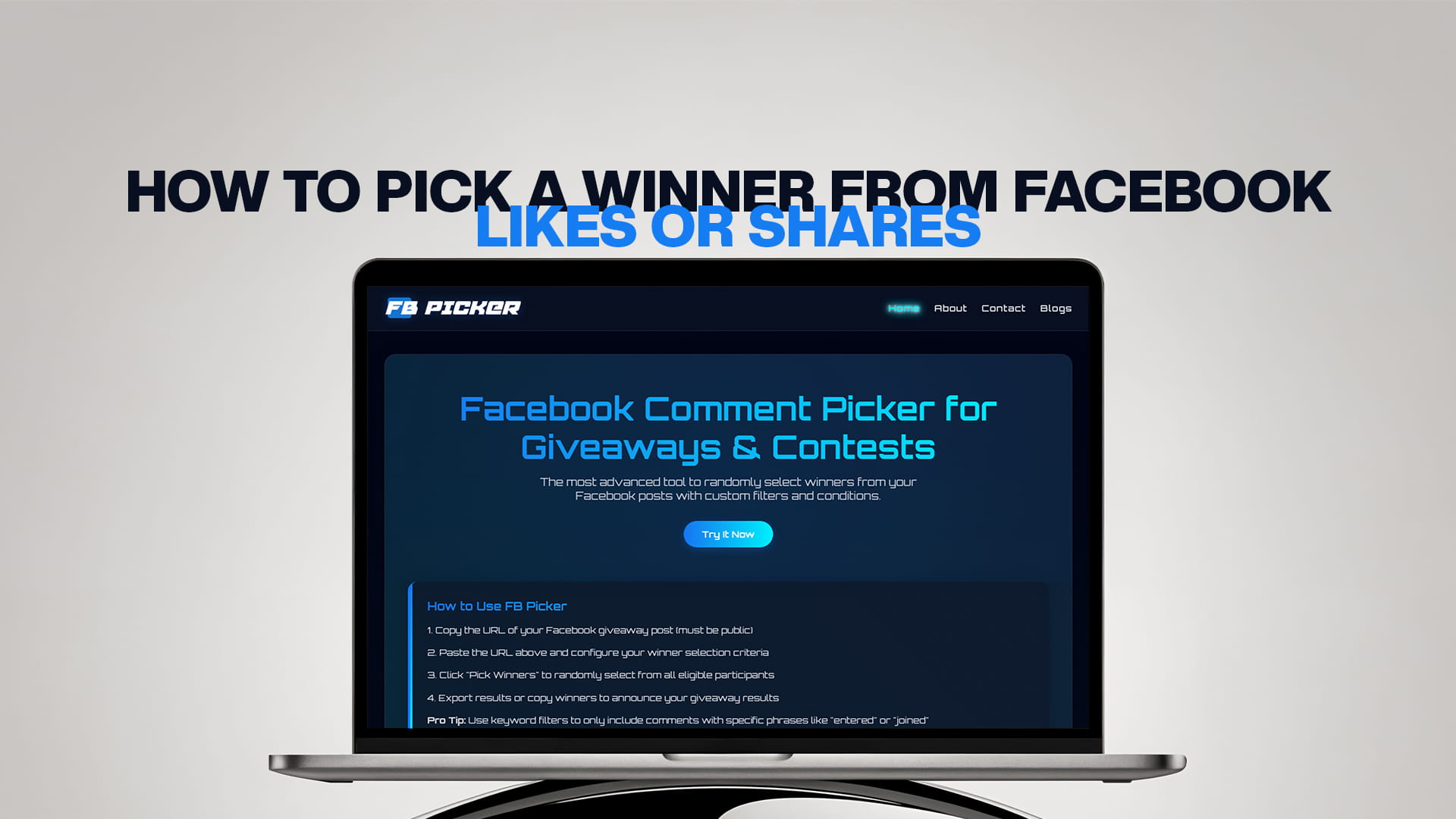
How to Pick a Winner From Facebook Likes or Shares
"Like this post to enter" and "share to win" are two of the most common giveaway instructions on Facebook, which makes it genuinely surprising how badly both of them fall apart when it's time to actually draw a winner. You have 800 likes and 200 shares sitting on your post, you open a comment picker expecting to load them, and discover the tool only reads comments. So you try to do it manually and hit a second wall: Facebook won't reliably show you a complete, workable list of who did either thing.
This isn't a tool limitation you can shop around. It's a structural feature of how Facebook exposes engagement data, layered on top of platform rules that actively discourage two of these mechanics. This guide explains why likes and shares are poor entry signals, what you can and can't actually see, the manual workaround for small giveaways, and the entry design that solves the problem permanently.
The short answer
Likes and shares are not reliably enumerable, so you generally cannot draw a fair winner from them at any meaningful scale.
Reactions (likes, loves, and the rest) are visible to you as a total count, and you can manually browse the list on your own post, but there's no practical way to export or randomly draw from that list, and no third-party picker can read it from a public URL the way it reads comments.
Shares are worse. A large share of "shares" go to audiences you cannot see: friends-only timelines, private groups, individual messages, which means the list of people who shared your post is fundamentally incomplete from your side, and no tool can complete it.
Comments, by contrast, are public, enumerable, timestamped, and readable from a post's URL, which is exactly why every serious comment picker is built around them. The fix isn't a better tool. It's an entry mechanic that produces a countable, verifiable list.
Why likes and reactions don't work as entries
Three separate problems stack up here.
The data isn't exposed for enumeration. Meta's platform surfaces reaction data primarily as aggregate counts, and for third-party access it's heavily restricted. Even with official API access approved, what's typically available is a reaction breakdown by type, how many likes, loves, hahas, and so on, rather than a workable roster of individual reactors you can draw from. Meta's own developer documentation is blunt about how limited access to other people's engagement on your content can be: for a personal profile's post, you generally can't retrieve who published a comment on it, let alone build a reliable reactor list. Aggregate counts are for analytics, not for drawing winners.
Manual browsing doesn't scale and can't be verified. You can click your post's reaction count and scroll the list, and for a post with 30 reactions that's tolerable. At 800 it's hours of work; the list loads progressively, names shift as new reactions arrive, and you have no exportable record. Worse, you can't prove to your audience that the winner came from a complete list, because you can't show the list. Fairness you can't demonstrate isn't much use.
Like-gating has been off-limits for years. Facebook explicitly prohibited "like-gating", requiring a Like to access content or enter a promotion, back in the Graph API v2.1 era, and Meta's promotion policies have discouraged making a Like the mechanism of entry ever since. A "like to enter" giveaway sits awkwardly against platform rules even before you hit the technical problems.
You can, and should, still ask people to like your post and follow your page. Likes are a useful engagement signal that helps distribution. Just don't make the like the thing you draw from.
Why shares are the worst option of the three
Shares fail for a reason that has nothing to do with tooling: privacy audiences make the list structurally incomplete.
When someone shares your post, they choose an audience. Public shares you can see. But shares to friends-only timelines, shares into private groups, and shares sent as direct messages are invisible to you, permanently. So even if you painstakingly compile every share you can find, you're excluding an unknowable number of people who genuinely did what you asked. Drawing a "random winner" from a list you know is incomplete isn't a fair draw; it's a draw from whoever happened to be visible, which systematically favors people with public profiles.
On top of that, there's the compliance problem. Meta's promotion rules discourage requiring shares or reposts as a condition of entry, and a share-gated giveaway is one of the clearer signals that a promotion isn't following platform policy, to the point that it's a recognized hallmark of scam giveaways. Requiring shares makes your legitimate contest look like a fake one, which is a strange trade for an entry signal you can't even count.
If you want the reach that sharing provides, encourage it without requiring it, and keep your countable entry mechanism separate.
The manual workaround (small giveaways only)
If you've already run a like-based giveaway and need to draw a winner, here's the honest best you can do, and it only works at small scale.
Open your post and click the reaction count to open the list of people who reacted. Scroll all the way to the bottom so the full list loads, then copy the names into a spreadsheet or a text file, one per line. Number them. Then use a random number generator to pick a number in that range, and the corresponding name is your winner. Screen-record the process, including scrolling the list and generating the number, so there's at least some evidence of a fair method.
Be honest with yourself about the limits. This is viable up to maybe a few dozen reactions. It's error-prone, it can't be audited by your audience, and if reactions arrive while you're compiling, your list and your post disagree. Treat it as a rescue for a giveaway already run, not as a method to plan around. And whatever you do, don't attempt the equivalent for shares, since the invisible-audience problem means the list can't be completed at all.
The design that actually works
The permanent fix is to comment the entry, because comments are the only engagement type that's public, complete, enumerable, and exportable.
The standard pattern is to layer the signals rather than choose between them: like the post and follow the page (encouraged), comment to enter (the countable action), tag a friend for a bonus entry (optional). You keep every engagement benefit, likes and follows still help distribution, tags still spread reach, while the thing you actually draw from is a comment thread you can read, filter, export, and verify.
This also makes the draw defensible. A comment-based entry list can be loaded from your post's public URL, de-duplicated so nobody wins by commenting twenty times, filtered for a required keyword, and drawn from at random on screen while you record it. FB Picker does exactly that: paste the post URL, no login needed, strip duplicates, and it selects the winner at random with a secure method. For tiered prizes or backups against a no-show, you can pick multiple winners in a single pass, and you can export the entrant list as a record of exactly who was eligible. None of that is possible with a reaction list, which is the whole argument in one paragraph.
Writing the entry instruction properly
Small wording changes prevent this problem entirely.
Instead of "Like to enter," write "Like this post and comment [your answer] to enter." The like is requested; the comment is the entry.
Instead of "Share to win," write "Comment to enter, and feel free to share with a friend who'd love this." Sharing becomes voluntary reach rather than an uncountable, policy-awkward requirement.
Comment a purpose while you're at it. "Comment your favorite flavor" or "tell us who you'd bring" produces more comments than "comment to enter," and each answer is a small piece of customer research you can use later.
Then state your selection method in your rules: winner chosen at random from all eligible comments on a stated date. That sentence tells entrants how it works, commits you to a fair process, and matches the draw you're actually able to run. Running each contest through the same random comment picker for giveaways workflow keeps that promise consistent every time.
What if you genuinely want to reward likes?
Occasionally there's a real reason to acknowledge likers specifically, a page-milestone thank-you, for instance. Two approaches work without requiring you to draw from an unreadable list.
Run the giveaway as a comment contest but frame it as a thank-you to everyone who's liked and followed the page. The sentiment lands, the mechanics stay workable.
Or make it a non-random reward: give everyone who likes the post a small perk, a discount code posted publicly, an offer in the caption, so there's no draw needed at all. Everyone who engaged gets something, which suits a gratitude post better than a lottery anyway.
The bottom line
You can't reliably pick a winner from Facebook likes or shares, and it isn't a tooling gap you can solve by finding a better picker. Reaction data is exposed as aggregate counts rather than a drawable roster, manual browsing doesn't scale past a few dozen and can't be shown to your audience, like-gating has been against platform rules for years, and shares are structurally incomplete because private and message-based shares are invisible to you, on top of being a mechanic Meta discourages requiring. Comments are the only entry signal that's public, complete, exportable, and verifiable, which is why the fix is a one-line change to your entry instruction: ask for the like, require the comment. Do that, draw transparently with a dependable free comment picker and giveaway tool, and you keep all the engagement while gaining a draw you can actually prove was fair.
Frequently Asked Questions
No. Pickers read comments because comments are publicly enumerable from a post's URL. Reaction data is exposed mainly as aggregate counts, and access to individual reactor identities is heavily restricted for third parties, so there's no reliable list for a tool to load or draw from.
You can browse the list by clicking the reaction count on your own post, and for a small post that's workable. But the list loads progressively, changes as new reactions arrive, can't be exported, and can't be shown to your audience as proof, so it isn't a practical basis for a fair draw at any real scale.
Two reasons. Technically, shares to friends-only timelines, private groups, and direct messages are invisible to you, so your list of sharers is permanently incomplete. Policy-wise, Meta discourages requiring shares as an entry condition, and share-gating is a recognized hallmark of scam giveaways, so it makes a legitimate contest look suspect.
Requiring a Like as the gate to enter or access content, known as like-gating, has been prohibited since the Graph API v2.1 era, and Meta's promotion policies have discouraged Like-based entry mechanics since. Asking people to like your post is fine; making the Like the entry mechanism is not a safe design.
Comment the entry: "Like this post and comment [your answer] to enter, tag a friend for a bonus entry." You keep the engagement benefits of likes and the reach of voluntary sharing, while drawing from a comment list you can filter, export, verify, and record, which is what makes the result defensible.