
Milestone Giveaway Ideas (1K/10K)
Hitting a follower milestone puts you in an oddly awkward spot. You want to mark it, because it genuinely means something, and a giveaway is the obvious way. But the number is about you, and a post that's mostly about your own achievement is a strange thing to ask your audience to celebrate. Meanwhile, the practical questions are real: is a 1K giveaway supposed to be bigger than a normal one? Is a 10K giveaway supposed to be ten times bigger? What's actually proportionate?
This guide is organised by tier, because that's the part generic milestone advice skips. A 1K giveaway and a 10K giveaway are genuinely different events with different audiences, different appropriate prize sizes, and different tones. Below you'll find what works at each level, how to size a prize without either underwhelming people or overspending to impress, caption templates you can adapt, and the framing that keeps a milestone post feeling like gratitude rather than a victory lap.
Why milestone giveaways outperform ordinary ones
Three things give these an edge over a standard contest.
The reason is built in. Most giveaways have to manufacture a pretext. A milestone hands you a genuine one, and audiences can tell the difference between "here's a contest because it's Tuesday" and "we hit 10,000 of you and wanted to mark it properly."
Gratitude disarms. People are guarded about marketing by default. A post that leads with thanks bypasses that defence, which is why milestone giveaways reliably draw warmer comments and more voluntary sharing than a straight prize post.
It's a story, not an ad. "We started this in a spare room three years ago and today there are 10,000 of you" is something people actually want to read. The giveaway rides along with the story rather than being the entire point, which paradoxically makes it perform better.
The 1K milestone
A thousand followers is the first milestone that feels real, and it's worth marking properly rather than waiting for a number that impresses strangers.
Who's watching: mostly people who found you deliberately, early supporters, actual customers, friends of the business. It's a small, warm, high-engagement audience, and your engagement rate at this size is probably better than it will ever be again.
Appropriate prize: one solid product or service, or a small themed bundle. This should feel a step up from a routine giveaway but not extravagant. A single signature item, a service voucher, or three or four small products packaged together all land well. If you normally give away a £15 item, a £40–50 prize reads as a genuine occasion at this level.
Best formats: a straightforward thank-you comment giveaway is perfect here. So is a "tell us how you found us" prompt, which produces genuinely interesting answers at this size and gives you real insight into where your audience is coming from. A partner giveaway also works well, since co-hosting introduces you to a new audience right when you're trying to grow.
Tone: personal and specific. At 1K you can plausibly recognise a fair number of your followers, so name a few regulars (with permission), mention the first person who ever ordered, be slightly self-deprecating about the early days. Specificity is what makes a small milestone charming rather than premature.
Don't: apologise for the number or frame it as small. "Only 1,000" undercuts the people who chose to follow you. Mark it confidently.
The 10K milestone
Ten thousand is the milestone people actually search for, because it feels like a threshold rather than a step.
Who's watching: a genuinely mixed audience now. Committed customers, casual followers, some people who followed for a previous giveaway, and a share who won't remember why they followed. Your engagement rate has probably dropped even as your reach improved.
Appropriate prize: this should be the most generous giveaway you've run, and the smartest way to spend that generosity is across more winners rather than on one bigger prize. Ten winners for 10K is a neat, well-liked structure that spreads goodwill far wider than a single grand prize. If your budget stretches to one £300 prize, five £60 prizes will produce more delighted people, more comments, more shared photos, and more sense that your community was thanked rather than one lucky person.
Best formats: multi-winner draws are the standout. A "your pick from our range" prize is generous and low-friction while quietly showcasing your catalogue. A community-spotlight post, where you feature customer photos and quotes alongside the giveaway, is the most generous version of a milestone post because your audience becomes the content. A pay-it-forward structure, where winners nominate someone else for a second prize, produces the warmest comment threads you'll get all year.
Tone: the ratio matters more at this size, because more of your audience has no personal connection to you. Spend most of the post on them and the journey, not the metric. Credit your team by name. Share one specific, true, slightly surprising detail rather than sweeping language about an incredible journey.
Do: ask them something. "What would you like to see more of?" turns a self-congratulatory moment into audience research and makes the post about your community rather than your dashboard.
Beyond 10K
At 50K, 100K, and above, two things change. Prize hunters arrive in volume, so filtering matters more and the prize needs to be tightly on-brand to avoid attracting people who'll never buy. And the personal touch gets harder to fake, so lean on genuine specifics, team credits, customer stories, real numbers, rather than a warmth you can't authentically project at scale.
The multi-winner logic intensifies too. At 100K, a single winner means 99,999 people watched someone else win, which is a poor return on a gratitude post. Spreading across many winners, or pairing the draw with something everyone gets, a public discount code, an open offer, keeps the "thank you" plausible.
How to size the prize without overspending
Two failure modes, and both are common.
Under-delivering on a big number. A 50K milestone marked with a £10 voucher is worse than not marking it, because it tells your audience what you think they're collectively worth. If the budget isn't there, spread a modest amount across several winners rather than offering one insultingly small prize.
Overspending to impress. An extravagant prize from a small business reads as desperate rather than celebratory, and it attracts exactly the wrong entrants. It also sets an expectation you'll have to match next time.
The workable rule: a milestone prize should feel like roughly two to three times your routine giveaway, and if the budget is the constraint, add winners rather than inflating value. Because you can pick multiple winners in a single draw, a ten-winner milestone is no more work to run than a one-winner one, which removes the main practical objection to spreading.
Caption templates
For 1K:
1,000 of you. Honestly, thank you.
[Specific, slightly self-deprecating detail about the early days, e.g. "I still remember the week three people commented and one of them was my mum."]
[Credit: a regular customer, a partner, whoever actually helped.]
To say thanks, we're giving away [prize] to one of you. Just comment [simple prompt] below to enter. That's it.
And genuinely, we'd love to know: how did you find us?
[Rules, dates, and the not-sponsored-by-Facebook line.]
For 10K:
10,000. Thank you, all of you.
[One specific, true detail about the journey, ideally surprising.]
[Credit your team by name, and your customers as a group.]
So we're doing this properly: [number] winners, each getting [prize]. Comment [prompt] to enter, and tag a friend if you'd like a bonus entry.
While we're here, tell us what you'd like to see more of from us this year. We'll actually read them.
[Rules, dates, and the not-sponsored-by-Facebook line.]
Both structures put more words on the audience than on the achievement, offer something real, and turn the spotlight around with a question. That's the whole formula.
Avoiding the humblebrag
The line between "thank you" and "look at us" is thinner than most brands realise, and it comes down to proportion.
Spend more words on them than on you. If five of your six sentences are about your achievement, you've written an announcement, not a thank-you. Be specific rather than grand, since "we remember the first week nobody commented" is humble and "this incredible journey has been nothing short of amazing" is not. Don't inflate the milestone beyond what it is. Credit real people by name, because a post that shares credit reads completely differently from one that hoards it. And skip the fake modesty; "we're so humbled" usually isn't, so just say thank you plainly and let the prize carry the sincerity.
Close it like you mean it
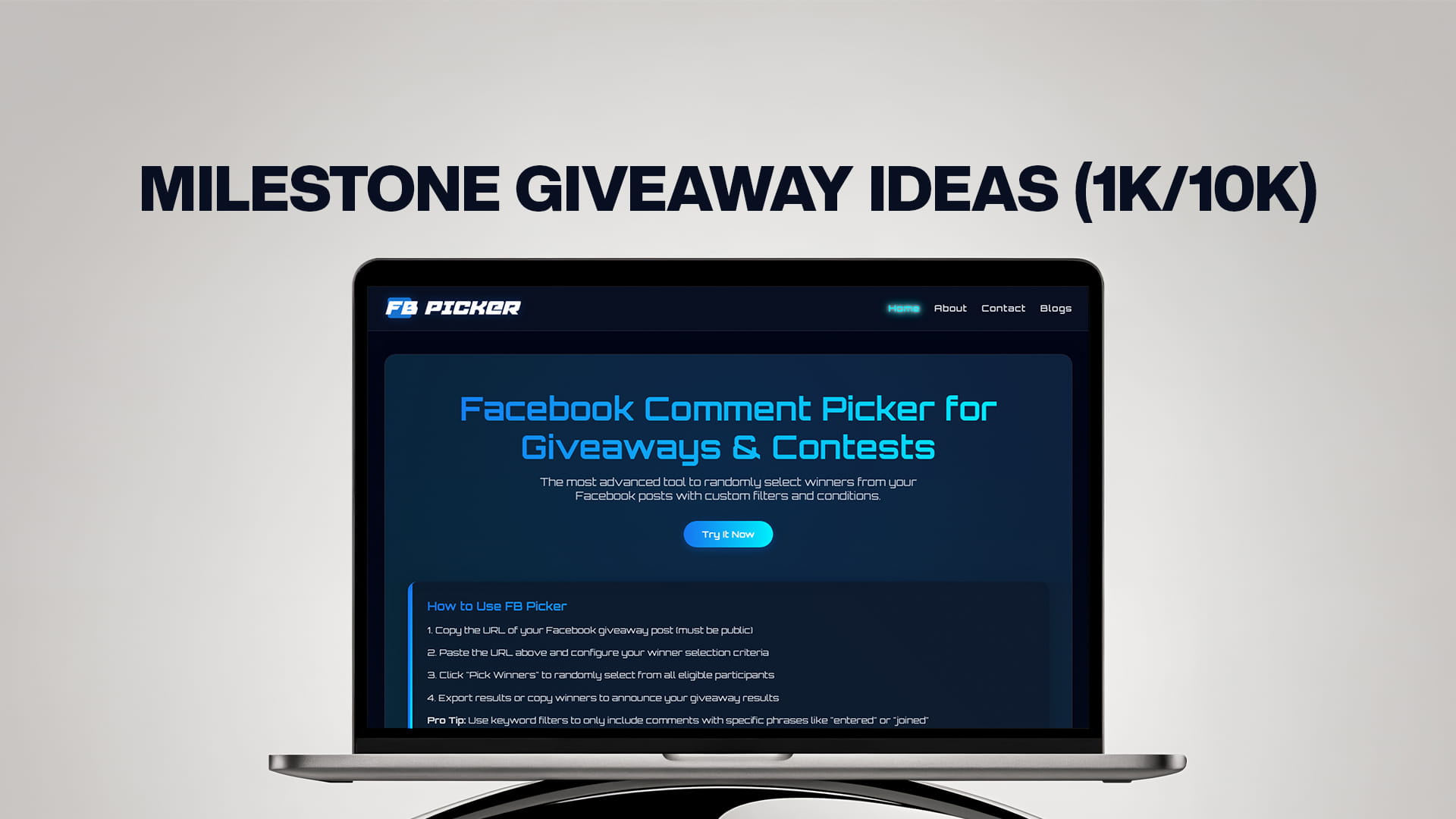
A gratitude giveaway with a murky ending is worse than no giveaway, because you spent the whole post saying how much you value these people and then picked a winner behind a curtain. Draw it in the open. FB Picker runs from your post's public URL with no login, strips duplicate entries, and selects the winner at random on screen, so recording the draw takes seconds and a ten-winner milestone draw is one pass and one clip. Running it through the same random comment picker for giveaways workflow every time means your milestone draws look as consistent as your routine ones.
Then finish the thought properly: thank everyone again in the announcement, quote a few of the nicest comments people left (they're often genuinely lovely on milestone posts), and give the non-winners something small, because a thank-you that only reaches one person out of thousands isn't much of a thank-you.
The bottom line
Milestone giveaways work because the reason is real, so scale them to the moment rather than treating every milestone the same. At 1K, mark it confidently with one solid prize, a personal, specific tone, and a "how did you find us" prompt that suits a small, warm audience. At 10K, go multi-winner rather than one big prize, spend most of the post on your audience instead of the metric, credit your team by name, and ask them something. Above that, lean harder on specifics and on spreading the prize, because a single winner is a poor thank-you to a hundred thousand people. Keep the prize roughly two to three times your routine giveaway, add winners rather than inflating value when budget is tight, and close with a fair recorded draw through a dependable free comment picker and giveaway tool so the ending is as warm as the opening.
Frequently Asked Questions
One solid product or service, or a small themed bundle, roughly two to three times the value of your routine giveaway. At 1K your audience is small and warm, so a single generous prize plus a personal, specific caption lands better than anything elaborate. Keep it on-brand rather than generic.
More generous than anything you've run, but the smartest structure is more winners rather than one bigger prize. Ten winners for 10K is a popular, well-liked format because it spreads goodwill much wider. Five £60 prizes will produce more delighted people and more engagement than one £300 prize.
Spend more words on your audience than on the number, use specific true details rather than sweeping language, credit real people by name, keep the entry effortless, and ask your audience a question so the spotlight turns to them. The prize itself is what proves the thank-you is sincere rather than performative.
Absolutely, and don't wait for a number that impresses strangers. The milestone only has to matter to your community. Smaller pages also have warmer, higher-engagement audiences, which is exactly what a gratitude format depends on, so a 1K post often outperforms a much larger page's 50K post.
More than a routine giveaway, and matching the winner count to the milestone (ten winners for 10K) is a neat structure people respond to. Since the point is thanking many people, spreading a modest budget across several winners suits the sentiment far better than concentrating it in one prize.