
How to Run a Facebook Giveaway (Complete Guide)
Most Facebook giveaways fail quietly. They don't blow up or get taken down; they just underperform: a few dozen comments, a spike in followers that evaporates within a fortnight, a prize handed to someone who was never going to buy anything, and no measurable effect on the business. The mechanics worked fine. The giveaway just wasn't designed to accomplish anything.
The difference between that and a giveaway that actually moves the needle isn't budget or audience size. It's a sequence of decisions made before the post goes live, plus a follow-through most organizers skip entirely. This guide walks the full process end to end: setting a goal, choosing a prize that attracts buyers rather than prize hunters, picking a compliant entry mechanic, writing rules, promoting it properly, drawing a winner fairly, and converting the people who didn't win. Work through it in order, and you'll avoid nearly every mistake that makes giveaways feel like wasted effort.
Step 1: Decide what the giveaway is for
Start here, because this decision determines every subsequent one, and skipping it is why so many giveaways feel pointless afterward.
Reach and awareness. You want new people to encounter your brand. This favours prizes with broad appeal within your niche and mechanics that encourage sharing.
Follower growth. You want a bigger audience. Follow-to-enter is the core action, and you should expect some of the growth to be temporary.
Email list building. You want owned contacts rather than rented ones. This means a form or landing page, which raises your compliance burden but produces the most durable asset.
Sales. You want revenue in the following weeks. This makes the prize a preview of what you sell and puts the entire weight on the post-giveaway offer.
Community goodwill. You want to thank existing customers. This favours generosity spread across multiple winners and a warm, gratitude-led tone.
Pick one primary goal. A giveaway optimised for everything is optimised for nothing, and the choice tells you what to measure afterward, which is the only way to know whether it worked.
Step 2: Choose the right prize
The prize is the single biggest determinant of who enters, and therefore of whether the giveaway helps you.
Give away your own product or service. This is the most important rule. An on-brand prize filters for people who actually want what you sell, which means every entrant is a potential customer. A generic prize, cash, a tablet, a games console, attracts professional prize hunters who will enter, unfollow, and never buy. It also costs you wholesale rather than retail, so it's cheaper in real terms while feeling more generous.
Size it to the moment. A routine monthly giveaway needs a modest prize. A milestone or seasonal campaign justifies more. Overspending to impress attracts the wrong crowd and sets an expectation you'll have to match.
Consider spreading rather than concentrating. Five smaller prizes often produce more delighted people, more comments, and more shared photos than one large prize, which matters if your goal is goodwill or reach.
Make it taggable. The best prizes are things people want to share with a specific person, which is what drives organic spread.
Watch the restrictions. Alcohol, firearms, medical products, and similar categories carry extra rules in many places, and prizes that require shipping need a realistic eligibility radius.
Step 3: Choose a compliant entry mechanic
This is where a lot of otherwise-good giveaways breach platform policy without realising it.
Meta's Page policies are explicit about what you cannot require. Personal timelines and friend connections must not be used to administer promotions, and the policy names specific examples as not permitted: asking people to share on their timeline to enter, asking them to share on a friend's timeline for additional entries, and asking them to tag friends in the post to enter. Promotions are administered on Pages, not on personal profiles.
So the compliant core mechanic is straightforward: commenting on your post, optionally combined with liking the post and following your Page. Commenting is publicly enumerable, verifiable, and explicitly fine.
Comments do work while you're at it. "Comment your favourite flavour" or "tell us who you'd share this with" produces more comments than "comment to enter," and each answer is a small piece of customer research. If you want a keyword for filtering purposes, ask for one.
What you can do about sharing and tagging: you may invite people to share or tag if they'd like to, but you cannot require it as a condition of entry or make entries contingent on it. Keep the entry itself satisfied by the comment alone.
Step 4: Write your rules
Rules are required by Meta, expected by promotion law in most countries, and, most usefully, the thing that lets you handle every awkward situation by pointing at something published in advance.
Cover: who's running it and how to contact you; that entry is free with no purchase necessary; eligibility (age, location, exclusions); exact start and end date and time with a time zone; how to enter; the prize and its approximate value; how and when the winner will be selected; how the winner will be notified and their deadline to claim before forfeiting to a backup; and the acknowledgement that the promotion is in no way sponsored, endorsed, administered by, or associated with Meta, along with a complete release of Meta by each entrant.
Put them somewhere entrants can actually reach: a linked page is cleanest, but the essentials in the post or a pinned comment work for a small contest. Keep a saved copy of exactly what you published, and never edit the rules mid-giveaway.
Step 5: Build the post
The post itself does the persuading, so treat it as a piece of creative rather than an announcement.
Lead with the visual. A single striking photo of the prize, or a short video, outperforms text every time. If the prize is a service or experience, show the result of it.
Open with the prize, not the preamble. The first line should tell people what they could win. Save the story for later in the caption.
Make the entry instruction impossible to misread. Numbered steps, plainly worded, with the deadline stated explicitly including the time zone.
Include the compliance essentials. A link to your rules and the Meta disclaimer, at minimum.
Say how you'll pick and announce. "Winner drawn at random on Friday and announced on this post" pre-empts half the questions you'd otherwise field, and sets up the transparency you'll deliver later.
Step 6: Promote it
Organic reach on Facebook Pages sits at roughly 1–1.4% of followers per post, so a giveaway that's merely posted will barely be seen. Promotion is what makes the difference, and the timing of it matters more than the tactics.
Launch at a peak window for your audience, typically midweek, late morning to mid-afternoon, and check your own Page insights rather than a generic chart. Pin the post immediately, share it to Stories, and cross-post to your email list and other channels the same day. Reply to the first wave of comments quickly, since early engagement is what triggers wider distribution.
Mid-window, post a fresh reminder with different creative rather than resharing the original, and Story it again. This is also the sensible point to consider a paid boost, if the post has already proven itself organically.
Final hours, post an urgency reminder. "Closing at 8pm tonight" reliably produces one of the biggest entry spikes of the whole campaign, and almost nobody sends it.
Partnering with a complementary business is the highest-leverage free tactic available, especially for smaller pages, since you borrow their audience at no media cost.
Step 7: Pick the winner fairly
When entries close, resist the urge to scroll and pick. Two problems make manual selection unreliable.
First, Facebook's comment ranking filters what you see by default, so the thread you're scrolling may show a fraction of your actual entrants. Drawing from that isn't a random selection from all eligible entries, whatever your rules promised.
Second, hand-picking looks arbitrary even when it isn't, and in a community where entrants include your regulars, that suspicion is expensive.
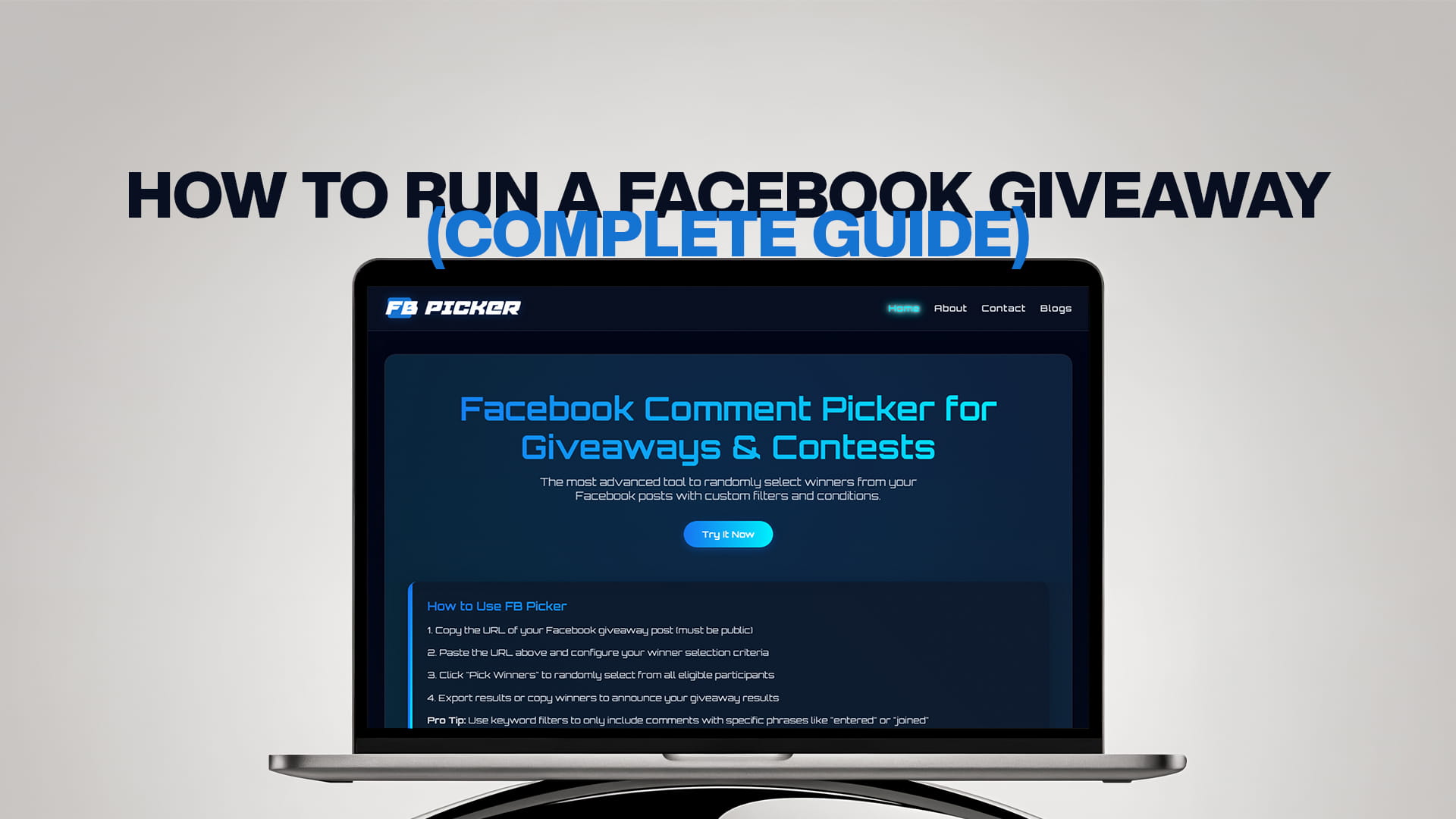
Use a tool that reads the comments from the post itself. FB Picker works from a pasted public post URL with no login, pulls the full comment set, removes duplicate commenters so nobody wins by commenting twenty times, filters by keyword if you used one, and selects the winner at random using a secure method. Draw one or two backups in the same pass, since you can pick multiple winners at once, and a backup drawn in the original selection is what makes a no-show a non-event rather than a public redraw.
Record the draw on screen while you do it. That thirty-second clip is the most persuasive proof of fairness available, and it costs nothing.
Step 8: Verify before you announce
Spend a minute checking the drawn account before you post their name. Does it look like a real person with genuine history? Did they actually follow your entry instructions, including any keyword? Do they meet your stated eligibility? Is this their only entry?
If they fail, promote your backup quietly under your published disqualification clause. A quiet substitution before announcement costs nothing; a public correction afterward looks exactly like "we didn't like who won."
Keep verification proportionate. Collect only what you need to deliver the prize, never ask for ID on a small prize, never ask for bank details, and never ask a winner to pay anything.
Step 9: Announce properly
The announcement is the most-watched moment of your giveaway, and it's where most organizers waste the attention they built.
Name the winner, confirm the prize, include the recorded draw as proof, state the claim deadline, and thank everyone who entered. Post it as a new post and reply on the original giveaway post, since people check back there. Pin it. And state clearly how you contact winners and that you'll never ask anyone to pay to claim a prize, which inoculates your audience against the impersonation scams that follow successful giveaways.
Step 10: Convert the people who didn't win
This is the step that separates giveaways that build businesses from giveaways that build comment counts.
Everyone who entered raised their hand to say they want what you offer. Within an hour of announcing, give them a reason to buy: a time-limited discount, a free add-on, an offer pointed at the specific product involved, linked directly to that product rather than your homepage. Retarget everyone who engaged, since they're now a warm audience that costs a fraction of cold traffic. And invite entrants to follow for the next giveaway so each campaign compounds into the next.
Then measure against the goal you set in step one: retained followers a week later, email sign-ups, code redemptions, orders. Comment counts are not the outcome.
The bottom line
Running a Facebook giveaway well is a sequence, not a post. Decide what it's for, choose an on-brand prize that attracts buyers rather than prize hunters, use a compliant comment-based entry mechanic (Meta explicitly prohibits requiring shares or friend tags), publish real rules, and promote deliberately at launch, midpoint, and deadline. Then draw the winner with a tool that reads the whole comment pool rather than the filtered view on your screen, record it, verify before announcing, and convert everyone who didn't win while their interest is still warm. Do that consistently, closing each contest through a dependable free comment picker and giveaway tool and the same repeatable random comment picker for giveaways workflow, and giveaways stop being a hopeful stunt and become a reliable channel.
Frequently Asked Questions
One to two weeks suits most giveaways: long enough for word to spread through tags and shares, short enough to keep urgency. Shorter works for flash contests and frequent giveaways; longer suits high-value prizes that need time to build momentum. Always state the exact closing date, time, and time zone.
Commenting on your post is the safest core mechanic, optionally with liking the post and following your Page. Meta's policy explicitly prohibits requiring people to share on their timeline, share on a friend's timeline for extra entries, or tag friends in the post to enter. You may invite sharing and tagging, but entry must not depend on it.
Use a Page. Meta's policy states that promotions are administered on Pages or within apps, and that personal timelines must not be used to administer promotions. Running from a personal profile breaches the policy and also makes the comments harder to work with for a fair draw.
Use a comment picker that reads the post directly rather than scrolling your screen, because Facebook's default comment ranking hides many comments, and drawing from the visible ones excludes most entrants. Remove duplicates, apply your keyword filter, draw at random, record the selection, and draw backups in the same pass.
Announce publicly with proof of the draw, notify the winner with a claim deadline, then immediately give everyone who didn't win a reason to buy, since they're your warmest audience. Retarget engagers with ads, invite entrants to follow for the next contest, and measure retained followers, sign-ups, and orders rather than comments.