
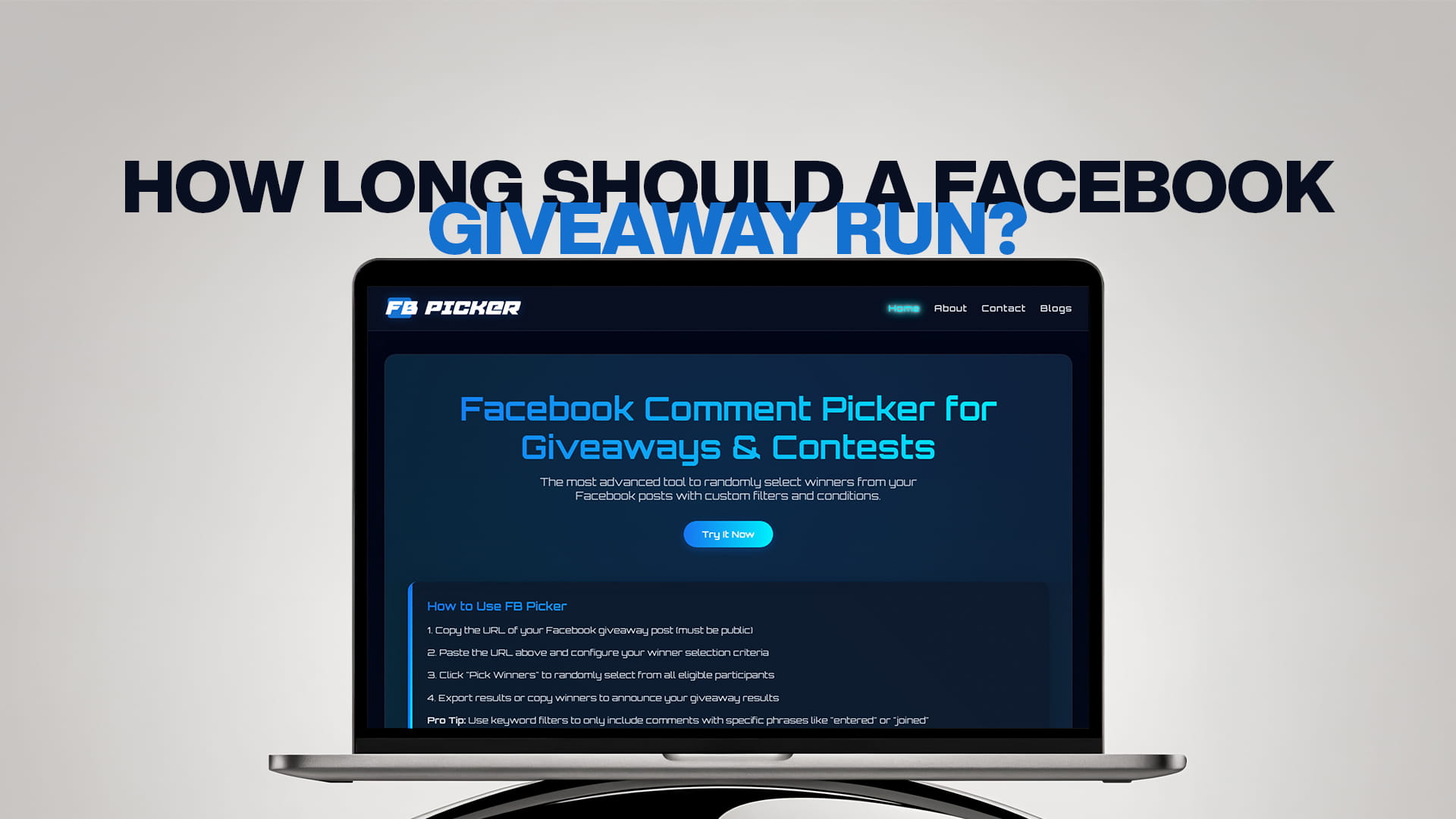
How Long Should a Facebook Giveaway Run in 2026?
If you want the short answer, it's about two weeks. That length works for most Facebook giveaways most of the time, and if you stopped reading right here and ran your next contest for 14 days, you'd be fine.
The honest answer is that it depends, and the people who get the best results are the ones who match the length to what they're actually trying to do. A flash giveaway and a month-long lead campaign are different animals, and running one at the other's length is where things go sideways. So let me walk through how to actually decide, starting with why that two-week number keeps coming up.
Why two weeks is the usual sweet spot
Look across the contest-marketing world and the same range keeps surfacing: one to two weeks. RafflePress lands on 14 days as its general recommendation. ShortStack tells anyone who isn't sure to just default to two weeks. Gleam puts the sweet spot at 7 to 14 days. The exact figure wobbles a bit from source to source, but the center of gravity sits right around the two-week mark.
There's a reason for that, and it comes down to two forces pulling against each other.
On one side, you need time. Word has to spread. People who open Facebook twice a week need a chance to actually see the post. Friends have to tag friends, the algorithm has to decide your giveaway is worth showing to more people, and all of that takes a few days to build.
On the other side, urgency fades. A giveaway that feels like it'll be around forever is a giveaway people put off entering, and "I'll do it later" quietly becomes "I forgot." Stretch the window too far and engagement sags in the middle while everyone waits for a deadline that still feels distant.
Two weeks is roughly where those forces balance. Long enough to travel, short enough that nobody forgets.
Picture it in practice. You post on a Tuesday morning. The first few days bring in your regulars and the people who check Facebook daily. Around the end of week one, the tags and shares have done their work, and you start seeing names you don't recognize, friends of friends who'd never have found you otherwise. Then the closing date approaches and a second wave shows up, the procrastinators and the people who needed a reminder. A one-week contest cuts that second wave off before it arrives. A month-long one drops a flat, silent valley between the two. Fourteen days catch both ends without the dead air in between.
One thing worth knowing: the average social media contest actually runs closer to a week, and plenty of brands run them even shorter than that. But average isn't the same as ideal. A lot of those short contests are short because the brand runs them constantly, not because seven days is optimal. When people study what performs rather than what's common, the one-to-two-week range tends to come out ahead for a normal campaign.
When a shorter giveaway makes sense
Short giveaways, the one-to-three-day kind, have a real job to do. They create urgency. When people know the window is tiny, they act now instead of later, and you get a fast, concentrated burst of entries.
A few situations suit them well. If you run giveaways often, keeping each one short stops them from blurring into each other. If the prize is modest, a quick contest gets you more out of the effort than dragging it out would. And if you already have an engaged audience that pays attention, you don't need two weeks for word to spread, because your people are already here.
The cost is reach. News takes time to travel, and a giveaway that's over in 48 hours won't get far past the followers who happened to be online when you posted. So if you go short, your timing has to be sharp. Launch when your audience is awake and scrolling, because you don't have spare days for stragglers to wander in. You're betting on a narrow window, so make it a good one.
I'll go further and say short giveaways are underrated for small pages. If you've got a few thousand followers and you're running your first contest, a tight three-day giveaway with a clear prize often beats a sprawling two-week one. It's easier to keep the energy up, and it's easier to keep yourself on top of it.
When a longer giveaway earns its keep
Now the other direction. Some giveaways should run three or four weeks, sometimes more, and they tend to fall into a pattern.
High-value prizes are the clearest case. If you're giving away something expensive, a premium bundle, a big-ticket item, a genuine experience, it makes no sense to hide it behind a 24-hour window almost nobody sees. The bigger the prize, the longer you can justify running the contest, because the reward is worth the wait and worth promoting harder.
Lead generation is the second case. If the whole point is building an email list or a pipeline of prospects, you want a steady trickle of entries over time, not a one-day stampede. A longer window gives that trickle room to run.
And if you only do a giveaway once or twice a year, each one deserves more runway. You're not worried about contests stepping on each other, so you can let a single campaign build slowly.
Here's the catch with long giveaways, and it's what sinks most of them: the middle goes quiet. Interest spikes when you launch, spikes again near the deadline, and in between sits a dead stretch where people forget the thing exists. If you're going to run a contest for a month, you have to fill that gap. Reminder posts. A behind-the-scenes update. A "two weeks left" nudge. Maybe adding a runner-up prize partway through. Something every few days to drag it back into the feed. A long giveaway with no plan to keep it alive is just a short giveaway with a lot of silence bolted on.
Let the prize set the length
A simple rule of thumb cuts through most of this: match the duration to what you're giving away.
Rafflecopter has long suggested scaling a giveaway's length to the retail value of the prize, and it's good advice. A few stickers and a t-shirt don't warrant the same runway as an all-inclusive trip. Run a small prize for a short window and a serious prize for a longer one. The mismatch is what looks off. A luxury prize crammed into a single day wastes its pulling power, and a cheap prize stretched across a month wastes your audience's patience.
Your goal and your time get a vote too
Two more things deserve a say in this.
Your goal points you in a direction. Want a quick jolt of engagement or a fast batch of leads? Lean short. Building slow, long-term awareness or a quality lead pipeline? Lean longer. The contest is a tool, and the length should follow the job you hired it for.
Your own bandwidth matters more than people like to admit. Staying on top of a giveaway for a week is one thing. Answering questions, moderating comments, and keeping the energy up for a solid month is another. If you're a small team, or one person having a busy stretch, a shorter contest isn't a compromise. It's the sensible call. A well-run one-week giveaway beats a neglected four-week one every single time.
Format plays in as well. A comment-to-win contest can be short, since entering takes about five seconds. Ask people to make a photo or video entry, and you need to give them more room, because creating something takes effort and nobody does it on a whim.
One rule: don't extend it once it's live
This one's a personal hill I'll die on. If turnout looks thin halfway through, resist the urge to quietly push the end date back. It rarely helps, and it costs you something that's hard to win back: people stop trusting your deadlines. The next time you say "ends Friday," a chunk of your audience assumes it doesn't really, so they don't bother entering on time, which makes your next giveaway look even slower, and round it goes.
Set a length you can commit to, announce it clearly, and honor it. If a contest underperforms, that's information for next time, not a reason to move the goalposts mid-game.
Mind the calendar
Whatever length you pick, look closely at where the start and especially the end land. Ending a giveaway on a major holiday or a big event day is a quiet mistake. Your audience is out celebrating, traveling, or simply off their phones, so your winner announcement and final entry push land in an empty room.
If you're running something holiday-themed, it's usually smarter to close a few days before or after the holiday rather than on it, so the finish happens when people are actually around to care. Same goes for a big game, an awards night, or anything else that yanks your audience's attention somewhere else.
However long it runs, the ending is what people remember
Here's the part that's easy to forget while you're agonizing over duration: the moment people actually judge you on is the draw. You can run a flawless two-week campaign and undo all of it by picking a winner in a way that looks rigged.
Once the contest closes, you've got a pile of comments and one job: choose a winner nobody can argue with. Scrolling the thread and landing on a name you happen to recognize is exactly what people suspect you're doing, so don't do it. Use something built for the job. A random comment picker for giveaways pulls every entry off your post and draws fairly in about a minute.
That's where FB Picker earns its place. You paste in your post URL, it gathers the comments, and you can strip out duplicates so the person who commented twenty times doesn't get twenty chances at the prize. When you draw, it selects the winner at random using a method that can't be nudged, and if your longer, higher-value campaign had more than one prize, you can pick several winners at once and line up backups for anyone who never claims. Record the draw while it runs and post the clip. That thirty-second video does more for your credibility than any promise you could type out.
So, how long?
If you remember one thing, make it this: default to two weeks, and only move off that number when you have a reason. Go shorter for a flash contest, a modest prize, or a giveaway you run all the time. Go longer for an expensive prize, a lead-gen push, or a once-a-year event you're genuinely willing to nurse along with reminders.
Then watch what your own audience does, because they'll tell you more than any guideline can. Some communities reward a tight one-week sprint. Others need the full fortnight for word to make the rounds. Run a couple of contests, see where the entries actually cluster, and shift your timing by a few days in whichever direction the numbers lean. After three or four giveaways you'll know your audience's real attention span cold, and you'll stop second-guessing the calendar entirely.
Pick a sensible length, keep the contest breathing while it runs, and finish with a draw people believe. The best free Facebook comment picker takes care of that last part, which leaves you free to obsess over the only thing that really moves the needle anyway: what you're giving away.