
How Long Should a Facebook Giveaway Run?
Set your giveaway's duration too short and word never spreads; too long and people lose interest and forget to enter. Getting the length right is one of the quietest but most important decisions you'll make, and unlike the prize or the caption, it's easy to overlook until the contest is already underway.
So how long should a Facebook giveaway run? The short answer, backed by research across thousands of contests, is that one to two weeks is the sweet spot for most. But the right length genuinely depends on your goal, your prize, and how often you run giveaways. This guide breaks down the data, the trade-offs of going shorter or longer, and how to choose the duration that fits your specific campaign.
The Data-Backed Sweet Spot: 1–2 Weeks
If you want a single recommendation to start from, run your Facebook giveaway for about two weeks. Across multiple studies of social media contests, the most commonly cited sweet spot lands between 7 and 14 days. A run of around two weeks gives word time to spread, lets people who only check Facebook occasionally find and enter the contest, and still keeps a sense of urgency before momentum fades.
Two weeks works because it balances the two forces that pull in opposite directions. You need enough time for the post to circulate, get shared, and reach beyond your existing followers, but not so much time that the giveaway feels permanent and people put off entering until they forget entirely. Shorter than a week and many of your audience simply never see it; longer than two or three weeks and engagement tends to sag in the middle.
It's worth noting that the average social media contest actually runs about a week, partly because many brands run frequent giveaways where a short window makes sense. But "most common" isn't the same as "most effective," and when studies look at performance rather than habit, the one-to-two-week range consistently comes out ahead for the typical campaign.
When to Run a Shorter Giveaway (1–3 Days)
A short, flash giveaway has real strengths. It creates urgency, people act fast when they know the window is tiny, and it suits brands that run giveaways often and don't want each one to drag on. Short contests are quick to manage, easy to promote in a single burst, and great for a fast engagement spike.
The trade-off is reach. News takes time to travel, and a giveaway that lasts only a day or two won't circulate far beyond the followers who happen to be online when you post. Choose a short run when your goal is a quick jolt of engagement rather than broad reach, when you have an engaged audience that's already paying attention, when the prize is modest, or when you run giveaways frequently and want to keep them snappy. If you go short, lean hard on timing, launch at a peak window so the limited time isn't wasted on an inactive audience.
When to Run a Longer Giveaway (3–4+ Weeks)
Longer contests, three to four weeks or more, make sense in specific situations. A high-value prize justifies a longer run, because it would be a waste to attach a premium reward to a window so short that few people see it. Lead-generation campaigns also benefit from extra time, since you want a steady stream of qualified entrants rather than a one-day rush. And if you only run one or two giveaways a year, a longer period gives each campaign the runway to generate real buzz.
The danger with long giveaways is the middle slump: enthusiasm spikes at launch, dies down, then spikes again near the deadline, leaving a quiet stretch in between. The fix is a touchpoint plan, schedule reminder posts, behind-the-scenes content, or "X days left" updates to keep the giveaway fresh and re-trigger momentum throughout. Without that, a long contest simply goes stale.
Match Duration to Prize Value
A useful rule of thumb: scale the length to the prize. A small giveaway, a few branded items, a modest gift card, doesn't warrant a month-long campaign; a short run gets you more impact for the effort. A high-value prize, an expensive bundle, a premium experience, deserves a longer window so its appeal has time to spread and the effort of running it pays off. Mismatching the two, a tiny prize stretched over a month, or a luxury prize crammed into 24 hours, wastes either your audience's attention or the prize's pulling power.
Match Duration to Your Goal and Resources
Beyond the prize, two more factors shape the ideal length. Your goal: a short-term spike in engagement or leads suits a one-to-two-week contest, while ongoing brand awareness or a high-quality lead pipeline may call for a longer or recurring campaign. Your resources: it's far easier to stay on top of a giveaway for one or two weeks than to be on call engaging entrants for a month. If you have a small team, shorter is kinder to your bandwidth and usually just as effective.
Contest format matters too. A simple comment-to-win contest can be short, because entering takes seconds. A photo or video UGC contest needs a longer window, because creating an entry takes real effort and people need lead time to participate.
Don't Forget the Calendar
Whatever length you choose, mind the calendar around your start and end dates. Avoid ending a giveaway on a major holiday or big event day, when your audience is celebrating, traveling, or simply off their phones; your winner announcement and the final entry rush will fall flat. If you're running a holiday-themed giveaway, it's often better to close a few days before or after the holiday itself rather than on it, so engagement stays high when it matters most.
Closing the Giveaway: Picking Your Winner
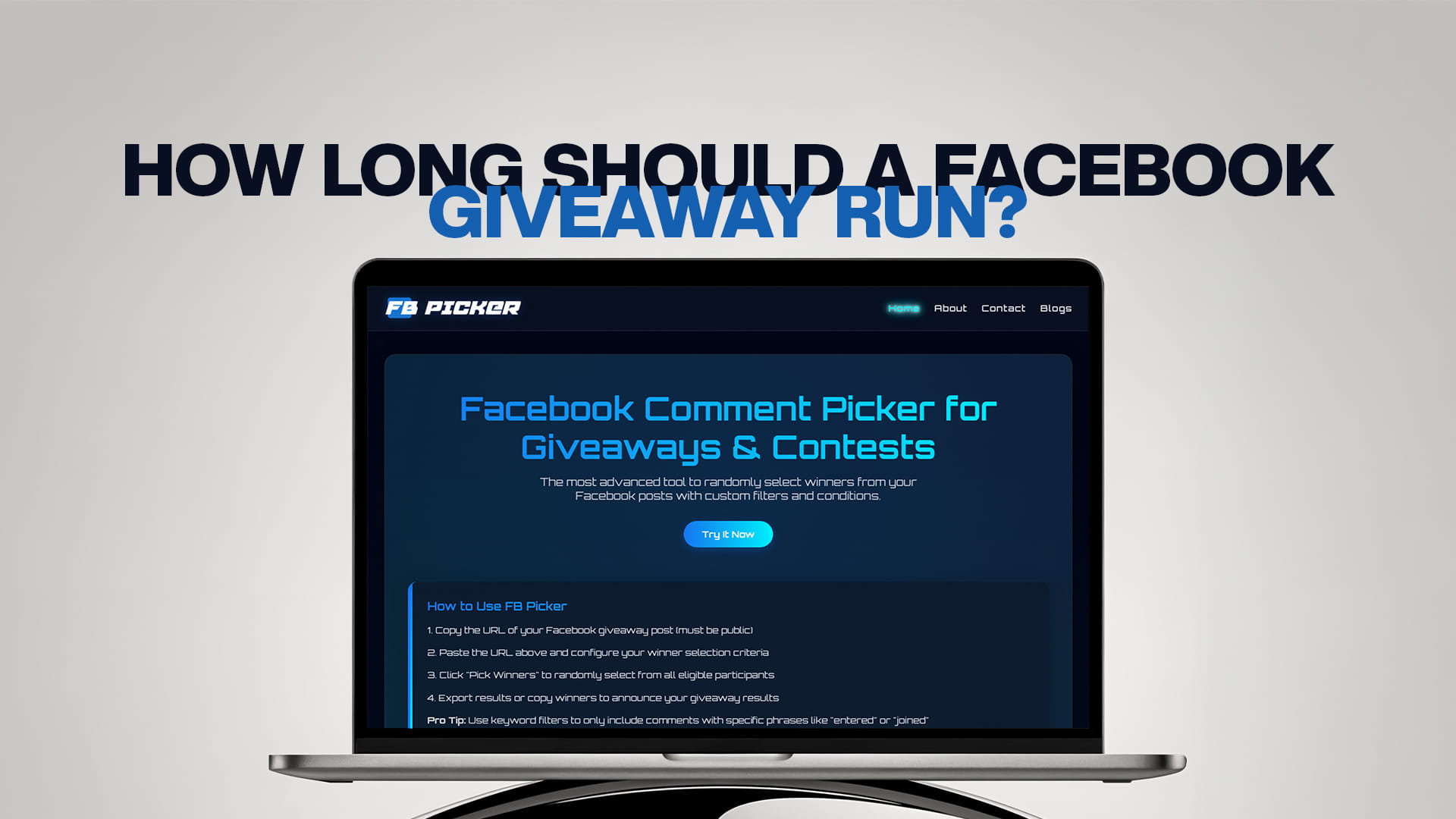
However long your giveaway runs, it ends the same way: you have to choose a winner, and that moment is where trust is built or broken. Picking a name by hand from a long entry list looks arbitrary, so use a tool designed for it. FB Picker is the most advanced tool for randomly selecting winners from your Facebook posts.
Paste your post URL and it gathers every comment automatically, no matter how many accumulated over your one, two, or four weeks. Set your conditions, filter out duplicate commenters so no one wins twice, and run the draw; it selects winners randomly with a secure algorithm. If your longer, higher-value campaign included several prizes, you can pick multiple winners at once and line up backups for no-shows. Record the on-screen draw so the result is provably fair, the perfect end to a well-timed contest.
A Simple Framework to Choose Your Duration
If you're still unsure, run through four quick questions and let the answers point you to a length.
First, what's your goal? A quick engagement spike points short (a few days to a week); steady lead generation or brand awareness points longer (two to four weeks). Second, what's the prize worth? A modest prize points short; a high-value prize points longer so its appeal has time to spread. Third, how often do you run giveaways? Frequent contests should be short so they don't overlap and exhaust your audience; once or twice a year means each can run longer. Fourth, how much time can you give it? A small team or a busy month points short, since shorter contests are far easier to manage and promote consistently.
Tally where the answers lean. If most point short, run a one-week flash contest and lean hard on timing. If they're mixed, default to the two-week sweet spot, it's the safest choice for the widest range of situations. If most point long, commit to three or four weeks but only with a plan to keep it alive, which brings us to the next point.
Building a Touchpoint Plan for Longer Giveaways
The reason long giveaways fail isn't the length itself, it's the silence in the middle. Enthusiasm spikes at launch and again near the deadline, leaving a dead zone where people forget the contest exists. A touchpoint plan fills that gap with scheduled moments of contact.
Map out posts across the run before you launch. Day one is the announcement. A few days in, share a reminder framed around the prize ("still time to win [prize], here's why it's worth entering"). Midway, post something different: a behind-the-scenes look, a spotlight on entries so far, or a bump in the prize ("we've added a runner-up prize!"). In the final stretch, switch to urgency: "48 hours left," then "last chance, closing tonight." Each touchpoint re-surfaces the giveaway in feeds and re-triggers the algorithm's momentum.
Space these so you're visible without being spammy; roughly one giveaway-related post every three to five days works for most audiences. Done well, a touchpoint plan turns a long, sagging contest into a series of small peaks that sustain entries from launch to close.
Bringing It All Together
For most Facebook giveaways, one to two weeks is the data-backed sweet spot, long enough to spread, short enough to keep urgency. Go shorter (1–3 days) for flash contests, modest prizes, frequent giveaways, or quick engagement spikes, and go longer (3–4+ weeks) for high-value prizes, lead generation, or infrequent campaigns, provided you keep them alive with reminders. Match the length to your prize, goal, resources, and format, mind the calendar around your close, and finish with a fair, recordable draw. When that moment comes, the best free Facebook comment picker and a consistent random comment picker for giveaways workflow turn weeks of entries into a winner your whole audience can trust.
As with every part of a giveaway, let your own results refine the rule. After each contest, note how long it ran, where entries clustered, launch, middle, or final push, and whether the length felt too rushed or too drawn out. A few campaigns will show you your audience's real attention span: some communities reward a tight one-week sprint, others need the full two weeks to circulate. Use the data-backed sweet spot as your default, then adjust by a few days in whichever direction your numbers point. Over time you'll dial in a duration that fits your audience, your prizes, and your bandwidth, and you'll stop guessing about it entirely.
Common Questions People Ask
How long should a Facebook giveaway run for the best results? For most campaigns, one to two weeks is the sweet spot. It gives word time to spread and lets occasional users find the contest while keeping enough urgency that people don't forget to enter.
Is a one-day giveaway too short? Not necessarily, short flash giveaways create urgency and suit frequent contests or modest prizes. The trade-off is limited reach, since the post won't circulate far in a single day. If you go short, launch at a peak engagement window.
When does a longer giveaway make sense? For high-value prizes, lead-generation goals, or brands that only run a giveaway once or twice a year. Longer runs (three to four weeks or more) give campaigns room to build buzz, but you'll need reminder posts to prevent a mid-contest slump.
Does the prize value affect how long I should run the giveaway? Yes. Scale the duration to the prize: modest prizes suit short runs, while high-value prizes justify longer windows so their appeal has time to spread. Mismatching the two wastes either attention or the prize's pulling power.
Should I avoid ending a giveaway on a holiday? Yes. Ending on a major holiday or event day usually means your audience is offline, so the final entry rush and winner announcement get little attention. Close a few days before or after instead.
How do I pick a winner after the giveaway ends? Use a comment picker that draws at random, removes duplicates, and lets you record the result. Tools like FB Picker pull every comment from your post URL and select a verifiable winner, or multiple winners, in under a minute.