
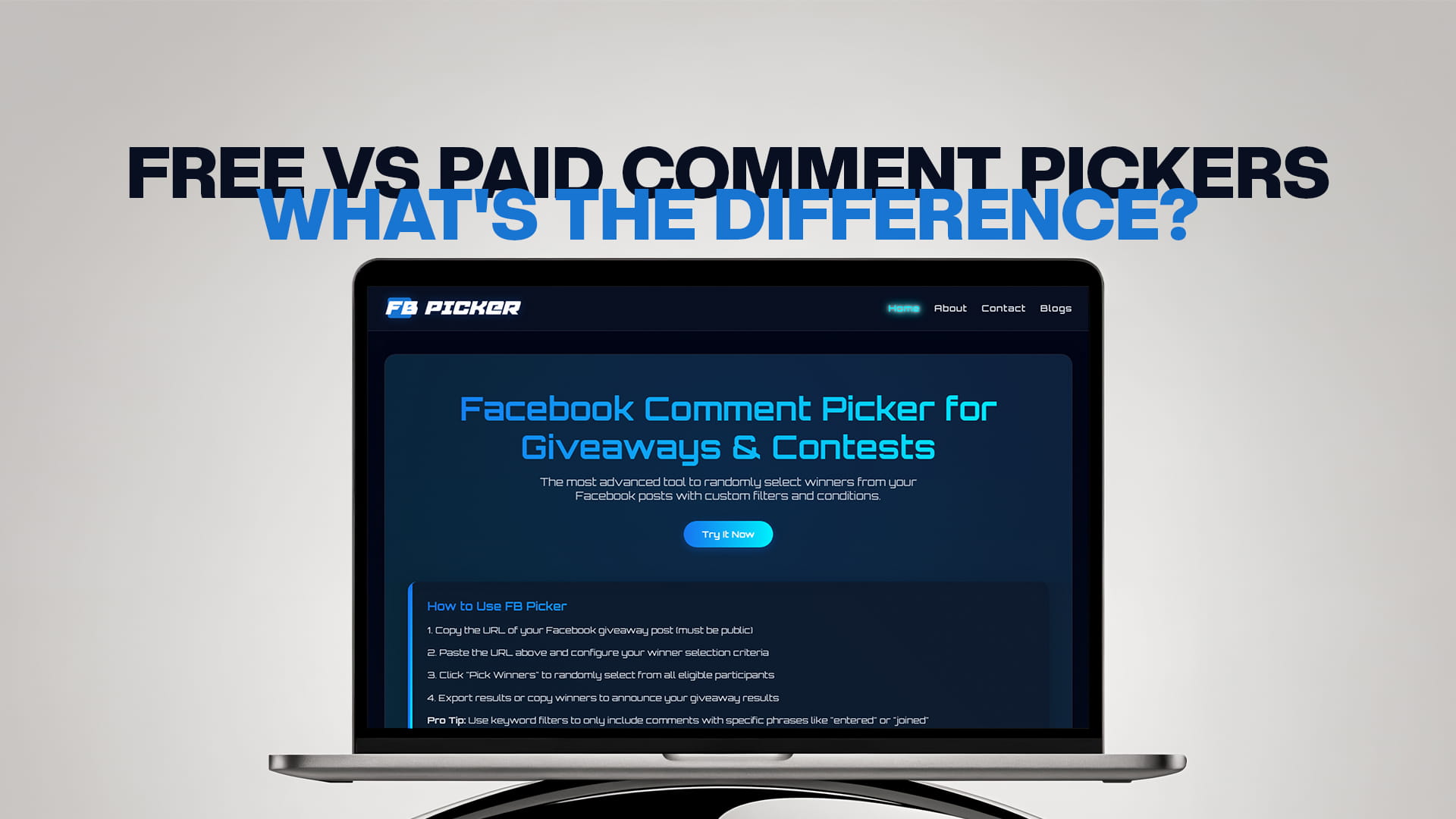
Free vs Paid Comment Pickers: What's the Difference?
Search for a comment picker, and you'll find two kinds: free tools that draw a winner in seconds with no account, and paid tools or platforms that charge a monthly fee. The obvious question is which one you need, and the honest answer is that most people running normal giveaways never need to pay. The free version does the job.
But "most people" isn't everyone, and the gap between free and paid is real once your giveaways get bigger or more frequent. So the useful question isn't "free or paid?" in the abstract. It's "where do free tools stop, and is that anywhere near where I actually operate?" This guide walks through exactly what changes when you pay, where free is genuinely enough, and how to tell which side of the line you're on.
What "free" usually means
A free comment picker almost always does the core job well: paste your post URL, it pulls the comments, and it draws a random winner. For a giveaway with a few hundred entries, that's the whole task, and a good free tool handles it cleanly. The best free Facebook comment picker options will also remove duplicate commenters and let you record the draw, which covers the fairness most giveaways need.
Where free tools differ is in their limits, and those limits are how the paid versions make their money. Free tiers typically cap the number of comments they'll read per draw, restrict how many draws or exports you can run in a day or month, keep the filtering basic, and show ads or stamp the results with the tool's branding. None of that matters for a small contest. All of it starts to matter at scale.
What you're actually paying for
When you upgrade, you're rarely paying for "better randomness," because a fair draw is a fair draw. You're paying to remove limits and unlock features. Here's what that money typically buys, dimension by dimension.
Comment limits
This is the single biggest difference. Free tiers commonly cap a draw at somewhere between 50 and a few hundred comments. One popular tool's free Facebook draw stops at 100 comments; another caps its free plan at 50. If your post pulls 2,000 entries and the free tool reads the first 100, you're not running a fair draw at all, you're drawing from a fraction of your entrants. Paid plans lift the cap to thousands or to unlimited.
It's worth understanding how the cap behaves, because it's not always obvious. Some tools read the most recent comments up to the limit, others read the oldest, and a few quietly stop fetching once they hit the ceiling without warning you. In every case the result is the same: a chunk of your entrants never makes it into the pool, so people who entered in good faith had no chance of winning. That's the kind of quiet unfairness that gets noticed only when someone asks "why did an early commenter win when I entered too?" To know whether this affects you, check the comment count on your last few giveaway posts. If they regularly sit under the free cap, the limit is irrelevant. If they're creeping past it, you've found your reason to pay, and ignoring it means running draws that aren't genuinely random.
Filters and conditions
Free versions usually give you a random pick plus, if you're lucky, duplicate removal. Paid tiers open up the conditions that turn a basic draw into a controlled one: keyword requirements so only people who followed your instructions qualify, hashtag and mention filters, date-range limits, friend-tag conditions, exclusion lists, and on the most advanced tools, weighted entries and regex matching.
A concrete example shows why this matters. Say you run a contest where the rule is "comment the word PUMPKIN to enter," and you get 800 comments, but only 500 actually contain the word. With a basic free draw, all 800 are eligible, including people who commented something unrelated or who tried to enter twice. A keyword filter narrows the pool to the 500 valid entries, and duplicate removal trims it further to one entry per person. Now the winner is genuinely someone who followed your rules. Weighted entries take it further still, letting you give an extra chance to people who tagged a friend or entered early, which rewards the behavior you wanted. If your contests are simple "comment to win" draws, you may never miss any of this. If you run structured campaigns with specific entry rules, advanced filtering is often the single reason to upgrade.
Multiple winners and prize tiers
Some free tools draw one winner at a time, which is fine until you're awarding several prizes or want backups for no-shows. The ability to pick multiple winners in a single pass, with separate tiers, is frequently a paid feature elsewhere, so it's worth checking whether your free tool includes it before you assume you need to upgrade.
Ads and branding
Free almost always means ads, the tool's own branding on the results page, or both. For a casual giveaway, nobody cares. But if you're an agency running a client's contest, or a brand that wants a clean, professional result to share, paying to remove ads and branding is often less about features and more about how the draw looks to your audience.
Verification and provable fairness
A trustworthy free tool already selects the winner at random and lets you record the draw, which is enough proof for most audiences. A few paid tools go further with cryptographic seed verification that lets anyone independently confirm the result wasn't tampered with. Unless you're running high-value contests where entrants might genuinely dispute the outcome, recording the on-screen draw from a free tool gives you the fairness you need without paying for the extra layer.
Exports and record keeping
Free tiers often limit exports, a handful per month, or cap how many results you can download. Paid plans give you unlimited CSV, Excel, or PDF exports of entrants and winners. This matters more than it sounds, because several countries' promotion rules expect you to keep records proving a fair draw. If you run regular contests and need a clean archive, generous exports are a practical reason to pay.
Multiple platforms
Many free tools cover one network. Paid plans, or platform tools, unlock Instagram, YouTube, TikTok, and others from one dashboard. If your giveaways live only on Facebook, this is irrelevant. If you run the same contest across several networks, paying for a multi-platform tool saves you juggling three different free ones.
Support and the platform extras
At the top end, "paid" stops being a picker at all and becomes a marketing platform: landing pages, email capture, referral tracking, leaderboards, scheduling, analytics, and user-generated-content galleries. These are powerful, and they're priced accordingly, often $30 a month or more. They're built for brands running contests as a core marketing channel, not for someone picking a winner once a month.
What the free tiers actually look like
It helps to see how this plays out in real tools rather than in the abstract. The exact numbers shift over time, so treat these as a snapshot rather than gospel, but the pattern is consistent across the market.
The most established free option caps its Facebook draw at around 100 comments and asks you to connect a Business Page, with a Premium plan from roughly $9.99 a month that removes ads and raises the limits. Another well-known tool offers a free draw of up to about 50 comments, with paid plans for unlimited entries and a downloadable winner video. A newer, fairness-focused option keeps a limited free draw and charges around $9.99 a month, or $99 a year, for unlimited comments, unlimited winners, and its full filter set. And the full campaign platforms, the ones with landing pages and analytics, tend to start free for tiny campaigns and jump to roughly $32 to $37 a month once you want unlimited participants.
Notice the shape of it. Almost every tool gives you a real, working free draw, then puts the comment ceiling, the advanced filters, the ad removal, and the extras behind the paywall. The free version is a genuine product, not a crippled demo, which is exactly why so many small giveaways never need to pay.
The hidden cost of free
Free isn't always free in the way that matters. The real cost of a free tool shows up as your time and your credibility when the limits bite. Reading only the first 100 of 2,000 comments produces an unfair draw you might not even notice. Hitting a daily export cap mid-campaign forces you to wait or work around it. Ads on a results page you're sharing with a client look unprofessional. None of these are dollar costs, but they're costs, and they're worth weighing against a modest subscription if you run contests often.
That said, the opposite trap is just as common: paying for a platform you barely use. If you run four small giveaways a year, a $37-a-month marketing suite is mostly wasted. The skill is matching the tool to your actual volume, not to the most impressive feature list.
Who should stay free, and who should pay
Here's the rough split.
Stay free if you run occasional giveaways, your posts pull comment counts within the free cap, you don't need advanced filtering, and a recorded on-screen draw is enough proof for your audience. That describes most creators, small businesses, and community pages, and there's no reason to pay for something you'll never use.
Consider paying if any of these are true: your posts regularly exceed the free comment limit, you run contests often enough to hit draw or export caps, you need keyword, hashtag, or weighted filtering, you want ads and branding gone for a professional or client-facing result, or you've outgrown a single platform and want everything in one place. The bigger and more frequent your contests, the faster a subscription pays for itself.
Three quick scenarios
Abstract advice only goes so far, so here's how the decision lands for three common situations.
A hobby baker with a 4,000-follower page runs a giveaway every couple of months, and her posts pull 150 to 300 comments. She wants a fair draw she can record and post. For her, free is the clear answer. A no-signup tool that handles a few hundred comments, removes duplicates, and lets her record the draw covers everything she needs, and a subscription would sit unused between contests.
A growing e-commerce brand runs a contest most weeks, often pulling well over a thousand comments, and uses keyword entry rules to filter for people who answered a product question. This brand has outgrown free. The comment cap alone would compromise the draw; the agency runs giveaways for a dozen clients, each expecting clean, branded results, captured leads, and a report. This is platform territory. The agency needs ad and branding removal, unlimited exports, multi-platform support, and ideally landing pages and analytics, which is exactly what the $30-plus marketing suites provide. For them, the higher price is a rounding error against billable client work, and the time saved justifies it many times over.
Most readers will recognize themselves somewhere on that spectrum, and the right answer follows from where you sit, not from which tool has the longest feature list.
Where FB Picker fits
This is the part worth being straight about, because plenty of "free vs paid" articles exist mainly to push you toward the paid button. FB Picker is built so that the free version covers what most people actually need rather than holding the useful features hostage. It's free with no signup, works from any public post URL, and still includes the things some tools charge for: custom filters and conditions, duplicate removal, multiple winners, and exports to CSV, Excel, and PDF. It also processes large comment volumes rather than quietly cutting you off at a low cap.
Premium features exist for businesses and power users who need them, which is the right model: pay when your scale or workflow demands it, not just to unlock a basic, fair draw. If you're starting out, the free comment picker and giveaway tool gives you a genuinely capable draw at no cost, and you can move up only if and when your contests outgrow it.
A simple way to decide
You don't need to agonize over this. Run through four quick checks. First, how many comments do your giveaways typically get, and does that sit comfortably under the free tool's cap? Second, do your entry rules need filtering beyond duplicate removal, like keywords or tags? Third, how often do you run contests, enough to hit daily or monthly limits? Fourth, does the draw need to look clean and branded for a client or a high-value prize?
If you answered "small, no, rarely, no," stay free and don't think about it again. If you answered the other way on two or more, a paid plan or a platform will probably save you time and look more professional. And if you're in between, start free, run a couple of contests, and let the limits tell you when it's time to upgrade. Hitting a wall is a much better reason to pay than a feature list ever is.
The bottom line
The difference between free and paid comment pickers isn't fairness; it's headroom. Free tools draw a perfectly legitimate random winner; they just cap how many comments they read, how often you can draw and export, how much you can filter, and how clean the result looks. For occasional, modestly sized giveaways, that headroom is more than enough and paying would be a waste. For high-volume, frequent, or client-facing contests, the caps start to pinch, and a subscription earns its keep. Figure out where your giveaways actually sit, start with a capable free tool, and upgrade only when your own numbers push you there.