
Facebook vs Instagram Giveaway Rules: Key Differences
Here's the thing most "Facebook vs Instagram giveaway rules" articles bury: the two platforms have the same owner, so the rules are mostly identical. Meta runs both, and a single promotion policy sits underneath both of them. If you already know how to run a clean giveaway on one, you're about 90% of the way to running one on the other.
The remaining 10% is where people slip up. The differences are small, but they're the kind that get a post quietly removed or an account restricted, so they're worth knowing precisely. This guide covers what's identical across Facebook and Instagram, the handful of things that actually differ, and the one thing that doesn't change no matter which platform you use.
Same owner, mostly the same rulebook
Both Facebook and Instagram are governed by Meta's promotion policies, and those policies say nearly the same thing on each platform. Before the differences, it's worth pinning down the shared core, because it's the bulk of what matters.
On either platform, you have to publish official rules and eligibility terms. That means stating who can enter (age, residency), how to enter, what the prize is, when entries open and close (with the time zone, which is the single most common omission), and how and when you'll pick the winner.
On either platform, your rules must include a complete release of the platform and a statement that the promotion is not sponsored, endorsed, administered by, or associated with it. The only thing that changes between the two is the name in that sentence, more on that in a moment.
On either platform, you can't require payment to enter. Charging a fee or requiring a purchase turns a giveaway into something Meta treats under its gambling rules, and it can turn your promotion into an illegal lottery under the law.
On either platform, Meta has tightened its stance on entry actions that publicise your post. Requiring or incentivizing people to share or repost your content, or to tag others to spread it, runs against the current policy. Asking someone to comment or follow is fine. Requiring a share is the risky part, and it's the same on both.
And on either platform, there's no pre-approval. Meta doesn't review your giveaway before launch. Enforcement is reactive, usually kicked off when a competitor or annoyed entrant reports the post, which is exactly why building it compliant from day one is cheaper than fixing it after it's flagged.
So far, no difference at all. Now the parts that do change.
Difference 1: the disclaimer names a different platform
This one is simple but non-negotiable. Your Facebook giveaway has to state that it isn't sponsored, endorsed, or associated with Facebook. Your Instagram giveaway has to say the same about Instagram. The wording is otherwise identical, and Meta expects it more or less verbatim rather than paraphrased.
It sounds trivial, and it is, until you copy a giveaway from one platform to the other and forget to swap the name. A Facebook disclaimer pasted onto an Instagram post technically fails Instagram's requirement, because it doesn't release Instagram. If you run on both, write both. Don't assume one covers the other.
Difference 2: Instagram's explicit ban on inaccurate tagging
This is the rule that's genuinely specific to Instagram, or at least the one Instagram states most plainly. Instagram's promotion guidelines prohibit inaccurately tagging content, or encouraging people to do it. The textbook example: you can't ask entrants to tag themselves in a photo they don't actually appear in. "Tag yourself in this product shot to enter" is explicitly off-limits.
The line is accuracy, not tagging itself. Tagging a friend in a comment is fine. Following, commenting, and tagging real people in the right places are all fine. Asking people to tag themselves into images they're not in, or otherwise tag content falsely, is the violation. Because Instagram is so visual and tag-driven, this trips up creators more often than it does on Facebook, where photo-tagging mechanics are less central to how giveaways usually run.
Difference 3: links work differently, so your rules live in different places
On Facebook, a link in your post is clickable. You can drop a URL to your full terms and conditions or a landing page straight into the giveaway post, and people can tap through.
On Instagram, links in captions are not clickable. A URL in your caption is just text people would have to copy and retype, which nobody does. That changes where your rules and any landing page have to live. On Instagram you point people to the "link in bio," use a link sticker in Stories, or host the rules somewhere they can actually reach. It's a practical difference rather than a legal one, but it directly affects how you meet the shared requirement to make your official rules available. Plan for it before you post, because a giveaway whose rules nobody can open is a giveaway whose rules nobody agreed to.
Difference 4: the surfaces you can run on
Facebook and Instagram give you different places to host a giveaway, and that shapes the mechanics.
Facebook giveaways run on Pages, in Groups, and through Events, alongside regular feed posts, videos, and Reels. Groups in particular are a Facebook-only option, useful for rewarding a tight community, though they come with their own access quirks for tools that read comments.
Instagram giveaways run on feed posts, Reels, and Stories. Stories-based entries, where the action happens in a 24-hour ephemeral post, are an Instagram pattern with no real Facebook equivalent. Just remember the shared rule here: a Story share you require for entry pushes against Meta's stance on mandatory sharing, even though plenty of brands ask for it. A voluntary Story share is fine; a mandatory one is the gray area.
Difference 5: entry mechanics and platform culture
The rules permit similar actions on both platforms, but the culture of each one nudges you toward different mechanics.
Facebook giveaways lean on commenting, following the Page, and tagging friends in comments, with the option to push people to a landing page through a working link. The audience skews a little older, and the longer comment format and clickable links make it easy to collect detailed entries or route people off-platform.
Instagram giveaways lean on tagging friends in comments, following the account, hashtags, and Reels. Hashtags do real discovery work on Instagram in a way they don't on Facebook, so branded-hashtag entries are far more common there. The format is more visual, the audience skews younger, and short video carries the most organic reach.
None of this changes what's allowed. It changes what works. Designing your entry around how each platform actually behaves is the difference between a giveaway that travels and one that sits there.
What doesn't change at all: the law
Here's the point that gets lost in platform comparisons. The law that governs your giveaway is the same whether you run it on Facebook or Instagram, because the platform is just the venue, not the regulator.
A giveaway is a prize promotion wherever it lives. In the US, that means it's a sweepstakes and entry has to be free, with no purchase necessary. In the UK, a free-entry draw stays outside the Gambling Act's lottery rules. In Canada, you still need a skill-testing question for the winner and clear disclosure. In Australia, larger chance-based prize draws may need state permits regardless of platform. Across the EU, GDPR still governs the entrant data you collect, and you still can't force people to accept marketing as a condition of entry.
Switching from Facebook to Instagram does nothing to any of that. If your giveaway would need a permit, a disclosure, or a no-purchase-necessary structure on one platform, it needs the same on the other. Treat the platform policy and the law as two separate checklists, and run both every time.
Running one giveaway across both platforms
A lot of brands post the same giveaway to Facebook and Instagram at once, which is sensible for reach but adds a few wrinkles.
Write the disclaimer for each platform, naming Facebook on Facebook and Instagram on Instagram. Decide up front how entries combine: are Facebook comments and Instagram comments one shared pool, or two separate draws with separate prizes? Say so in your rules, because "I entered on Instagram, why did a Facebook person win?" is a real complaint you can prevent with one sentence. And remember that links work on one platform and not the other, so your "full rules here" pointer has to be set up differently for each.
Picking the winner on each platform
However you run it, the giveaway ends the same way: you choose a winner, and you'd better be able to show the choice was random. Both platforms collect entries as comments, and on both, hand-picking a name looks rigged no matter how honest you are.
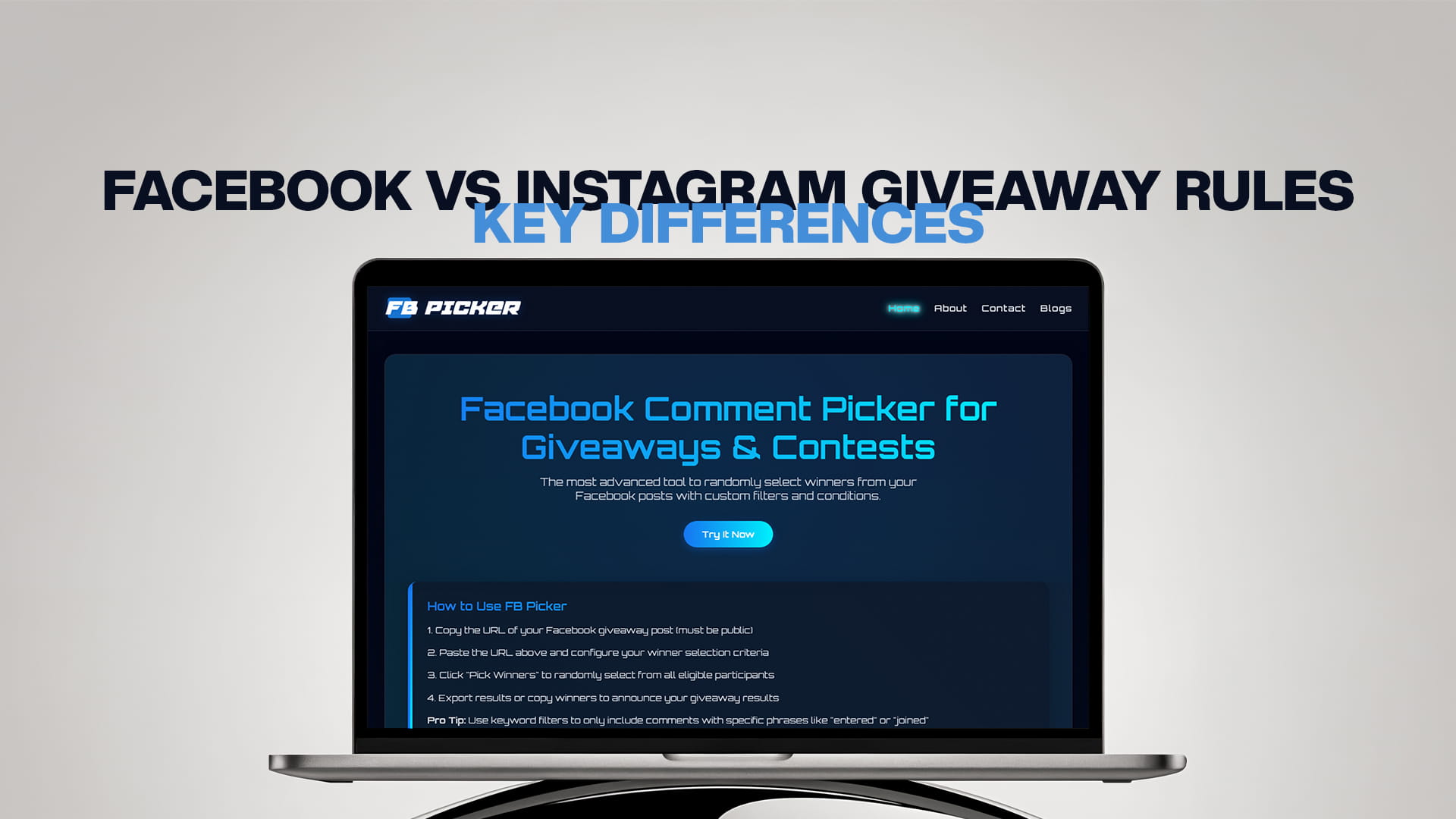
For a Facebook giveaway, FB Picker is built for exactly this. You paste your post URL, it gathers every comment, you strip out duplicate commenters, and it selects the winner at random using a method that can't be nudged. If you're cross-posting with separate prizes, or want documented backups for no-shows, you can pick several winners in one pass. The same logic applies to an Instagram draw: pull the comments and run a transparent, recorded selection rather than scrolling and guessing. Using a random comment picker for giveaways on both platforms keeps your process consistent, and recording the draw gives you proof of fairness that works the same way for either audience. For a first campaign, the best free Facebook comment picker handles the Facebook side without adding cost.
Where people actually go wrong moving between platforms
Most violations aren't dramatic. They're small copy-paste errors made by someone running the same campaign in two places at speed.
The classic is the wrong disclaimer. You build the giveaway on Facebook, duplicate the caption for Instagram, and the words "associated with Facebook" ride along onto an Instagram post that's supposed to release Instagram. It reads fine to a human and fails the platform's requirement.
The second is the dead link. A caption that worked on Facebook, with a tappable "full rules here" link, becomes useless on Instagram where that URL is just unclickable text. Entrants can't reach your rules, which undercuts the whole point of publishing them.
The third is importing a Story or share requirement. "Share this to your Story for an extra entry" feels harmless and is extremely common, but requiring or rewarding a share is exactly the mechanic Meta has been enforcing against, and it can get the post pulled within a few days.
The fix for all three is the same: treat the second platform as a fresh build, not a paste. Swap the platform name, move the link to where that platform can use it, and re-check that every required action is something the policy actually allows. Two minutes of review saves a removed post and a stalled campaign.
The short version
Facebook and Instagram giveaways run on the same Meta rulebook, so most of what you know carries straight across. Publish clear rules, keep entry free, don't require shares or reposts, and include the platform's non-affiliation disclaimer. The real differences are narrow: name the right platform in the disclaimer, mind Instagram's ban on inaccurate tagging, remember that Instagram captions can't hold clickable links, and design your entry mechanics around how each platform actually behaves. And never forget the part that doesn't move between them: the sweepstakes and privacy law of your entrants' country, which applies wherever you post. Get those right, pick your winner transparently, and the same giveaway will run clean on both.