
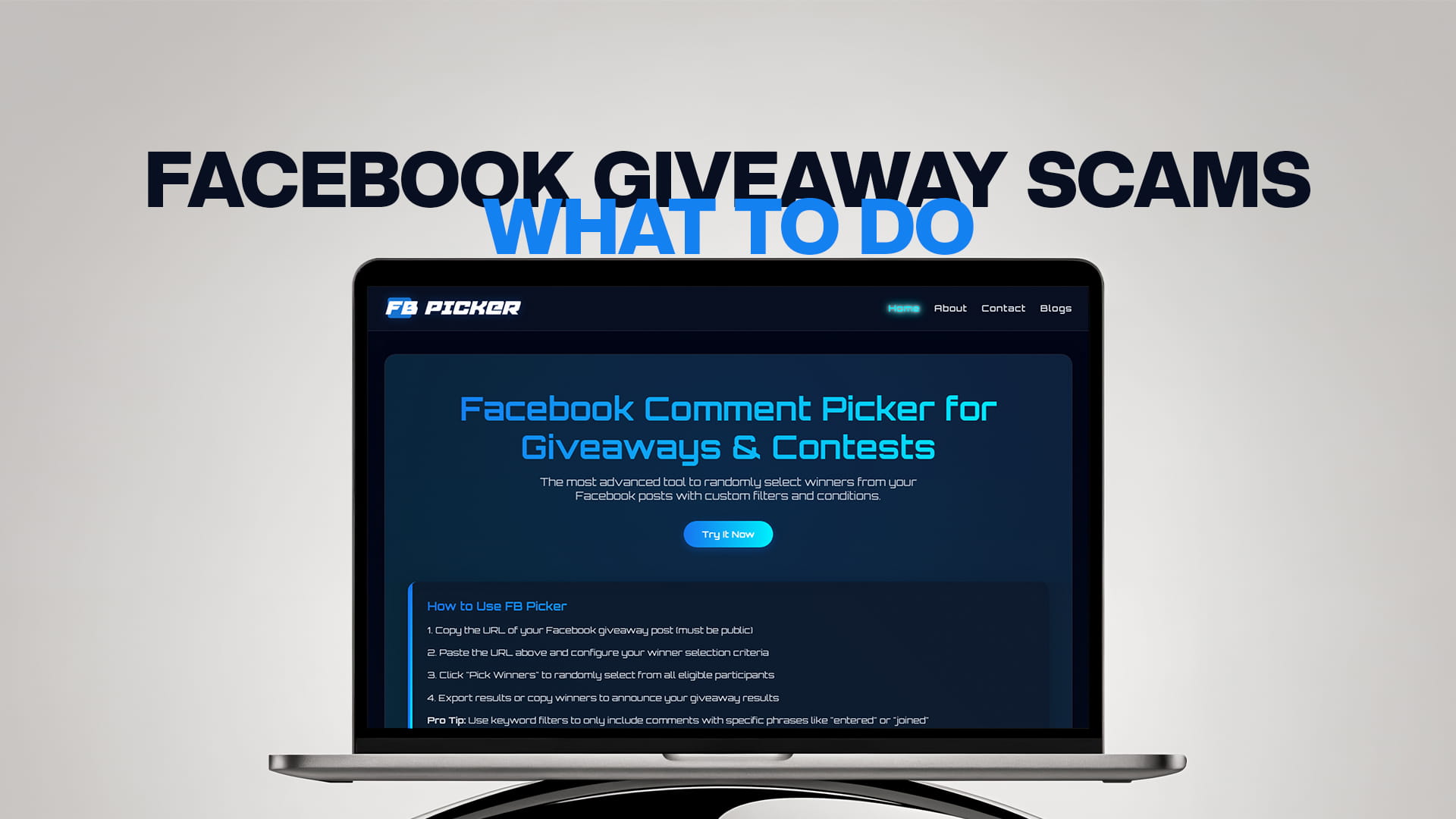
Facebook Giveaway Scams What to Do
Most advice about Facebook giveaway scams stops at "here's how to spot one." That's useful before anything happens, but it's cold comfort if you're reading this because a message just told you that you won a contest you don't remember entering, or worse. After all, you've already sent money to claim a "prize" and something feels wrong. This guide is for that moment: what to actually do when a giveaway scam is in front of you or has already caught you.
Giveaway and prize scams are among the most common frauds reported to authorities, and they're expensive. US consumers reported losing around $145 million to prize, sweepstakes, and lottery scams in 2024, and because fraud is badly underreported, the real figure is far higher. The good news is that quick, correct action can stop a scam in its tracks, and sometimes recover money that's already gone. This covers the immediate steps, how and where to report, whether you can get money back, and how to make sure it doesn't happen again. If you want the companion guide on identifying fakes before they reach this stage, our piece on spotting fake giveaway pages pairs with this one.
First: the test that settles almost everything
Before any of the steps below, run the one check that exposes nearly every giveaway scam in a single question: are you being asked to pay anything to claim a prize?
If yes, it's a scam. Full stop. Legitimate prizes are free. Nobody running a real giveaway will ever ask you to pay "taxes," "shipping," "processing," "customs," "insurance," or a "release fee" before sending your prize. Real sponsors don't collect money from winners, and in the US, any prize taxes are settled between you and the IRS at tax time, never wired to a company. The moment payment is requested, you have your answer, and you can stop engaging immediately.
The companion question closes the rest: did you actually enter this giveaway? If you have no memory of commenting on or entering the contest, you didn't win it, because you can't win something you never entered. A "congratulations" message for a contest you don't recognize is a scam with near-perfect reliability.
If either test flags, don't reply, don't click, don't pay. Move to the steps below.
If a scam message just reached you (no money lost yet)
You're in the best possible position: you've spotted it in time. Act to shut it down and protect yourself.
Don't engage. Don't reply, even to tell them off. A response confirms your account is active and real, which makes you a more valuable target and can invite more attempts.
Don't click any links. Scam "claim your prize" links lead to phishing pages that harvest your Facebook login or personal details, or to malware. Treat every link in an unexpected win message as hostile.
Screenshot it. Capture the message, the sender's profile, and the page or post it came from before anything gets deleted. You'll want this for reporting.
Report and block. Report the message and the page or profile to Facebook (more on how below), then block the sender so they can't reach you again.
Check the real brand. If the scam impersonated a business you actually follow, go to that brand's genuine page yourself, not through any link in the message, and see whether a real giveaway exists. Often you'll find the brand has already posted a warning about the exact scam.
Warn others if it's public. If it's a fake giveaway post rather than a private message, a quick comment or a share to your own network warning people is genuinely helpful, since these spread through exactly the people who trust you.
That's it. Spotted early, a giveaway scam is harmless, an attempt that failed, and your job is simply to close the door and flag it.
If you've already paid or shared information
This is the harder situation, but fast action still matters enormously, and people recover more often than they expect. Move quickly through these.
Contact your bank or payment provider immediately. This is the single most important step, and speed is everything. Call the bank, card issuer, or payment service you used and tell them you've been scammed. Ask them to stop, reverse, or dispute the transaction. Card payments and bank transfers can sometimes be halted or clawed back if you act fast enough, and the sooner you call, the better your odds.
If you paid by gift card, contact the card company now. Scammers love gift cards because they're hard to trace, but call the issuer (the brand on the card) immediately, report the fraud, and ask whether the funds can be frozen. Occasionally, if the card hasn't been drained yet, they can help.
If you wired money or sent crypto, still report it fast. These are the hardest to recover, but report to the service used regardless; some have fraud processes, and the report matters for the investigation even when recovery is unlikely.
If you shared your Facebook password, change it right now. Change it immediately, enable two-factor authentication, and check your account for unauthorized changes, posts, or messages sent in your name. A compromised account is often used to run the same scam against your friends.
If you shared personal data (address, date of birth, ID, bank details), protect against identity theft. Change relevant passwords, watch your accounts and statements closely, and consider a fraud alert or credit freeze with the credit bureaus in your country. Personal details harvested by scammers get resold and reused.
Keep every record. Save the messages, receipts, transaction references, and screenshots. You'll need them for your bank and for reporting, and they help authorities connect cases.
Acting within hours rather than days is the difference between a reversible transaction and a lost one, so make the calls before you do anything else, including finishing this article.
Where to report a Facebook giveaway scam
Reporting rarely gets you a personal refund, which is why people skip it, but it's how patterns get spotted and operations get shut down, and given how underreported this fraud is, each report genuinely counts.
Report to Facebook. Use the report option on the scam page, post, or message directly, so Meta can remove the fake and act on the account.
In the US: report to the FTC at ReportFraud.ftc.gov. If you lost money, also file with the FBI's Internet Crime Complaint Center at IC3.gov, and notify your state attorney general.
In the UK: report to Action Fraud (actionfraud.police.uk), the national fraud reporting centre.
In Canada: report to the Canadian Anti-Fraud Centre.
In Australia: report through Scamwatch, run by the ACCC.
Elsewhere: your national consumer protection agency or fraud reporting body is the equivalent stop.
If your bank was involved, report to them as fraud as well, both to pursue recovery and because it strengthens your case. And if the scam impersonated a specific brand, tell that brand too, so they can warn their audience and report the impersonator themselves.
Can you get your money back?
Honestly, it depends on how you paid and how fast you acted, so here's the realistic picture rather than false hope.
Card payments offer the best odds. Credit and debit cards have chargeback and dispute mechanisms, and if you report the fraud quickly, your bank may be able to reverse the charge. Bank transfers are harder but not hopeless, especially if you call before the money has moved on; some banks can recall a recent transfer or have fraud-reimbursement processes. Gift cards are difficult, but a fast call to the issuer occasionally freezes remaining funds. Wire transfers and cryptocurrency are the hardest to recover, which is exactly why scammers push for them.
The consistent theme is speed. Recovery odds drop sharply with every hour, so the single best thing you can do for your chances is contact your payment provider immediately, before the scammer moves the money and before it becomes someone else's problem to trace. And beware of a cruel second wave: "recovery scammers" target people who've already been scammed, promising to retrieve lost funds for an upfront fee. That's another scam. No legitimate service asks for money upfront to recover money you lost, so treat any such offer as fraud number two.
Protecting yourself (and your business) going forward
Once the immediate crisis is handled, a little defense prevents the next one.
As a potential target: internalize the two tests: real prizes are free, and you can't win what you didn't enter, because between them they defuse almost every giveaway scam instantly. Be skeptical of urgency; "claim in 24 hours!" exists to stop you thinking. Never pay to claim a prize, never share financial or ID details to "verify" a win, and never click links in unexpected win messages; go to the brand's real page yourself. And know that AI has made these scams look far more polished than the typo-ridden versions of a few years ago, so professionalism is no longer evidence of legitimacy.
As a business that runs giveaways: you're a target too, because scammers clone successful giveaways and impersonate the brands behind them, defrauding your audience in your name. Protect them by stating in every giveaway post exactly how you contact winners and that you'll never ask for payment, getting your page verified if you can, and announcing winners publicly on the original post rather than only in private messages. Run visible, recorded draws so your genuine giveaways are hard to imitate convincingly. FB Picker works from your public post URL with no login, removes duplicate entries, and selects the winner at random on screen so you can post the clip as proof, and you can pick multiple winners and export the entrant list in one pass. A giveaway that ends with a public, documented draw through a dependable free comment picker and giveaway tool gives your audience a real version to compare any fake against, and running every contest the same way with the best free Facebook comment picker makes your legitimacy the easy thing to verify.
The bottom line
If a Facebook giveaway scam reaches you, the response depends on where you are in it. Spotted early, no money lost: don't engage, don't click, screenshot, report, and block, and it's a failed attempt, nothing more. Already paid or shared details: move fast, contact your bank or payment provider immediately (speed is everything for recovery), change any exposed passwords, protect against identity theft, keep records, and report to Facebook and your national fraud body. Recovery is realistic for card payments caught quickly, and harder the further you go toward wires and crypto, and beware recovery scammers who prey on victims a second time. Above all, carry the two tests with you: real prizes are free, and you can't win what you didn't enter, because those two sentences stop nearly every giveaway scam before it can cost you anything at all.
Frequently Asked Questions
Almost certainly, yes. You can't win a giveaway you never entered, so a "congratulations" for a contest you don't recognize is a classic scam. Don't reply or click any links, and if it asks you to pay anything to claim the prize, that confirms it, real prizes are always free.
Contact your bank or payment provider immediately and ask them to stop, reverse, or dispute the transaction; speed is critical for recovery. Change any passwords you shared, watch for identity theft if you gave personal details, keep all records, and report the scam to Facebook and your national fraud body (in the US, the FTC and IC3.gov).
It depends on how you paid and how fast you act. Card payments have the best odds through chargebacks; bank transfers are harder but sometimes recoverable if caught quickly; gift cards, wires, and crypto are the hardest. Contact your payment provider immediately; recovery odds fall with every hour, and beware "recovery services" that charge upfront, which are a second scam.
Report the page, post, or message to Facebook directly. In the US, file with the FTC at ReportFraud.ftc.gov and, if money was lost, IC3.gov and your state attorney general. In the UK, Action Fraud; in Canada, the Canadian Anti-Fraud Centre; in Australia, Scamwatch. Reports rarely bring a personal refund but help shut operations down.
State in every giveaway post how you contact winners and that you'll never ask for payment, get your page verified, and announce winners publicly on the original post. Run visible, recorded random draws so your genuine giveaways are hard to fake, and warn your audience promptly if an impersonator appears, with instructions on identifying your real account.