
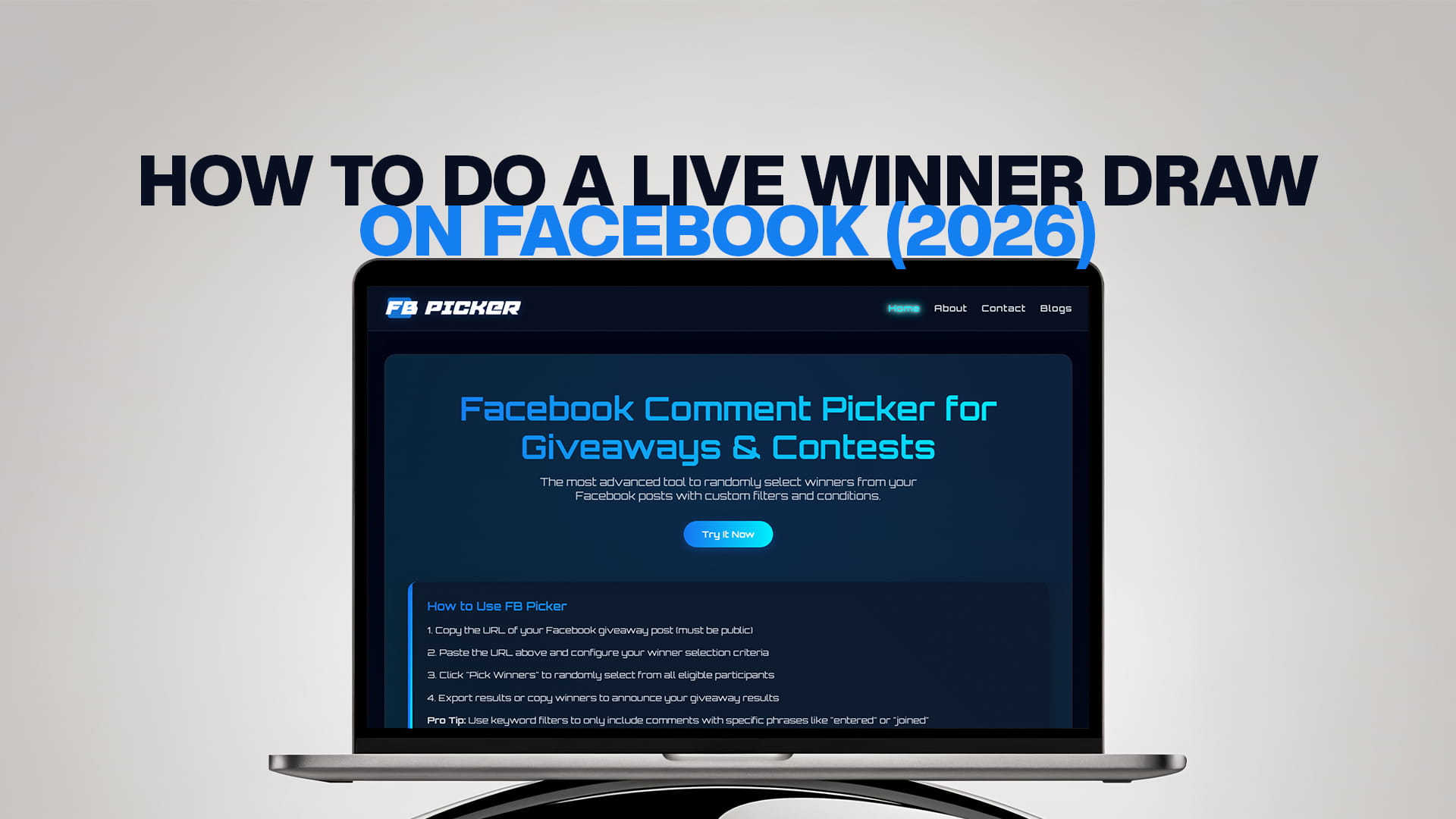
How to Do a Live Winner Draw on Facebook (2026)
A live draw is the strongest proof of fairness a giveaway can offer. A recorded draw is excellent, but a skeptic can always mutter that you did ten takes and posted the one you liked. A live draw removes even that: your audience watches the comments load, watches the filters apply, and watches the name appear, all in real time, with no possibility of a retake. Nothing else you can do builds trust faster.
It's also an event. People show up, comment, react, and stay, which means the draw itself becomes a second engagement moment rather than a quiet administrative task. The trade-off is that live has no undo button, so it rewards preparation and punishes winging it. This guide covers the setup, exactly how to run the draw on camera, how to handle the things that go wrong, and one crucial platform rule that catches almost everyone: your live video won't stay on Facebook forever, and if you're not careful, your proof of fairness will quietly disappear.
The 30-day catch nobody warns you about
Start here, because it undermines the entire point of a live draw if you miss it. Since February 19, 2025, Facebook stores live videos for only 30 days. After that, they're automatically deleted. This changed a long-standing policy under which live videos were kept indefinitely, and Meta's stated reasoning is that most live views happen in the first few weeks, so long-term storage no longer made sense.
Think about what that means for a giveaway. You go live, run a beautiful transparent draw, and post it as your evidence. Thirty-one days later, that evidence is gone. If a dispute surfaces two months on, or a new entrant asks whether your draws are legit, or you simply want to point to your track record, the video isn't there. The most persuasive proof you ever created has evaporated on a timer.
The fix takes two minutes, and you should treat it as part of the draw itself, not an optional extra:
Download the video immediately. Right after the stream ends, download it from the Videos or Live tab on your Page, or through Meta Business Suite. Keep it in your own storage where no policy change can touch it.
Clip it into a reel. Facebook lets you cut a shorter moment from a live video and share it as a reel, and reels aren't subject to the 30-day live deletion, so they stay on your Page. Clipping the ten seconds where the winner is selected gives your proof a permanent home in public.
Re-upload the key portion as a normal video post. A regular uploaded video isn't a "live video" for storage purposes, so posting the saved draw as an ordinary video preserves it on your Page indefinitely.
Do at least the download every single time. Do the clip or re-upload whenever the giveaway matters. A live draw you didn't save is proof with an expiry date.
Before you go live: the prep checklist
Live is unforgiving, so front-load the work.
Announce the time in advance. Tell people when you'll draw, in the original giveaway post, in a reminder, and in Stories. A live draw nobody watches is just a recording with extra risk, and the audience is the whole point.
Close entries first, and say so. Your entry window should end before the stream begins, not during it. Announce "entries closed at 8 pm, drawing live at 8:30" so nobody argues that late comments should have counted.
Have the post URL ready. Copy your giveaway post's link and have it on your clipboard or in a notes app before you start. Fumbling for the link on camera is the single most common way a live draw looks amateurish.
Confirm the post is public. A URL-based picker reads public comments; if the post's audience is restricted, the tool won't load them, and discovering that live is a bad time to discover it.
Do a dry run off-camera. Run the exact draw privately an hour earlier, not to see the winner, but to confirm the comments load, your filters behave, and you know where every button is. Then refresh and do it for real on stream.
Check the boring things. Battery, signal or wifi, notifications silenced, a lit room, and a stable phone. Nothing tanks a trust-building event like a stream that drops halfway through the reveal.
Setting up the stream
You have two workable approaches, and the right one depends on what you want people to see.
Phone, screen-recording style. Go live from the Facebook app and use your device's screen sharing so viewers watch your actual screen as you paste the URL and run the draw. This is the most transparent option because there's no gap between what you see and what they see.
Desktop with streaming software. Using a tool like Meta's Live Producer or third-party streaming software, you can share your screen while your webcam sits in a corner. This is the more polished setup: viewers see both your face and the draw, which is warmer and more convincing than a disembodied screen.
The simplest version. Point your phone at your laptop screen while you run the draw. It looks low-fi, but honestly, low-fi reads as authentic here; nobody suspects a shaky handheld shot of a laptop of being staged.
Whichever you choose, the requirement is the same: the audience must be able to see the comments and the selection, not just your reaction to them. A live stream of your face saying "and the winner is..." proves nothing at all.
Running the draw on camera
Here's the sequence that works, and the reasoning behind each step.
Open by restating the giveaway. What the prize is, when entries closed, how many people entered, and how the winner will be chosen. Thirty seconds of context orients everyone who just arrived.
Show the original post and its comments. Scroll the real thread on camera. This is what proves the entry pool is genuine rather than a list you typed up beforehand.
Paste the URL and load the comments live. Let people watch the tool ingest the actual comments. FB Picker suits this well because it works straight from a public post URL with no login, so there's no sign-in screen to fumble through or account details to accidentally expose on stream.
Apply your filters out loud. "I'm removing duplicate commenters so nobody gets extra chances by posting twenty times, and filtering for the keyword we asked for." Narrating the filters shows you're enforcing your own published rules rather than improvising.
Run the draw without cutting away. Press the button and let it play. The unbroken moment between the full comment pool and the winner's name appearing is the entire value of doing this live. It selects the winner at random while everyone watches, which is a claim no recorded video can make quite as strongly.
Draw your backups in the same session. Announce that you're also selecting one or two backup winners in case the first doesn't claim. Because you can pick multiple winners in a single pass, the backup is chosen by the same random process, on the same stream, which means if you ever need to promote them, nobody can suggest the replacement was hand-picked.
Congratulate, then explain the next step. Name the winner, restate the claim window from your rules, and tell them to expect a message. Then thank everyone who entered and give them their consolation offer while they're still watching; this is the highest-attention moment your giveaway will ever have.
When things go wrong live
They will, occasionally. Plan the responses now so you're not improvising on camera.
The stream drops. Go live again and resume. Explain what happened, and if the draw hadn't run yet, run it fresh. Don't quietly draw off-camera during the outage and come back with a name; that's exactly the gap suspicion lives in.
The comments won't load. Almost always because the post isn't public or you pasted the wrong link. Say so plainly, fix it, and carry on. Visible troubleshooting is far less damaging than a mysterious pause.
The winner is obviously a bot. This is why you narrate your rules up front. If the drawn account has no photo, no history, and twenty identical comments, say "this account doesn't meet our eligibility rules, so I'm drawing again" and redraw on camera. Handling it transparently in real time is actually a trust win, not a loss, as long as you're applying a rule you stated rather than a preference you invented.
Almost nobody is watching. Run it anyway. The recording, saved properly, still does the work, and consistency matters more than any single stream's viewer count.
After the stream
The draw isn't finished when the stream ends. Save the video, as covered above, download it, and clip or re-upload the key moment so it survives past 30 days. Post a written announcement too, since plenty of your audience won't watch a replay but will read a post; include the winner, the proof clip, the claim deadline, the thank-you, and the consolation offer. Message the winner. Pin the announcement. And keep an export of your entrant list alongside the video, since the two together are a complete record of a giveaway run honestly, which is exactly what you want on file if anyone ever asks. Running every contest through the same random comment picker for giveaways workflow keeps those records consistent from one draw to the next.
Is live always worth it?
Honestly, no. Live draws take preparation, carry real risk, and demand an audience willing to show up at a specific time. For a small monthly giveaway, a recorded draw posted with the announcement delivers nearly all the trust for a fraction of the effort.
Save the live treatment for the moments that earn it: high-value prizes, milestone giveaways, contests where the audience is large or unusually invested, or any situation where trust has been questioned before. Used selectively, a live draw is a statement. Used for everything, it becomes a chore you'll eventually skip, and an abandoned habit is worse than a modest one you actually keep. A quick recorded draw through the best free Facebook comment picker is the sustainable default; live is the special occasion.
The bottom line
A live winner draw is the most convincing fairness proof available, because there's no edit, no retake, and no gap between the comment pool and the reveal. Prepare properly, announce the time, close entries first, have the URL ready, test off-camera, then run it on stream showing the real comments, the filters, and the uncut selection. Handle problems out loud rather than off-screen. And whatever you do, remember that Facebook now deletes live videos after 30 days, so download the stream and clip the key moment into a reel or a normal video post the same day. A live draw is powerful precisely because it can be watched, so make sure it can still be watched next year.
Frequently Asked Questions
Announce the time in advance, close entries before you start, then go live sharing your screen. Show the real comment thread, paste your post URL into a comment picker so viewers watch the comments load, narrate the filters you apply, and run the random selection without cutting away. Draw backups in the same session and announce the claim deadline.
Yes. Since February 19, 2025, Facebook stores live videos for 30 days and then deletes them automatically, a change from the previous policy of storing them indefinitely. Download your draw immediately after streaming, and clip the key moment into a reel or re-upload it as a regular video so your proof survives past the 30-day window.
It's stronger proof, since there's no possibility of retakes, but it's also more work and riskier. A recorded draw posted with your announcement delivers most of the trust benefit for far less effort. Save live draws for high-value prizes, milestones, large or invested audiences, or when your fairness has been questioned before.
The real comment thread on your original post, the comments loading into your picker, the filters you apply (like duplicate removal), and the uncut moment of selection. A stream showing only your face announcing a name proves nothing, viewers need to see the pool and the process, not just the result.
State your eligibility rules at the start, then if the drawn account clearly breaches them, say so on camera and redraw immediately. Handling it transparently in real time builds trust, as long as you're enforcing a rule you announced rather than a preference invented on the spot.