
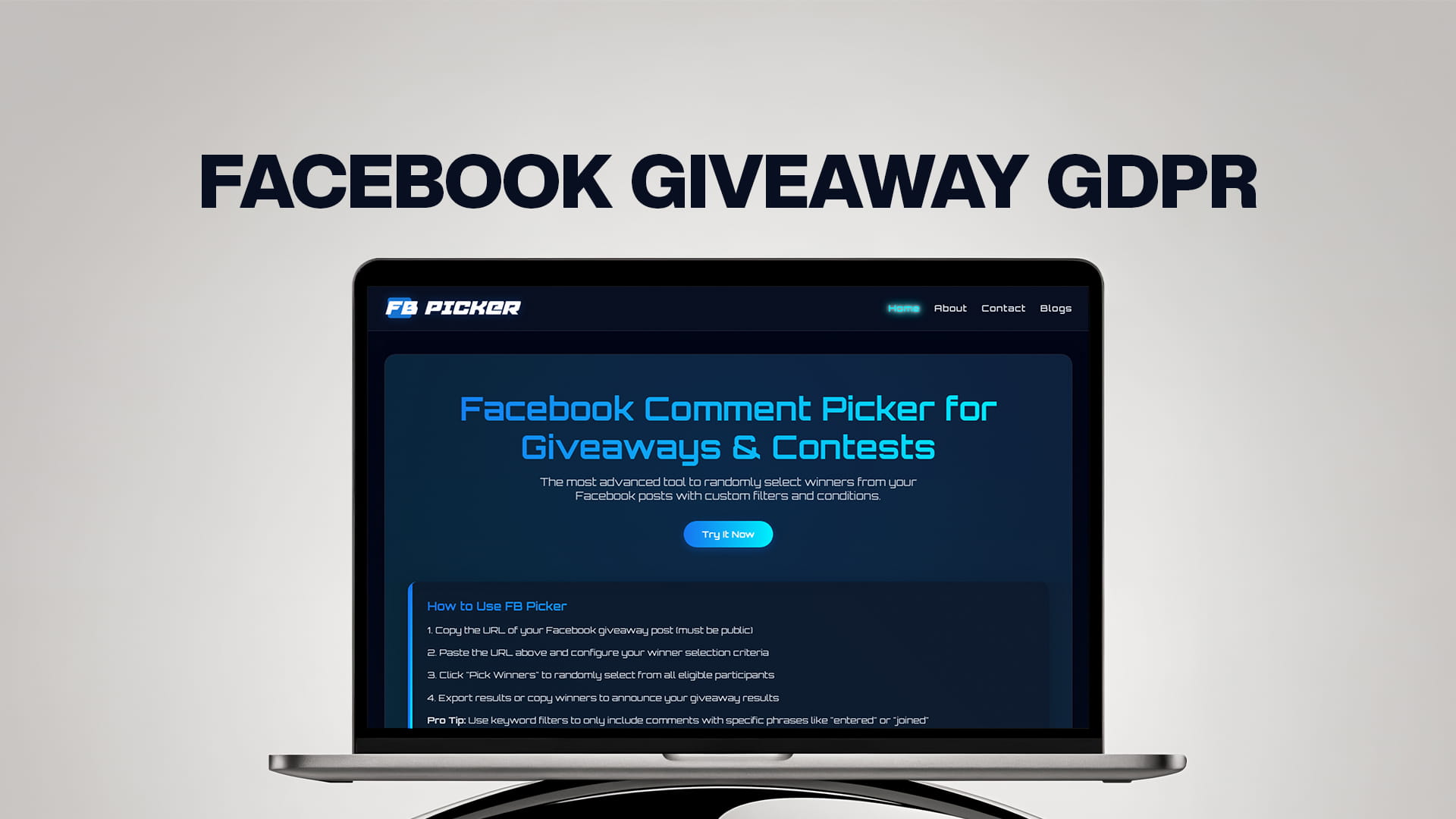
Facebook giveaway GDPR
There's a version of the giveaway that data protection regulators genuinely dislike, and a lot of brands are still running it. It goes: enter our prize draw by giving us your email address, and by entering you agree to receive our newsletter. Two things get bundled into one action, the entry and the marketing sign-up, and under GDPR that bundle is the problem, because consent obtained that way generally isn't valid.
The good news is that most Facebook giveaways are far simpler than that and carry a much lighter compliance load than the horror stories suggest. A comment-to-win contest on a public post involves very little personal data compared with a form-based campaign feeding an email list. This guide separates those two cases clearly, explains what GDPR actually requires at each level, covers retention and entrant exports (the bit people forget), and flags what changed in 2026, because the UK has diverged from the EU in ways that matter if your audience includes British entrants.
This is general information, not legal advice. Data protection obligations depend on your specific processing, so for a significant campaign or anything unusual, take proper advice.
Does GDPR even apply to your giveaway?
Yes, if you're processing the personal data of people in the EU or UK, and it applies regardless of where your business is based. A US company running a giveaway open to European entrants is processing their personal data and is within scope. Geography of the business doesn't determine it; geography of the entrants does.
What varies enormously is how much GDPR asks of you, and that depends on what data you actually collect.
Comment-based giveaways are light-touch. When someone comments on your public Facebook post to enter, you're processing minimal personal data, essentially their public profile name and their comment. You're not collecting an email address, you're not building a database at entry stage, and Facebook is doing most of the heavy lifting as the platform. Your obligations exist but are modest: be transparent about what you're doing, don't misuse the data, and don't retain it longer than you need.
Form-based giveaways are where it gets serious. The moment you ask entrants to submit an email address, name, phone number, or postal address through a form or landing page, you're a controller collecting personal data directly, and the full apparatus applies: a lawful basis, a privacy notice, data minimisation, retention limits, security, and the ability to honour data subject rights.
Knowing which one you're running tells you how much of the rest of this article applies to you. Most Facebook comment giveaways sit firmly in the first camp, which is a genuine advantage of the format.
The consent rule that catches everyone
This is the single most important thing to get right, and it's where most non-compliant giveaways go wrong.
Under GDPR, consent must be freely given, specific, informed, and unambiguous, and given through a clear affirmative action. Pre-ticked boxes don't work. Opt-out doesn't work. And, critically, consent generally isn't "freely given" if refusing it means you can't access something you'd otherwise be entitled to.
Applied to giveaways, that means: entering the giveaway and signing up for marketing must be two separate decisions. An entrant must be able to enter your prize draw without consenting to receive your newsletter. If marketing consent is a condition of entry, that consent is very likely invalid, which means the entire list you built is legally shaky.
The practical implementation is simple. On your entry form, have one action for entering and a separate, optional, unticked checkbox for marketing consent, with clear wording about what they'd be signing up for. People who tick it are on your list legitimately. People who don't still get to enter.
The UK's Information Commissioner's Office has been notably unenthusiastic about using prize draws as a list-building mechanism precisely because of this dynamic, with the guidance being that people should be able to access the incentive without being automatically enrolled in ongoing marketing. You can still grow a list through giveaways, you just have to do it with genuine, separate, optional consent, which incidentally produces a better list, since everyone on it actually wanted to be there.
Data minimisation: collect less than you think
GDPR requires you to collect only what's necessary for the stated purpose, and giveaways are a classic over-collection scenario because the entry form feels like a free opportunity to gather data.
For most giveaways, a name and an email address are sufficient at entry stage. You do not need a postal address from every entrant, you need it from the winner, once, after the draw. You don't need a date of birth unless age eligibility genuinely requires verification. You certainly don't need a phone number "for marketing purposes" collected under the guise of prize fulfilment.
The staged approach is both compliant and practical: collect the minimum to run the draw, then collect fulfilment details from the winner alone once they're selected. That means you're holding delivery addresses for one person rather than two thousand, which is less risk, less storage, and less to delete later.
Retention: the part everyone forgets
Personal data can only be kept as long as necessary for the purpose you collected it for. Once your giveaway is over and the prize is delivered, the clock is running on your entrant data.
There's no universal number, but the guidance commonly points toward keeping promotion data only for a reasonable period after the promotion ends, with around three months after the close of the campaign frequently cited as a sensible benchmark, sufficient to handle prize fulfilment, disputes, and any regulatory query, after which the data should be deleted or anonymised. The exception is data you hold under a separate lawful basis, such as email addresses of people who gave genuine, optional marketing consent, which you keep under that consent rather than under the giveaway.
Set a deletion date when you launch, note it in your privacy notice, and actually delete. "We'll get round to it" is how organizations end up holding entrant lists from 2019.
Your entrant export is personal data
Here's a specific point relevant to anyone running comment giveaways, and it's routinely overlooked.
When you export an entrant list from a comment picker, that spreadsheet of names is personal data, and it's now sitting in your files under your control. Everything above applies to it: keep it because you have a reason to (evidencing a fair draw, handling a dispute), keep it only as long as that reason lasts, store it somewhere reasonably secure rather than a shared drive anyone can browse, and delete it when the retention period expires.
That's not an argument against exporting; the export is genuinely valuable as proof that your draw was fair and complete, and it's what lets you answer questions about eligibility later. It's an argument for treating the file deliberately: know why you have it, where it lives, and when it goes. A clean export from a FB Picker, which works from your public post URL and lets you export the entrant and winner lists after it selects the winner at random, gives you exactly the record you need, and the discipline is simply to schedule its deletion alongside the rest of your campaign data.
Transparency: tell people what you're doing
Whatever you collect, entrants need to know what's happening to it before they hand it over. Your privacy notice, linked from the entry point, should cover who you are, what data you collect, why, the lawful basis, who else receives it (including any third-party tools or processors you use, named), how long you keep it, and what rights entrants have.
Your giveaway terms should reference this rather than duplicate it, and should be clear that winners may be announced publicly, since that's a use of their name people should know about in advance.
On rights, entrants can ask for access to their data, correction, and erasure, and after the giveaway ends there's rarely a good reason to refuse a deletion request. Have a route for people to make one and a person who handles it.
What changed in 2026
Two developments worth knowing if you're running promotions across the EU and UK.
The UK has diverged further. Following changes to UK data protection law in 2025, with provisions taking effect in early 2026, UK GDPR now sits meaningfully apart from EU GDPR. Changes include new categories of "recognised legitimate interests" that skip the usual balancing test, relaxed rules around automated decision-making, broader cookie exemptions for low-risk situations, and substantially increased penalties for cookie and electronic marketing violations, reportedly up to £17.5 million or 4% of global turnover. If your promotions reach UK entrants, the ICO's updated guidance is the reference point rather than assuming EU rules apply identically.
EU reform is being debated but hasn't landed. Proposals under discussion include a narrower definition of personal data, simplified record-keeping obligations for smaller companies, and revised cookie consent rules. A final version isn't expected before late 2026 at the earliest, so nothing has changed in practice yet, but it's worth watching if you run frequent campaigns.
The practical takeaway is that "GDPR compliance" is no longer one target if you operate in both markets. The core principles, lawful basis, minimisation, transparency, retention, still align closely, but the details increasingly don't.
Member state rules sit on top
One more layer worth flagging: GDPR is EU-wide, but individual member states have their own promotion and competition regulations that apply alongside it. Germany's promotional practices are shaped by its unfair competition law, and several countries have specific requirements around prize draws that go beyond data protection. If you're running an EU-wide giveaway, data protection compliance doesn't automatically mean promotional compliance, and vice versa.
A practical compliance checklist
For a standard Facebook comment giveaway: publish clear rules, state that winners may be announced publicly, don't require marketing sign-up to enter, collect winner fulfilment details only from the winner, treat your entrant export as personal data with a deletion date, and link a privacy notice.
For a form-based giveaway, add: a separate optional marketing consent checkbox (unticked), a stated lawful basis, a privacy notice at the point of collection naming any processors, data minimisation at entry stage, a defined retention period, a security review of wherever the data lands, and a documented route for handling access and erasure requests.
For either, run the draw itself in a way that doesn't create additional data exposure, which a URL-based picker handles naturally since it works from public comments rather than requiring you to build a database. Drawing backups in the same pass, using the option to pick multiple winners, also means you avoid collecting fulfilment details from a second person unless the first winner actually forfeits. Running each contest through the same random comment picker for giveaways workflow keeps both your fairness evidence and your data footprint consistent.
The bottom line
GDPR doesn't make Facebook giveaways impractical; it makes one specific popular tactic, bundling marketing sign-up into entry, unusable, and asks you to be deliberate about everything else. Entrants must be able to enter without consenting to marketing, which means separate, optional, unticked consent. Collect only what you need, and collect fulfilment details from the winner rather than everyone. Tell people what you're doing through an accessible privacy notice. Set a retention period and honour it, including for the entrant export sitting in your files, which is personal data like anything else. And if your audience spans the EU and UK, note that the two regimes diverged further in 2026, so check the ICO's current guidance for British entrants rather than assuming one rulebook. Do that, keep your draw clean and documented with a dependable free comment picker and giveaway tool, and a comment giveaway is one of the lowest-risk promotions you can run.
Frequently Asked Questions
Generally no, not under GDPR. Consent must be freely given, and it usually isn't if refusing means you can't enter. Entry and marketing sign-up must be separate decisions: let people enter without consenting, and offer marketing as an optional, unticked checkbox. Consent obtained by bundling is very likely invalid.
It applies if entrants are in the EU or UK, but the burden is light because you're processing minimal data, essentially public profile names and comments, rather than collecting personal data through a form. Be transparent, don't misuse the data, and don't retain entrant exports longer than necessary. Form-based giveaways carry much heavier obligations.
Only as long as necessary for the purpose. There's no fixed figure, but around three months after the promotion closes is a commonly cited reasonable benchmark, enough to cover fulfilment, disputes, and queries, after which data should be deleted or anonymised. Data held under separate valid marketing consent is kept under that consent instead.
Yes. An exported list of entrant names is personal data under your control, so the usual rules apply: have a reason to hold it (evidencing a fair draw), store it securely, and delete it when that reason expires. Keep exporting them; they're valuable proof, just schedule their deletion with the rest of your campaign data.
For the UK, yes. Changes to UK data protection law in 2025 took effect in early 2026, diverging further from EU GDPR, with new "recognised legitimate interests," relaxed automated decision-making rules, broader cookie exemptions, and much higher penalties for cookie and marketing violations. EU-level reform proposals are still being debated, with nothing finalised, so EU rules are unchanged in practice.