
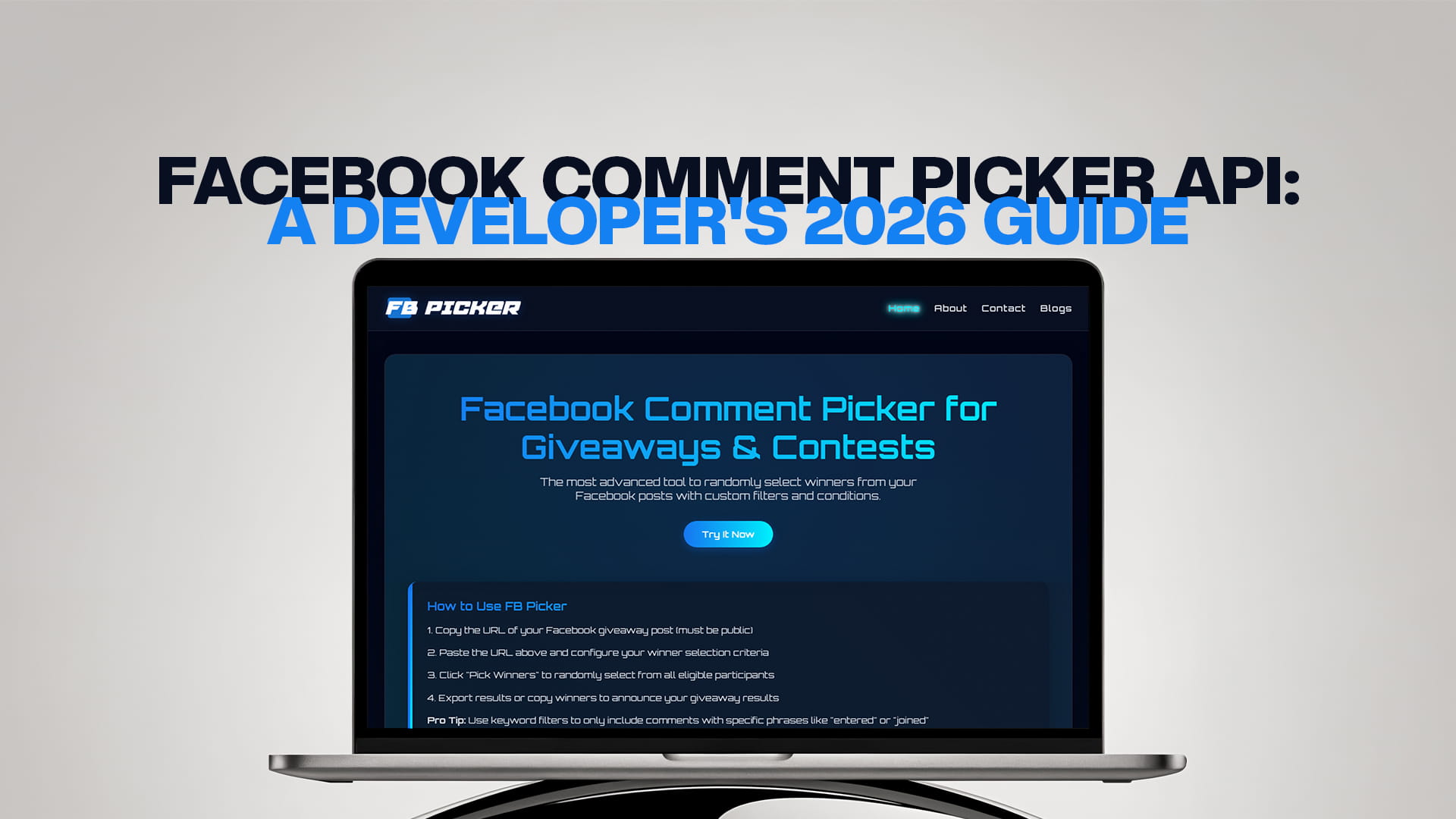
Facebook Comment Picker API: A Developer's 2026 Guide
If you're planning to build a comment picker, the architecture looks trivial from a distance: fetch the comments on a post, de-duplicate them, pick a random element, return it. Three lines of pseudocode. The reality is that almost all of the difficulty lives in the first step and the third, and both are more constrained than they appear. Getting comments out of Facebook programmatically means navigating App Review, permission scopes, and an API version-deprecation treadmill. Picking "a random element" correctly means not using the random function you reach for by default.
This guide covers what Meta's Graph API actually permits in 2026, the permissions and review process you'll hit, the endpoint and pagination mechanics, how to implement randomness that's genuinely defensible, and, importantly, an honest assessment of when building this yourself is the wrong call. It assumes you're comfortable with REST APIs and OAuth-style token flows.
What the Graph API allows, and what it doesn't
Start with the constraint that determines your whole project: whose posts do you need to read?
Your own Page's posts are the straightforward case. With a Page access token and the appropriate permissions, you can read comments on posts published by a Page you manage. This is the well-trodden path and the one Meta's documentation is written for.
Public posts on Pages you don't own are the hard case. This requires App Review and approval for Page Public Content Access, which Meta grants selectively based on your use case. Without it, you cannot programmatically read third-party Pages' public content, even though a human can see it in a browser.
Personal profile posts are essentially off the table. Meta's own documentation is explicit that access to User objects is restricted to the user who owns them, and notes that if another person comments on your post, you generally will not be able to retrieve that comment or who published it through the API. Don't architect around personal profiles.
That triage matters because a lot of would-be comment-picker projects assume the middle case is as easy as the first. It isn't, and discovering that after you've built the rest of the system is an expensive surprise.
Permissions and App Review
Practically, you'll be assembling a few things.
Create a Meta app in the developer dashboard with the relevant use case configured. For reading engagement on Pages you manage, you'll be looking at permissions in the pages_read_engagement family, obtained through a user authorization flow that then yields a Page access token. Different endpoints require different permissions, and Meta's guidance is to request the minimum set your feature actually needs, both because review is easier and because over-scoped apps are a liability.
For anything touching third-party public content, budget real time for App Review. You'll need to demonstrate a legitimate use case, provide a working demo, and often supply a screencast showing the exact flow that consumes the permission. Approval is not guaranteed, and "we want to run giveaways" may or may not clear the bar depending on how you present it and what you're building.
If your product is intended for other people's Pages, this is the single biggest risk in your project plan, and it's worth resolving before you write meaningful code.
The endpoint mechanics
Once you have access, the fetch itself is unremarkable.
You'll request the comments edge on a post node, specifying the fields you need rather than accepting defaults, and paginate through results. Comment threads of any size will be paginated, so handle cursors properly and don't assume a single response contains everything. Decide early whether replies count as entries, since nested replies come through a separate edge on each comment and doubling your request volume for data you'll discard is wasteful.
Two version-management realities to build around, both current as of 2026. Graph API versions expire on a published schedule: v18.0 expired January 26, 2026, and v19.0 expired May 21, 2026. Any integration you ship needs an owner and a calendar reminder, because a version reaching end of life will break your production calls. Separately, the metadata=1 introspection parameter that developers long used to discover available fields on a node was removed across every Graph API version on May 19, 2026, so field discovery now means reading the reference documentation rather than querying the API for its own shape. If you learned this API a few years ago, both of those will bite you.
Also plan for rate limits from the start rather than as a later optimization. Cache responses where you can, back off on errors rather than retrying tightly, and handle error codes explicitly, since Meta's error responses distinguish between transient and permanent failures in ways that matter for retry logic.
Randomness: the part most implementations get wrong
Here's where a comment picker stops being a CRUD exercise and starts being something you can be held to.
Don't use your language's default pseudo-random function for winner selection. Math.random() in JavaScript and random.random() in Python are not cryptographically secure. They're seeded predictably; they're not designed to resist prediction, and if anyone ever seriously audits or challenges a draw, "we used Math.random" is a weak answer. This isn't theoretical pedantry; it's the difference between a draw you can defend and one you can only assert.
Use the cryptographically secure primitives instead: crypto.randomInt() in Node.js, crypto.getRandomValues() in browsers, secrets.choice() or secrets.randbelow() in Python, crypto/rand in Go. They're a drop-in change in almost every case, and they cost nothing.
Avoid modulo bias. The naive random_bytes % list_length introduces a slight bias toward lower indices when the range doesn't divide evenly into the random space. The secure helpers above generally handle this for you, which is another reason to prefer them over hand-rolling from raw bytes.
Consider a verifiable seed if the stakes justify it. For high-value or contestable draws, the stronger pattern is a commit-reveal scheme: before the draw, publish a hash of a secret seed; after the draw, publish the seed itself so anyone can re-run your selection algorithm and confirm the result. Because the published hash can't be altered after the fact, this proves the outcome was fixed before it was revealed. This is what "provably fair" means in its strict sense, and it's genuinely worth implementing if you're building a picker other people will rely on. It's overkill for an internal tool.
Make de-duplication a deliberate decision. Decide whether uniqueness is by user ID (robust) or display name (fragile, since names collide), whether one person commenting five times gets one entry or five, and whether keyword or tag filters apply before or after de-duplication. Then document it, because these choices change who wins and users will eventually ask.
Auditability and records
If your picker will be used for real promotions, treat the audit trail as a feature rather than an afterthought.
Persist the entry pool as it existed at draw time, since the live post keeps changing and "we drew from the comments" is unverifiable a week later. Log the filters applied, the timestamp, the pool size, and the selected index alongside the winner. Expose an export so users can keep their own records, which is what they'll need if a result is disputed or if a jurisdiction expects them to show a fair draw. And if you implement a verifiable seed, expose a verification endpoint or page so the proof is usable by non-developers rather than theoretical.
This is also the part that distinguishes a serious tool from a toy. The randomness is easy; the demonstrability is what makes it trustworthy.
When not to build this
An honest engineering assessment: for most people who search for a comment picker API, building one is the wrong call.
If your goal is simply to run giveaways, even a lot of them, you'd be spending App Review cycles, implementing secure randomness and de-duplication correctly, building pagination, exports, and a recording workflow, and then maintaining all of it against an API whose versions expire twice a year, to replicate something that already exists and costs nothing. The engineering time alone dwarfs any plausible saving, and you inherit permanent maintenance.
The genuine reasons to build are narrow: you need the draw embedded inside a larger product you're shipping, you have a compliance mandate that entrant data cannot leave a controlled environment, or the picker itself is the product you're selling. If none of those apply, you're building infrastructure to avoid pasting a URL.
For the run-giveaways case, a URL-based tool skips the entire stack. FB Picker reads a public post's comments from its URL with no app, no token, and no App Review, de-duplicates entries, and selects the winner at random using a cryptographically secure method, with an on-screen draw you can record and an exportable entrant list. You can pick multiple winners and backups in one pass. That's the same output your build would produce, available immediately, which makes it the sensible baseline to beat before committing engineering time. If you want to see what the finished workflow looks like before deciding, the free comment picker and giveaway tool route takes about a minute end to end.
One note in the interest of accuracy: this guide covers building against Meta's Graph API. I'm not aware of a documented public API offered by FB Picker itself, so if you specifically need programmatic access to a hosted picker rather than building on Graph API, contact the provider directly to confirm what's available rather than assuming an endpoint exists.
The bottom line
Building a Facebook comment picker is less about the picking and more about the access. Establish first whose posts you need: your own Pages are straightforward, third-party public Pages require App Review and Page Public Content Access that may not be granted, and personal profiles are effectively closed. Then build for the realities of the platform, paginate properly, plan for version expiry (v18.0 and v19.0 both reached end of life in 2026), and note that metadata=1 field introspection was removed in May 2026. Get the randomness right by using cryptographically secure primitives rather than default PRNGs, avoid modulo bias, and consider a commit-reveal seed if your draws need to be provably fair. Treat the audit trail, the frozen entry pool, the logged filters, the exports, as a core feature. And be honest about whether you need to build at all, because for the common case of simply running giveaways, a random comment picker for giveaways that works from a URL delivers the same result today with none of the maintenance.
Frequently Asked Questions
Yes, with caveats. Reading comments on posts from a Page you manage is straightforward with a Page access token and appropriate permissions. Reading public posts on Pages you don't own requires App Review and approval for Page Public Content Access, which Meta grants selectively. Personal profile posts are effectively inaccessible.
Always use the current version and build a maintenance plan, because versions expire on a schedule. v18.0 expired January 26, 2026, and v19.0 expired May 21, 2026, so pinned code eventually breaks. Also note that the metadata=1 field-introspection parameter was removed across all versions in May 2026, so use the reference docs for field discovery.
No. Math.random() and Python's random.random() are not cryptographically secure and aren't designed to resist prediction, which makes a draw hard to defend if challenged. Use secure primitives instead: crypto.randomInt() in Node, secrets in Python, crypto/rand in Go, and be careful to avoid modulo bias when mapping bytes to an index.
Use a commit-reveal scheme: publish a hash of a secret seed before the draw, then publish the seed afterward so anyone can re-run your selection algorithm and verify the result. Because the hash can't be changed after the commitment, it proves the outcome was determined before it was revealed. Expose a verification page so non-developers can use the proof.
Build only if the draw must be embedded in a product you ship, you have a compliance mandate keeping entrant data in a controlled environment, or the picker is the product. Otherwise, you're spending App Review cycles and permanent maintenance to replicate a free tool. For simply running giveaways, a URL-based picker gives the same output with no app, token, or review.