
Best Time to Post a Facebook Giveaway
Timing is one of the most underrated levers in a Facebook giveaway. The Facebook algorithm rewards early momentum, so the first hour or two after you post largely determines how far the contest travels. Publish when your audience is asleep or busy, and even a brilliant prize gets buried before anyone sees it. Publish at a peak window, and the same post can snowball as early likes and comments signal to Facebook that your content deserves a wider audience.
So when should you actually hit publish? This guide pulls together what large-scale 2026 research says about the best times to post on Facebook, then adapts it specifically for giveaways, where you care not just about reach but about driving entries fast and timing your close for maximum visibility.
Why Timing Matters More for Giveaways
A normal post benefits from good timing; a giveaway depends on it. There are three reasons.
First, momentum compounds. Giveaways are engagement machines, and Facebook's algorithm shows engaging posts to more people. A burst of early comments tells the platform your post is worth distributing, so the entries you collect in the first hour help you collect far more over the following days.
Second, the entry window is finite. Unlike an evergreen post, a giveaway has a deadline. Every hour your post spends in front of an inactive audience is an hour of lost entries you can't recover.
Third, the close matters too. The final hours before a giveaway ends often see a rush of last-minute entries, and your winner announcement needs eyes on it. Timing both the launch and the close around peak activity maximizes the whole campaign, not just the start.
What the 2026 Data Says About the Best Days
Across the major 2026 studies, one pattern is consistent: midweek wins. Analyses of millions of posts repeatedly point to Tuesday, Wednesday, and Thursday as the strongest days for Facebook engagement, with Wednesday and Thursday often topping the list. Tuesday is frequently called the single best day, as users settle back into their weekly rhythm and scroll throughout the afternoon.
The flip side is equally consistent: weekends are weakest. Saturday is routinely the quietest day on the platform, and Sunday is mixed; some studies find Sunday afternoons spike, but most show weekend engagement dipping overall. Unless you're in entertainment, hospitality, or another weekend-active niche, midweek is the safer bet for launching a giveaway.
The Best Hours to Post
Here the studies diverge a little, which is itself useful to understand. Different datasets surface slightly different peaks, but they cluster into two broad windows.
The late-morning window (roughly 9 a.m. to noon) is favored by several large 2026 analyses, with engagement rising through mid-morning and peaking around late morning as people check Facebook during breaks. Some studies name a specific sweet spot around 9 a.m. on Thursday as a top global slot.
The midday-to-afternoon window (roughly noon to 3 p.m., extending toward early evening) is favored by other major 2026 datasets, which find that afternoon engagement outperforms mornings, with a sharp peak around 1 to 3 p.m. and a secondary bump in the early evening (around 6 to 8 p.m.) as people wind down after work.
Put simply: the strongest all-purpose window for most pages in 2026 is midweek, late morning through mid-afternoon (around 9 a.m. to 3 p.m. local time), with early evening as a solid secondary option. If you only post once, aim for late morning or just after lunch on a Tuesday, Wednesday, or Thursday.
The Contrarian Angle: Posting Off-Peak
There's a counterintuitive strategy worth knowing. Because so many brands pile into the same peak windows, competition for attention is fierce. Some analyses have found that posts published during quieter, off-peak hours can actually earn meaningfully higher engagement; in one cited finding, around a third more, precisely because fewer brands are competing for the feed at that moment. This won't apply to every audience, but if your peak-time giveaways feel like they're getting lost, testing an off-peak launch is a cheap experiment that sometimes pays off.
Timing Depends on Your Audience
Global data is a starting point, not gospel. The single most reliable guide is your own audience's behavior, which can differ sharply by industry, region, and time zone. Travel and lifestyle audiences often skew earlier; retail and fashion tend to peak midday. North American audiences are most active in the morning, while audiences in parts of Asia-Pacific lean toward the evening. If your followers span multiple time zones, no single post time serves them all, so you may want to post toward the window that covers the largest share of your audience.
Your own Facebook page insights are the best source here. Look at when your followers are online and when your past posts earned the most engagement, then treat the global windows above as a hypothesis to test against your real numbers.
How to Time the Whole Giveaway
For a giveaway specifically, think in terms of three moments, not one.
Launch at a peak midweek window so the post gets early momentum and the algorithm carries it further. Late morning or just after lunch on Tuesday through Thursday is a strong default.
Sustain with a reminder post partway through the entry window, also timed to a peak slot, to catch people who missed the original and to re-trigger momentum.
Close during a peak window too, ideally on a weekday, so last-minute entries and your winner announcement land when the most people are active. Avoid ending on a major holiday or event day, when your audience is offline and your announcement goes unseen.
After the Timing: Picking Your Winner
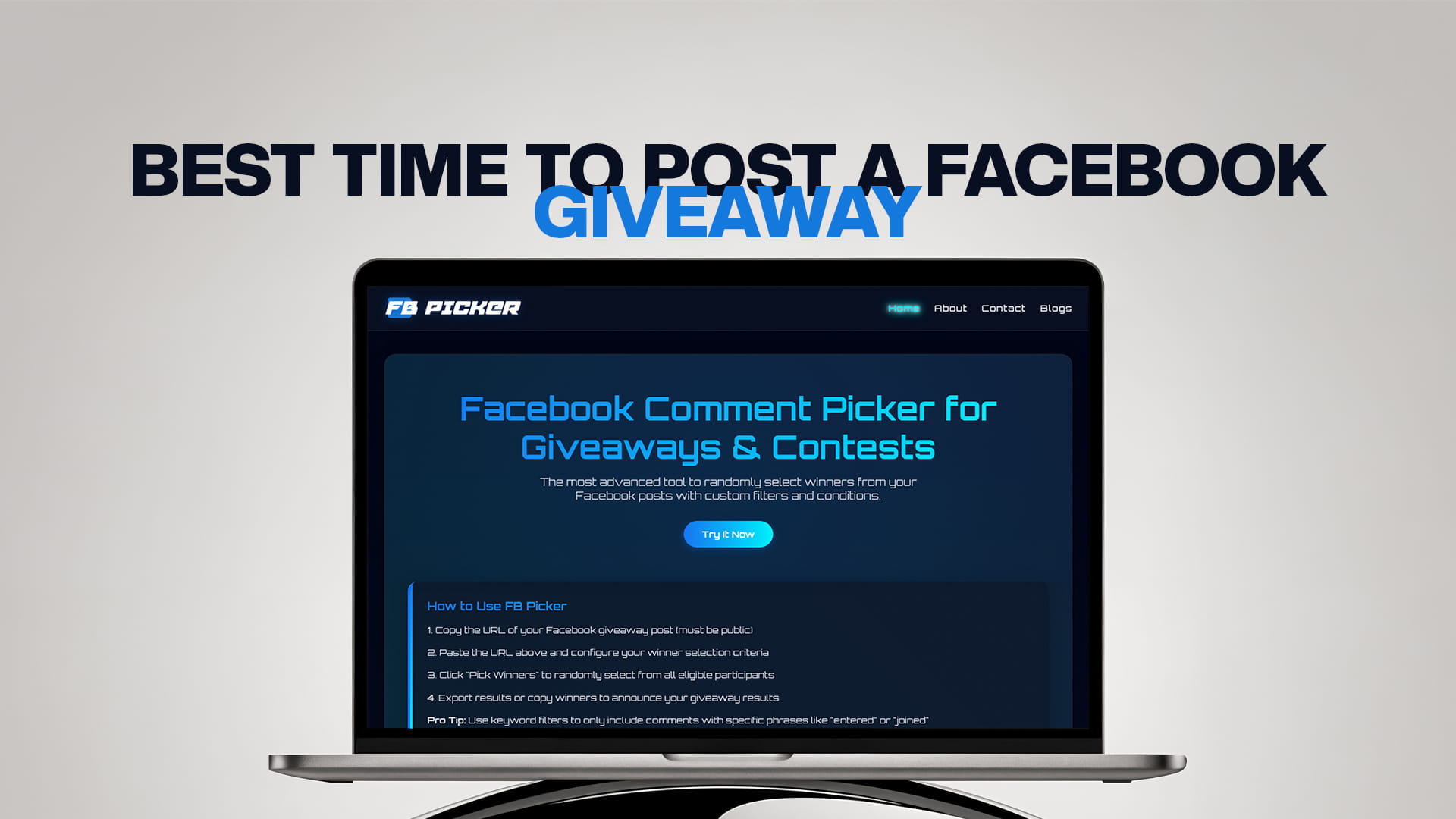
Perfect timing fills your post with entries, which brings the next task: choosing a winner everyone trusts. Picking a name by hand looks biased no matter how fair you are, so use a tool built for it. FB Picker is the most advanced tool for randomly selecting winners from your Facebook posts, paste your post URL and it pulls every comment automatically.
Set your conditions, filter out duplicate commenters, and run the draw; it selects winners randomly using a cryptographically secure method that can't be manipulated. If you offered more than one prize, you can pick multiple winners in a single pass. Time your draw and announcement to a peak window, record the selection on screen, and you've closed the loop with both maximum visibility and provable fairness.
How to Find Your Own Best Time Using Facebook Insights
Global windows are a starting point, but your own data is the real answer, and it's free to access. Open your Facebook Page's Insights (or Meta Business Suite), where you can see when your followers are online by day and hour. This single chart often reveals a peak your audience keeps that the global averages miss entirely.
Then look back at your own past posts. Sort your recent content by engagement and note the times and days your best performers went out. Patterns usually emerge quickly: maybe your audience reliably engages at lunchtime on weekdays, or maybe they're unexpectedly active on Sunday evenings. Cross-reference those two signals, when followers are online and when your posts have historically done well, and you've got a personalized launch window far more reliable than any industry chart.
Finally, treat it as an experiment. Run your next few giveaways at slightly different times within your strongest window and compare entry counts. Two or three contests is usually enough to confirm your real sweet spot. The global 2026 data tells you where to start looking; your own numbers tell you where to land.
Scheduling and Automation
You don't have to be at your keyboard at the perfect moment. Facebook's native scheduling tools in Meta Business Suite let you queue a giveaway post for any future date and time, so you can write it when it's convenient and have it publish at your peak window automatically. The same goes for your reminder post midway through and even a draft of your closing announcement.
Scheduling also helps you coordinate across time zones. If your audience clusters in a region several hours ahead or behind you, you can set the post to go live during their peak rather than yours. The one thing automation can't do is run the draw for you, when the giveaway closes you'll still choose the winner yourself, but timing the publish and reminders precisely takes a major variable out of your hands and makes your results far more consistent from one campaign to the next.
Bringing It All Together
The best time to post a Facebook giveaway in 2026 is midweek, Tuesday through Thursday, in the late-morning to mid-afternoon window, with early evening as a backup and weekends generally to be avoided. But the global data is only a starting point; your own page insights will tell you when your audience is actually online. Time your launch for early momentum, send a reminder at another peak, and schedule your close and announcement when people are active. Then finish with a fair, well-timed draw, the best free Facebook comment picker and a repeatable random comment picker for giveaways routine make that final step quick, transparent, and easy to repeat every campaign.
One final habit separates pages that win at timing from those that don't: consistency. A single well-timed giveaway is good; a repeatable schedule built around your proven peak windows is far better. Once your insights and a few test campaigns reveal when your audience reliably shows up, lock that window into your routine, same kind of slot, same midweek days, every time, so your followers start to anticipate your contests. Predictability compounds: an audience that knows roughly when your giveaways drop is primed to engage the moment they appear, which feeds the early momentum the algorithm rewards. Treat your best time as a standing appointment with your community, not a fresh guess each campaign.
Common Questions People Ask
What is the best day to post a Facebook giveaway? Midweek is strongest. Tuesday, Wednesday, and Thursday consistently show the highest engagement in 2026 studies, with Tuesday and Wednesday often leading. Weekends, especially Saturday, tend to be the weakest days.
What time of day should I launch a giveaway? For most pages, late morning through mid-afternoon (roughly 9 a.m. to 3 p.m. local time) performs best, with early evening as a secondary window. Check your own page insights to refine this for your specific audience.
Does timing really affect how many entries I get? Yes. Facebook rewards early engagement, so posting when your audience is active gives the giveaway early momentum that the algorithm amplifies. Posting during inactive hours can cause even a strong giveaway to be buried.
Should I post my giveaway on the weekend? Generally no, unless your audience is most active then (as in some entertainment or hospitality niches). Weekend engagement usually dips, with Saturday being the quietest day on the platform.
When should a giveaway end for the best results? End during a weekday peak window so last-minute entries and your winner announcement get maximum visibility. Avoid ending on major holidays or big event days when your audience is offline.
Is it better to follow global data or my own analytics? Your own analytics win every time. Global windows are a solid starting hypothesis, but your page insights show exactly when your followers are online and engaging, so test the recommended times against your real data and adjust. The brands that consistently get the most entries are the ones that treat the global numbers as a starting line, not a finish line.