
Are Facebook Giveaways Legal? Rules by Country (US/UK/CA/AU/EU)
The short answer is yes, Facebook giveaways are legal almost everywhere, as long as you set them up properly. The catch is that "properly" means satisfying two separate sets of rules at the same time: Meta's own platform policies, and the prize promotion law of whatever country your entrants live in. Most people only think about the first one. The second is where the real risk sits, and it changes depending on whether your audience is in Dallas, Manchester, Toronto, Sydney, or Berlin.
The good news is that ordinary social media giveaways, the "comment to win this prize, winner picked at random" kind, are about the lowest-risk promotion you can run, because they're free to enter. Free entry is the single thing that keeps most giveaways on the right side of the law. Once you understand why, the country-by-country differences are much easier to follow.
The two rulebooks you're playing by
Every Facebook giveaway answers to Meta and to the law.
Meta's rules are the same worldwide, and they're short. Your country's law is the part that varies, and it's where the country sections below come in. Both matter, and following one does not excuse you from the other. Meta even says so directly: you are responsible for the lawful operation of your promotion, including any registrations or approvals your jurisdiction requires.
What Meta requires
Meta's Policies for Pages, Groups and Events set the platform rules for any contest or sweepstakes you run on Facebook. They boil down to a few things.
You have to include official rules, and your terms must release Facebook from any liability and state clearly that the promotion is not sponsored, endorsed, administered by, or associated with Meta. That disclaimer is non-negotiable, and it belongs in your rules or on your giveaway landing page.
You can't require payment to enter. Charging people to take part turns a giveaway into something Meta treats under its gambling policies, which is a different and much more restricted category.
You're also limited in what you can demand as an entry action. Meta's policy says promotions must not require or incentivize people to share or repost your content or tag others to publicise it. Asking someone to comment on your post, follow your page, or visit a link is fine. Requiring them to share the post to their personal timeline, or to tag themselves in a photo, is not. The popular "tag a friend" mechanic sits in a gray zone under the strict wording of the current policy, so the safest entry actions to ask for are commenting and following.
Finally, if you collect any personal information from entrants, you have to make clear that you, not Meta, are collecting it, and get the consent your local privacy law requires.
The one legal idea behind almost every country's rules
Strip away the jargon and nearly every jurisdiction worries about the same thing: an illegal lottery. In most countries a promotion becomes a regulated or illegal lottery when three elements are present together: a prize, a winner chosen by chance, and "consideration," which means money or something else of value that entrants have to give up to take part.
Prize plus chance plus consideration equals a lottery, and lotteries are usually reserved for governments or licensed operators. Take away any one of the three and you're no longer running a lottery. Skill-based contests remove the chance element by judging entries on merit. Most brand giveaways remove the consideration element by letting people enter for free.
A normal Facebook giveaway, where the prize is awarded by random draw, keeps the prize and the chance. So the thing protecting you is the absence of consideration. As long as entry is genuinely free and you don't demand a purchase or some heavy, valuable effort, you've usually avoided lottery territory. Keep that in mind as you read the country rules, because it explains most of them.
United States
In the US, your random-draw giveaway is a sweepstakes: prize plus chance, with consideration removed. The federal principle is "no purchase necessary." Entry has to be free and open to everyone, and if you ever offer a paid way to enter, you must also offer a free alternate method of entry that carries the same chance of winning. No purchase necessary laws are enforced by the Federal Trade Commission and by state attorneys general.
For a typical free social media giveaway, there's no federal registration to file. The state-level details are where it gets fiddly. A few states, Florida, New York and Rhode Island, require registration and bonding once the total prize value crosses certain thresholds. Others, including Colorado, Maryland, Nebraska, North Dakota and Vermont, restrict or prohibit entry fees even for skill-based contests. Across all states you're expected to publish clear official rules covering eligibility, how to enter, the prize, how and when the winner is chosen, and the odds.
Practical takeaway: keep entry free, write proper rules, and check the registration thresholds in Florida, New York and Rhode Island if you're giving away something expensive.
United Kingdom
The UK is governed by the Gambling Act 2005, which draws a firm line between a lottery (which needs a Gambling Commission licence) and a prize competition or free draw (which doesn't). A lottery is, again, prize plus payment plus chance.
There are two clean ways to stay outside lottery territory. The first is a genuine skill element under the Act: a question or task hard enough to put off a significant number of would-be entrants, not something trivial like "what colour is the sky." The second, and the one that covers most social media giveaways, is the free draw. If there's no payment to enter, it isn't a lottery, full stop. Free draws and prize competitions don't need a Gambling Commission licence at all.
Because a standard Facebook giveaway is free to enter, it's a free draw, and it's legal in the UK without any licence. You still need clear terms and conditions, and your promotion has to follow general consumer protection law and the Advertising Standards Authority's CAP Code on how you advertise it.
Canada
Canada is the country with the most distinctive quirk. The Criminal Code effectively bans for-profit games that mix chance and consideration, which is why Canadian contests do two things at once. They remove consideration by being free to enter, and they remove pure chance by adding a skill element, almost always a mathematical skill-testing question that the winner must answer correctly before collecting the prize. That little "what is 15 + 8 x 3 - 4?" step you see on Canadian contests is the legal mechanism that turns a random draw into a permitted contest of mixed skill and chance.
On top of that, the federal Competition Act requires adequate disclosure: the number and value of prizes, the odds, the contest dates, and who's eligible.
For years, Quebec was the big headache. The province ran its own regime through the Régie des alcools, des courses et des jeux, with mandatory registration, duties based on prize value, security bonds, and French translation, so many brands simply excluded Quebec residents. That changed on 27 October 2023, when Quebec's Bill 17 repealed the province's publicity-contest rules entirely. There's no more RACJ registration, no duties, and no bonds for new contests. Contests open to Quebec residents are now governed by the same federal law as the rest of Canada. One thing survives: Quebec's French-language requirements still apply, so if your giveaway is open to Quebec residents, your rules and materials should be available in French. A lot of older advice online still tells you to exclude Quebec; that advice is out of date.
Practical takeaway: free entry, a skill-testing question for the winner, clear disclosure, and French materials if you're including Quebec.
Australia
Australia regulates giveaways, which it calls trade promotions, at the state and territory level rather than federally. Entry has to be free, and the key question is whether your winner is chosen by chance (a random draw) or by skill (judged on merit). Skill-based promotions generally don't need a permit. Chance-based draws might, depending on the prize value and which states your entrants are in.
The thresholds as they currently stand:
- New South Wales no longer issues one-off permits. You need a Trade Promotion Authority (granted for one, three or five years) for any chance-based promotion with a total prize pool over $10,000 open to NSW residents, and you notify NSW Fair Trading before each qualifying promotion. Under $10,000, no permit, but the fair-trading rules still apply.
- The ACT requires a permit once the prize pool reaches $3,001 or more.
- South Australia requires a permit at $5,001 or more, and for any instant-win or scratch mechanic regardless of value.
- The Northern Territory may also require a permit for games of chance.
- Victoria, Queensland, Western Australia and Tasmania don't run permit systems, but their lottery and gaming regulations and Australian Consumer Law still apply (WA, for instance, asks you to send in your terms and conditions).
Practical takeaway: a small random-draw giveaway under the thresholds usually needs no permit, just proper terms. A high-value, nationwide prize draw can mean a NSW authority plus ACT and SA permits, so price that time and cost in early.
European Union
There's no single EU giveaway law. Instead you've got EU-wide rules sitting on top of each member state's own promotion law, and the national rules vary a lot.
The EU-wide layer that catches everyone is data protection. Under the GDPR, you must tell entrants what personal data you collect, why, and how long you'll keep it, and let them withdraw consent. Crucially, you can't make entry conditional on signing up for your marketing. That "forced consent," where the only way to enter is to subscribe to advertising, is prohibited, and consent to marketing has to be a separate, explicit, voluntary choice. Data you gather for the giveaway can't be reused for marketing without separate permission. GDPR fines run up to €20 million or 4% of global turnover, so this is the part to take seriously.
On top of GDPR, each country differs. Germany and France are relatively permissive for free-entry promotions with clear terms (France dropped its old requirement to file rules with a bailiff back in 2014, though terms still need to be in French). Others are stricter: Italy and Poland impose registration and authorisation requirements that can be genuinely burdensome, and the Netherlands works under a code of conduct with an annual prize-pool cap per promoter. A giveaway aimed at one friendly country is usually straightforward; a pan-European campaign needs country-by-country checking.
Practical takeaway: nail your GDPR handling everywhere, and get specific advice before running a promotion into Italy, Poland, or other strict states.
A compliance checklist for any Facebook giveaway
Wherever your entrants are, these habits keep you out of trouble:
- Keep entry free. No purchase, no payment, no heavy paid effort. This is what stops a giveaway being treated as a lottery.
- Write clear official rules: eligibility, start and end dates with the time zone, the prize and its value, how and when the winner is chosen, the odds, and how to claim.
- Add Meta's disclaimer and liability release, and don't require timeline shares or tagging. Ask people to comment and follow instead.
- Set eligibility deliberately. State a minimum age and the regions you're open to, and exclude any region whose rules you can't meet.
- Handle entrant data lawfully, and never force marketing sign-up as a condition of entry, especially under GDPR.
- Add the country-specific piece: a skill-testing question for Canada, permits for larger Australian prizes, registration checks for high-value US prizes, and GDPR plus local law for the EU.
- Pick the winner at random and keep records of how you did it.
Picking the winner, and proving you did it fairly
That last point matters more than it looks. Several countries expect winners to be chosen genuinely at random, and almost all of them expect you to keep records. If a regulator or a disgruntled entrant ever questions your draw, "I scrolled the comments and picked someone" is not a great answer. A documented, random selection is.
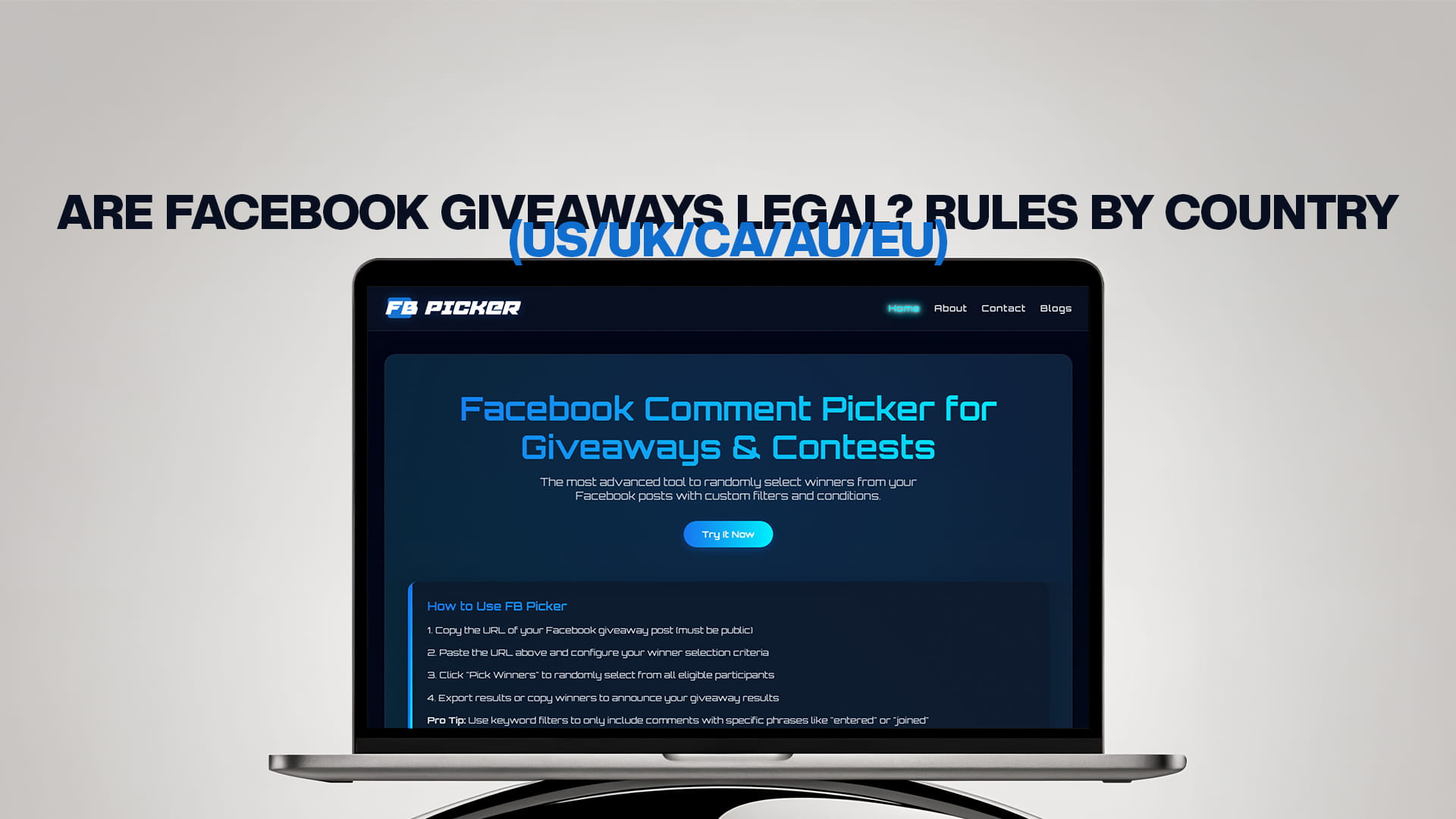
This is the practical reason a dedicated tool earns its place. A random comment picker for giveaways pulls every entry from your post and draws a winner you can stand behind. FB Picker does exactly this: paste your post URL, strip out duplicate commenters, and run the draw. It selects the winner at random using a method that can't be nudged, and if you're awarding more than one prize or want documented backups, you can pick several winners in one pass. Record the draw on screen and you've got both the fairness regulators expect and the proof your audience wants. When you're starting out, the best free Facebook comment picker covers this without adding cost to a small campaign.
So, are Facebook giveaways legal?
Yes, in every region covered here, provided you keep entry free, follow Meta's platform rules, write proper terms, and respect the local wrinkle: no purchase necessary in the US, the free-draw route in the UK, a skill-testing question in Canada, state permits for larger prizes in Australia, and GDPR plus national law across the EU. None of it is exotic. Most of it follows from one habit, letting people enter for free, and one piece of discipline, picking the winner at random and writing down how you did it.
The bigger your prize and the more countries you target, the more it's worth a quick check with the relevant regulator or a lawyer. For a normal giveaway to your own audience, get the basics right, and you're on solid ground.
Common questions people ask
Are Facebook giveaways legal? Yes, in the US, UK, Canada, Australia and across the EU, as long as entry is free, you follow Meta's policies, publish clear rules, and meet your country's specific requirements. Free entry is the main thing that keeps a random-draw giveaway from being treated as a lottery.
Do I need a licence or permit to run a giveaway on Facebook? Usually not for a small free-entry giveaway. In the UK a free draw needs no Gambling Commission licence. In Australia you may need a permit for chance-based draws above certain prize values (over $10,000 in NSW, $3,001 in the ACT, $5,001 in SA). In the US, a few states require registration for high-value prizes.
Why do Canadian giveaways make winners answer a math question? Canada's Criminal Code restricts games that combine chance and payment, so contests add a skill element. A mathematical skill-testing question, answered by the winner before they collect, converts a pure random draw into a permitted contest of mixed skill and chance.
Can I still exclude Quebec, or has that changed? You no longer need to exclude Quebec for regulatory reasons. Quebec repealed its publicity-contest registration regime on 27 October 2023, so there's no more RACJ filing, duties or bonds. If your giveaway is open to Quebec residents, your rules and materials should still be available in French.
Is it legal to require people to like, share, or tag friends to enter? Meta's policy prohibits requiring shares to a personal timeline or tagging others to publicise your promotion, and asking for a "like" as a condition has also been restricted. The safest entry actions are commenting on the post and following your page. Requiring a purchase is not allowed anywhere.
What about collecting entrants' data in the EU? Under GDPR you must tell entrants what data you collect and why, keep it only for the giveaway unless they separately agree to marketing, and let them withdraw consent. You can't make entry conditional on subscribing to your marketing.