
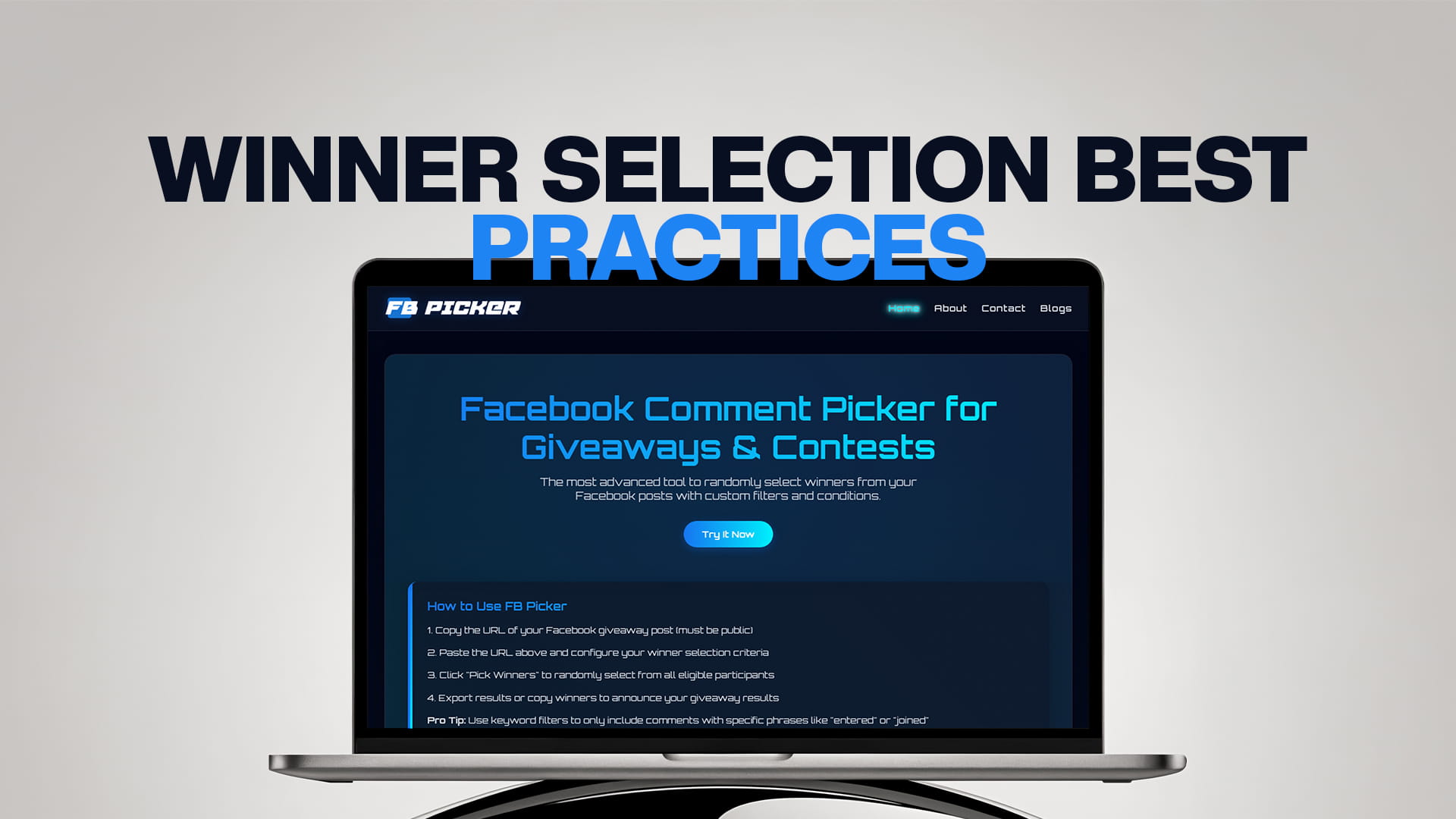
Winner Selection Best Practices
Picking a winner sounds like the easy part of running a giveaway. You did the hard work — wrote the post, promoted it, watched the entries come in. Now you just need to pick someone and hand over the prize.
But this is actually where a lot of giveaways fall apart.
Pick the wrong way, and your audience will question whether the whole thing was rigged. Pick without clear rules, and someone will always complain. Pick manually from hundreds of comments, and you introduce bias whether you mean to or not.
This guide covers everything you need to know about selecting giveaway winners fairly, transparently, and without drama — on Facebook and beyond.
Why Winner Selection Gets Complicated
When you have five entries, picking a winner is easy. You know all five people, you have their comments right in front of you, and you can flip a coin if you want.
When you have 500 entries, things change. When you have 5,000 entries, they change a lot more.
At scale, a few real problems start showing up.
Some people enter multiple times. Whether or not your rules allowed it, some people will comment again and again to improve their chances. If you are picking randomly from a list of comments without filtering, someone who commented 20 times has a 20x better shot than someone who followed the rules and entered once. That is not fair, and your audience will notice.
Some entries do not qualify. Maybe you asked people to tag a friend but some just wrote "me me me" with no tag. Maybe you required a specific keyword but some people just dropped an emoji. If your pick method cannot filter for valid entries, you might end up selecting someone who did not actually meet the requirements.
Accusations happen regardless. Even when you do everything right, someone will say the winner was a friend of the page owner, or that the draw was not really random, or that they entered first so they should have won. Without a documented, transparent process, those accusations are hard to defend against.
Manual selection is not actually random. If you scroll through comments and just point at one, that is not a random draw. Your eye gravitates toward names near the top, names you recognize, or names that appear more often. That is human psychology, not manipulation — but the result is still a biased pick.
Solving these problems is what winner selection best practices are actually about.
Best Practice 1: Define Eligibility Before the Giveaway Goes Live
The single most effective thing you can do to make winner selection easier is to decide your eligibility rules before you post — and then put them in the post itself.
Eligibility rules answer questions like:
- Does someone need to follow your page to enter?
- Is there an age requirement?
- Are there geographic restrictions (country, region, state)?
- Can people enter more than once?
- Does each tag in a comment count as a separate entry, or is it one entry per person regardless of how many tags they post?
- What happens if someone uses a fake or brand-new account?
Write these down before the giveaway starts. Include the key ones in your post caption. Save the full version somewhere you can refer back to.
When these rules exist before the draw, you have something concrete to point to if anyone challenges your result. "We drew from unique commenters only, as stated in the original post" is a complete answer. Without that documentation, you are defending yourself against feelings rather than facts.
Best Practice 2: Use a Dedicated Random Selection Tool
This is not optional if you are running giveaways seriously.
A dedicated tool removes human bias from the equation entirely. It does not know which entry came first. It does not recognize names. It cannot favor someone even accidentally. It just picks from the eligible pool based on genuine randomness.
FB Picker is built specifically for Facebook giveaways. It connects to your post, loads all the comments, applies whatever filters you set, and draws a winner. The process takes a few minutes at most, and you end up with a result you can screenshot and share publicly.
What separates FB Picker from a generic random name picker is the filtering capability. You are not just dropping a list of names into a wheel — you are working with real comment data and applying real conditions. Filter out duplicate commenters. Filter by keyword. Filter by reactions. Filter by people who actually followed your page. The tool handles the logic so you do not have to.
This matters because "random" without filtering is often not fair. If your entry rules said one entry per person and someone commented 15 times, including them 15 times in your random pool is technically random but obviously unfair. Filtering before the draw is what makes the result both random and valid.
Best Practice 3: Handle Duplicate Entries Correctly
Duplicate entries are one of the most common issues in Facebook giveaways, and how you handle them says a lot about how seriously you take fairness.
There are really two situations here.
The first is when duplicates are intentional and allowed. Some giveaways give extra entries for extra actions — comment once to enter, tag a friend for a second entry, share to a Story for a third. If this is your format, each valid additional action should be counted. Be specific in your rules about what earns extra entries and what does not.
The second situation is when duplicates are not allowed but happen anyway. Someone comments ten times hoping to increase their odds. In this case, you need to deduplicate before drawing. FB Picker handles this with a filter that counts only one entry per unique commenter, regardless of how many times they commented. That one setting closes the loophole entirely.
The important thing is that whichever approach you take, it is stated upfront. "One entry per person" or "each tag earns an additional entry" — both are legitimate, but only if people know before they enter.
Best Practice 4: Filter for Valid Entries Only
Not every comment on your giveaway post is a valid entry. Some people drop spam. Some misread the instructions. Some post-unrelated comments. If your entry required a specific action — tagging a friend, answering a question, using a keyword — then entries that did not do that thing should not be in your eligible pool.
This is where a lot of manual selection processes fall short. When you are scrolling through a comment section, it is genuinely hard to keep track of which comments meet your criteria and which do not. You end up making judgment calls on the fly, which opens the door to inconsistency.
With FB Picker, you can set keyword filters before the draw. If your giveaway required people to comment with the word "YES" or tag a specific handle, you filter for that. Only comments matching your condition enter the pool. The draw then happens from a list you can actually stand behind.
This is also the right approach from a legal and reputational standpoint. If you said "comment with your favorite color to enter" and your winner just wrote "in," you have a problem when anyone looks closely at the result. Filtering ensures the winner is someone who actually followed your instructions.
Best Practice 5: Document the Draw
Transparency is the difference between a giveaway that builds trust and one that creates controversy.
Document every step of the winner selection process. That means:
Take a screenshot or screen recording of the tool you used to pick the winner. Showing the filters you applied. Showing the result — the winning comment, the commenter's name, and the timestamp.
Then share that documentation publicly. Post it as a comment on the original giveaway post. Post it in a follow-up post. Show your audience exactly how the winner was chosen.
This does three things. It protects you against accusations of rigging. It shows potential entrants in future giveaways that you run things fairly. And it gives the winner something to point to when their friends ask how they won.
FB Picker generates a shareable result after every draw. You get a clean output that shows the winner and confirms the process was random. Screenshot it, post it, and move on. It takes 30 seconds, and it is worth every one of them.
Best Practice 6: Have a Backup Winner Ready
Not every winner responds. People get busy, miss notifications, or sometimes enter a giveaway and then forget about it completely.
Before you pick, decide what your policy is if the primary winner does not respond within a set time. 48 hours is standard. Some giveaway runners give 72 hours. Whatever you choose, state it in the original post: "The winner will have 48 hours to respond before an alternate is selected."
Then actually follow through. If your winner does not respond in time, pick the next eligible commenter from your draw or run a new draw from the remaining pool. Document that process the same way you documented the original.
This matters because leaving a giveaway unresolved — posting a winner, waiting weeks, never confirming delivery — is one of the fastest ways to lose credibility. People check back on these things. They notice when nothing happens.
Best Practice 7: Verify the Winner Before Announcing
Before you post "Congratulations to [name]!" publicly, spend two minutes checking that the winner actually exists and qualifies.
Look at their profile. Is it a real account? Does it look like an active person rather than a freshly created bot account? Do they meet any eligibility requirements you set — age, location, page follow?
This is not about being suspicious of everyone. Most giveaway entrants are genuine. But occasionally a bot account or a fake profile sneaks in, and announcing them as a winner only to retract it later is awkward and damaging.
FB Picker lets you review the winner's comment before finalizing. You can see their name, their comment, and their entry details before you announce anything publicly. If something looks off, you have the option to move to the next eligible entrant.
Best Practice 8: Contact Winners Privately First
Post the winner's name publicly, yes — but contact them privately first.
Send a direct message before the public announcement, or at least simultaneously with it. Let them know they won, what they need to do to claim the prize, and how you will be delivering it. Give them a clear deadline to respond.
Why private first? Because sometimes people do not want their name announced publicly on a page they follow casually. Sometimes they have privacy concerns. A heads-up via DM gives them a chance to be prepared for the public mention rather than finding out they won because 40 people tagged them.
It is also just more professional. It shows you planned the follow-through, not just the draw.
Best Practice 9: Be Consistent Across All Your Giveaways
If you run giveaways regularly, consistency matters more than any single decision you make about how to pick a winner.
Use the same tool every time. Apply the same filtering logic. Follow the same announcement process. Give winners the same timeline to respond.
When people see you run giveaways the same way every time, they trust the process. They know what to expect. That trust is worth more than any tactical tweak you might make to one individual contest.
Consistency also protects you legally and practically. If you always filter for unique commenters, you cannot be accused of suddenly changing the rules to favor someone. If you always post a screenshot of the draw result, one giveaway where you forget to do it stands out as an oversight rather than a pattern of secrecy.
Best Practice 10: Know What "Random" Actually Means
This sounds like a basic point, but it is worth being clear about.
Random does not mean "fair to everyone equally." It means each eligible entry has an equal chance of being selected. Those are related but not the same.
If someone entered 10 times and your rules allow multiple entries, their 10 chances are fair — you said multiple entries were allowed. If someone entered 10 times and your rules say one entry per person, their extras should be removed before the draw. In both cases, the draw itself is random. What changes is the eligible pool.
Fairness is about the pool. Randomness is about the draw. Both need to be right.
This also means that "I picked who I thought was the most deserving entry" is not a random draw. It might be a legitimate judging format — if you said upfront that entries would be judged rather than drawn — but do not call it random if it was not. People see through that pretty quickly.
Best Practice 11: Keep Records After the Draw
After the giveaway ends and the winner is confirmed, save your records.
Keep a copy of the original post, the entry rules, the draw result, and any communication with the winner. Store these somewhere you can find them for at least six months.
Why? Because disputes happen. Sometimes they happen weeks after the giveaway. Having documentation means you can resolve them in minutes rather than spending hours trying to reconstruct what happened.
Also, if you are running giveaways as part of a business or marketing operation, good records are just good practice. Tax implications, prize fulfillment documentation, proof of compliance with platform rules — these things matter as you scale up.
Best Practice 12: Announce Honestly if Something Goes Wrong
Sometimes things go wrong. The winner turns out to be ineligible. The prize gets lost in shipping. You made an error in the draw. Something gets flagged by Facebook. These things happen.
The right response is honesty. Tell your audience what happened. Explain what you are doing to fix it. If you need to redraw, do it publicly with the same documented process you used the first time.
Trying to quietly fix a mistake or hoping nobody notices is usually worse than the mistake itself. People follow brand pages for years. They remember things. A straightforward "we made an error and here is how we fixed it" earns more respect than a cover-up, every time.
Best Practice 13: Match Your Process to Your Giveaway Size
Not every giveaway is the same, and your winner selection process should scale with the size of the contest.
A small giveaway with 50 entries from a tight community might need only basic filtering — deduplicate, draw, announce. A large giveaway with thousands of entries from a broad audience needs more — stricter filters, more careful eligibility checking, possibly a staged selection process if there are multiple winners or prize tiers.
FB Picker handles both. The filters you apply can be as simple or as detailed as the giveaway requires. For a large-scale draw with complex entry conditions, you can layer multiple filters before running the selection. For a quick community giveaway, you can be up and running in under a minute.
The point is to think about the selection process before the giveaway starts, not after. By the time you have 3,000 comments to sort through, it is too late to wish you had set clearer entry rules.
Best Practice 14: Respect Privacy When Announcing
When you announce your winner publicly, be thoughtful about how much personal information you share.
First and last name and a tag is usually enough. Do not post someone's city, their other social media handles, or any information they did not include in their entry. If they comment with a full name and location in their entry, you can reference the comment — but you do not need to amplify personal details beyond what is already public.
This is especially relevant if your giveaway attracted entries from a younger audience. Being careful about privacy is both responsible and good for your reputation.
If a winner specifically asks you not to tag them publicly — maybe they have a private account or just prefer not to be singled out — respect that. You can announce "our winner has been notified and their prize is on the way" without naming them. Most audiences are fine with this as long as the overall process was transparent.
Best Practice 15: Learn From Each Giveaway
Every giveaway teaches you something if you pay attention.
After each one, look at a few numbers. How many eligible entries did you actually get after filtering out duplicates and invalid comments? What percentage of your total comments were actually valid entries? Did anyone complain about the selection process? Did your winner respond quickly or take the full 48 hours?
These data points tell you what to adjust next time. If half your comments were duplicates, your audience is clearly trying to game the system and you need a stricter one-entry rule. If most comments did not include the required keyword, your entry instructions were unclear. If your winner took 70 hours to respond and you have a 48-hour limit, you might want to extend that window.
Giveaways improve with repetition, but only if you actually review what happened each time.
The Short Version
Fair winner selection comes down to a few things that are not complicated:
Set clear rules before you start. Use a tool that filters and randomizes properly — FB Picker handles both. Document the process and share the result publicly. Contact the winner privately before announcing publicly. Keep records. Handle problems honestly.
None of this is difficult. Most of it takes less time than people think. The reason the giveaway winner selection goes wrong is usually not bad intentions — it is just a lack of process. These best practices are the process.
If you are running Facebook giveaways and not yet using FB Picker, the filtering and transparency features alone make it worth trying on your next draw. It is the part of the process that people see last but remember longest.
Running Giveaways on Other Platforms?
If your giveaways run beyond Facebook, there are purpose-built tools for every major platform that follow the same filtering and random selection principles.
For TikTok, TTPicker.com randomly selects winners from TikTok video comments. When a video goes viral, and the comment section hits tens of thousands, TT Picker makes fair selection possible without the manual chaos.
For YouTube giveaways run through video comments, YTPicker.com works the same way — connect your video, apply filters, and draw a winner. YouTube comments can be particularly messy with spam and bots, so the filtering matters even more here.
For Reddit-based contests and community giveaways, RDTPicker.com pulls from Reddit thread comments and lets you run a clean, documented draw. This is especially useful for product launches, subreddit appreciation events, or AMA giveaways.
And for Bluesky, BSKYPicker.com brings the same random winner selection functionality to the growing Bluesky community — fair draws, shareable results, same transparent process.
Wherever your audience lives online, the best practices covered in this guide apply. The platform changes. The principles do not.