
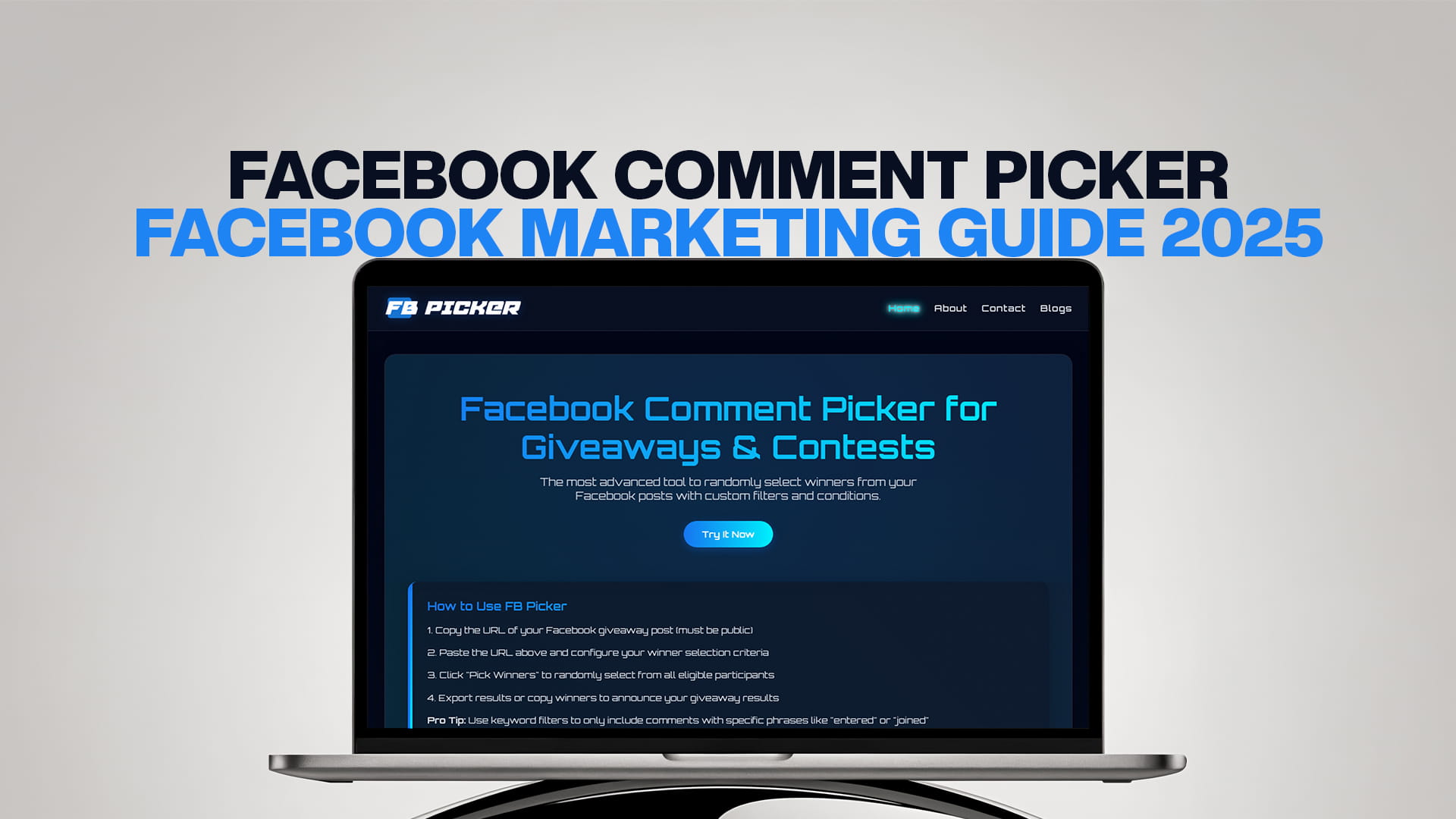
Facebook Comment Picker - Facebook Marketing Guide 2025
Facebook has changed a lot over the years, but one thing has not changed: it is still one of the most powerful platforms for reaching people and building a real audience around your brand.
The pages that grow in 2025 are not the ones with the biggest ad budgets. They are the ones that understand how the platform works right now — what content gets pushed, what drives genuine engagement, and how to build a community that keeps coming back.
This guide covers all of it. From setting up your page correctly to running giveaways that actually grow your following, this is a practical walkthrough of Facebook marketing in 2025. And along the way, you will see exactly where FB Picker fits in — because how you pick your giveaway winners has more to do with your long-term page growth than most people realize.
Understanding Facebook in 2025
Facebook is not what it was in 2015. The algorithm is different. The audience behavior is different. What works is different.
But the platform is not dead. Not even close. Facebook still has more than three billion monthly active users. Groups are more active than they have ever been. Local business pages still generate serious foot traffic. Niche communities thrive. And for many age demographics — particularly 30 to 65 year olds — Facebook remains the primary social platform they check daily.
The shift that matters most for marketers is this: organic reach from pages has dropped significantly over the past decade, but engagement-driven content still gets pushed. Facebook's algorithm does not just suppress all page content — it suppresses low-engagement page content. If your posts consistently get reactions, comments, and shares, the algorithm treats your page as a quality source and keeps showing your content to people.
That means the goal in 2025 is not to post more. It is to post content that earns responses. Everything in this guide points toward that goal.
Step One: Get Your Facebook Page Set Up Properly
Before any marketing strategy can work, your page needs to be set up in a way that makes it worth following.
A half-finished page sends the wrong signal. If someone sees your giveaway post, gets interested, and clicks through to your page — only to find a missing profile photo, no description, and three old posts from last year — they will not follow you. First impressions matter even on social media.
Go through each of these before you start any active promotion.
Profile photo. Use your logo if you are a brand, a clear headshot if you are a personal brand or creator. It should be recognizable at a small size since it appears as a thumbnail next to every post and comment.
Cover photo. This is the biggest piece of real estate on your page. Use it to communicate something — your tagline, your current offer, your next event. Update it periodically so returning visitors see something fresh.
Page description. Write a short, clear description of what your page is about and who it is for. Avoid jargon. If someone who has never heard of you reads it, they should immediately understand what you do and whether it is relevant to them.
Contact details and website. Fill these in completely. People check pages before they decide to follow or buy. Missing contact details make a page look abandoned.
Call to action button. Facebook lets you add a prominent CTA button under your cover photo — options include "Follow," "Shop Now," "Contact Us," "Book Now," and several others. Pick the one that matches what you most want visitors to do.
Page category. Choose the most accurate category for your page. This affects how Facebook classifies you and can influence who it suggests your page to.
Once these basics are solid, you have a page worth sending people to.
Step Two: Understand What the Facebook Algorithm Rewards
You do not need to know every detail of how the Facebook algorithm works. But you do need to understand its basic logic, because it determines whether your content reaches anyone.
The algorithm's job is to show each user the content most likely to keep them on the platform. It does this by analyzing what types of content each user has engaged with in the past and prioritizing similar content in their feed. For your page, this means your posts are shown first to users who have previously engaged with your content — and then, if they respond, pushed to a wider audience.
In 2025, the engagement signals the algorithm weighs most heavily are, in rough order: shares, comments, reactions, and time spent viewing a post. Shares matter most because they carry your content to new audiences. Comments matter because they signal genuine interest — someone cared enough to type something. Reactions are the lowest-effort signal but still count. Time spent matters for video and longer posts.
There are also negative signals. If users consistently hide your posts, unfollow your page, or report your content as spam, the algorithm will reduce your reach. This is why posting content your audience actually wants is not optional — low-quality or irrelevant posts actively hurt your page's future reach, not just the individual post.
What this means practically: every post you publish should give your audience a reason to do something. Ask a question. Share something useful. Post something entertaining. Run a contest. Give people a reason to stop scrolling and respond.
Step Three: Build a Content Calendar That Actually Works
Consistency is one of the most underrated factors in Facebook page growth. The algorithm rewards pages that post regularly. Your audience learns to expect content from you. Both effects compound over time.
The specific posting frequency that works depends on your audience and your capacity to produce good content. For most pages, three to five posts per week hits the balance between staying visible and not flooding your followers' feeds with low-effort filler.
What matters more than frequency is the mix of content types. A page that only posts one type of content — only product photos, only links, only promotional posts — gets boring. Varied content keeps your audience interested and tells the algorithm that different types of users engage with your page.
A practical content mix for most brands and creators:
Educational or helpful posts. Tips, how-tos, answers to common questions your audience has. This type of content gets saved and shared, both strong algorithm signals.
Entertainment or personality posts. Behind-the-scenes glimpses, humor, relatable observations, and team moments. This builds the human connection that makes people feel attached to a page rather than just following it out of habit.
Engagement bait — the good kind. Questions, polls, "caption this" posts, and "which would you choose" posts. These are designed to generate comments, and they work because they are low-effort for the respondent. No wrong answers, no commitment — just a quick reply.
Promotional posts. Your products, services, offers, and announcements. These should be a minority of your overall content — maybe one in five or one in six posts. If every post is an ad, people tune out.
Giveaway posts. Once or twice a month, a properly run giveaway that generates a burst of comments, reactions, and new followers. More on this below.
Map these types across a month, and you have a content calendar. You do not need a tool to do this — a basic spreadsheet works fine. The goal is to plan ahead so you are not scrambling for ideas every day.
Step Four: Write Posts That Get Responses
The words in your posts matter more than most people think.
A post that ends with a passive observation gets passive responses. A post that ends with a direct, specific question gets active responses. The difference is often just a sentence.
Some principles that consistently work.
Ask one question, not three. "What do you think? Have you tried this? Let us know your thoughts!" is too diffuse. People do not know which question to answer and often answer none of them. Pick one question and make it specific. "Which one would you order?" or "Have you ever tried this?" is more likely to get a response than a three-part invitation.
Keep captions readable. Long blocks of unbroken text lose people on mobile. Use short paragraphs. Break up the copy. The first sentence matters most — if it does not give people a reason to keep reading, most will not.
Write like a person, not a press release. "We are thrilled to announce" is page-speak that nobody in real life uses. "We just launched something new and we are honestly excited about it" is closer to how a real person talks. The tone shift sounds small but the engagement difference is real.
Use images and video. Posts with visual content get more reach and more engagement than text-only posts across the board. Videos — especially ones that are watchable without sound — tend to get the most reach. Even a simple photo adds more stopping power than a text post.
Post at the right time. Check your Facebook Insights to see when your followers are most active. Post during those windows. A post published at peak active time for your audience collects its first wave of engagement faster, which gives the algorithm more reason to push it further.
Step Five: Use Facebook Groups Strategically
Facebook Groups are one of the most underused tools for page growth in 2025.
Groups have higher organic reach than pages because they are community spaces rather than broadcast channels. The algorithm treats group content differently — posts in active groups reach members more reliably than page posts reach followers.
You can engage with groups in two ways.
The first is by creating your own group connected to your page. A brand-adjacent community where your customers, fans, or audience members interact with each other. The page runs the group, drives content, and benefits from the community activity. This works well if you have an audience that has something to discuss — niche interests, shared experiences, product communities.
The second is by participating in existing groups relevant to your niche. Not as a promotional tool — spamming groups with links to your page will get you removed and banned — but as a genuine community member who answers questions, shares knowledge, and builds relationships. Over time, this drives people to look up your profile and page organically.
If you run giveaways on your page, groups are a good place to mention them — many groups allow giveaway promotion in designated threads. This brings new participants to your page from an audience that did not know you existed before.
Step Six: Run Facebook Giveaways That Actually Build Your Page
Giveaways are one of the most effective tactics for growing a Facebook page quickly, but most people run them in a way that produces short-term noise rather than long-term growth.
The problem is usually the prize. When pages offer generic big-ticket prizes — an iPad, a $500 gift card, a laptop — they attract entries from everyone on Facebook, most of whom have no interest in the page beyond the giveaway. You get a follower spike followed by a slow bleed as those followers unfollow or simply stop engaging because your content was never relevant to them.
Your engagement rate tanks. The algorithm notices. Your reach on future posts drops. The giveaway did more harm than good in the long run.
The fix is matching your prize to your audience. Give away something your specific audience genuinely wants. A cooking brand should give away a high-quality kitchen tool. A fitness page should give away a piece of equipment or a coaching session. A local business should give away something tied to its product or service.
Smaller prizes that are highly relevant to your audience outperform larger generic prizes for page growth almost every time.
Beyond the prize, how you run the giveaway determines the quality of entries you get.
Clear entry requirements filter for people who are paying attention. If your giveaway asks "comment on your favorite product from our range to enter," the people who respond are people who know your products — a much more valuable audience than random entrants who just typed their name.
Tag-a-friend entries spread your giveaway to new people who are similar to your existing followers — because people tend to know people with similar interests.
Following your page as a requirement means new entrants become followers before the draw ends.
All of this only works if the giveaway is run fairly. Which is where the winner selection process matters.
Step Seven: Pick Winners Fairly With FB Picker
This is the step that most Facebook marketing guides skip entirely, but it is one of the most important.
How you pick your giveaway winner determines how much your audience trusts future giveaways. And trust in the giveaway process is what turns occasional participants into regular ones.
FB Picker is built specifically to handle this for Facebook posts. Connect it to your giveaway post, apply filters that match your entry conditions, and it draws a winner at random. The whole process takes a few minutes and produces a documented result you can share publicly.
The filtering system is what makes FB Picker more than just a random name picker. You can tell it to count only unique commenters — so someone who entered 20 times in hopes of improving their odds gets the same one chance as everyone who entered once. You can filter by keyword — so only entries that include your required phrase or tag a friend enter the eligible pool. You can combine filters for more complex giveaway formats.
This matters for your audience's trust because it proves the rules you wrote were actually enforced. If you said one entry per person and then drew from a pool full of duplicates, that is not a fair draw, regardless of whether the result was technically random. Filtering first and then drawing is what makes the selection both random and fair.
After the draw, share the result. Post a screenshot of the FB Picker output alongside your winner announcement. That screenshot — showing the tool, the filters, and the selected winner — tells your audience that the process was legitimate. It is the visual proof that no written explanation can fully replace.
Every time you do this, you build a small amount of credibility with everyone who entered and did not win. They saw it was fair. They are more likely to enter next time. Over a year of monthly giveaways, that compounding trust becomes a real asset.
Step Eight: Use Giveaway Momentum to Grow Beyond the Contest
A giveaway post does not end when the winner is announced. The momentum it creates is an opportunity most pages waste.
After a high-engagement giveaway, your page has more followers, higher recent engagement metrics, and the algorithm's attention. This is the best time to post your most compelling non-giveaway content — because it will reach more people than usual and be seen by new followers who are deciding whether to stick around.
Think about what you want new followers to see first. A strong how-to post? A popular product showcase? An entertaining behind-the-scenes video? Whatever represents your page at its best, post it within 24 to 48 hours of the winner announcement.
The winner announcement itself is a content opportunity. A post that says "Congratulations to [winner] — here is proof of our random draw and here is their prize on its way" is far more engaging than a simple tagged comment. It shows your page follows through. It humanizes the process. And the image of the prize being dispatched gives new followers a concrete sense of what they might win next time.
You can also use the post-giveaway period to preview the next one. A simple "stay tuned — we have another giveaway coming next month" keeps the followers you just gained interested in what is coming and gives them a reason not to unfollow.
Step Nine: Track Your Results and Adjust
Facebook Insights gives you detailed data about how your posts are performing, who your audience is, and how your page is growing over time. Most page owners check their follower count and not much else. That is leaving a lot of useful information on the table.
The metrics worth paying attention to regularly are:
Reach per post. How many unique accounts saw each post? Compare this across content types to see what the algorithm is pushing and what it is not.
Engagement rate. Total engagements divided by reach, expressed as a percentage. This tells you how compelling each post was relative to how many people saw it. A post with high reach but a low engagement rate means people saw it and kept scrolling. That is useful information.
Comments per post. Since comments are the highest-value engagement signal, tracking which posts generate the most comments tells you what your audience most wants to respond to.
Follower growth during giveaway periods. Compare your follower growth during giveaway weeks against your baseline. This tells you how much each giveaway actually moved the needle.
Response rate to winner DMs. If you track how quickly giveaway winners respond to your DM, you will start to notice patterns. A very slow response rate might mean your winner announcement is not visible enough, or your prize is not exciting enough to prompt an immediate reply.
Review these numbers monthly. Not to obsess over them, but to notice trends and adjust your approach based on what is actually working rather than what you think should be working.
Step Ten: Build Toward a Real Community
All of the tactics in this guide point toward a single goal: building a Facebook page with a real community behind it.
A real community is not just a follower count. It is an audience that comments on your posts without being prompted. That tags friends in things you share. I look forward to your giveaways because I trust you run them fairly. That checks your page when they have not heard from you in a while.
Building this takes time. There is no shortcut that gets you there faster than showing up consistently, producing content your audience actually values, engaging with your comment section, and running promotions — giveaways especially — with integrity.
The integrity part is where FB Picker makes a concrete, practical difference. Every draw done transparently, every winner selected fairly, every result documented and posted publicly — these are deposits into the trust account your community runs on.
Pages with highly engaged communities consistently outperform larger pages with passive audiences. They convert more. They grow more organically. They are more resilient to algorithm changes because their engagement metrics are strong enough that the algorithm keeps showing their content regardless.
That is the real goal of Facebook marketing in 2025. Not going viral once. Not hitting an arbitrary follower number. Building something genuine that holds up over time.
A Quick Reference: Facebook Marketing in 2025
For everything covered in this guide, here is the short version you can come back to:
Set up your page completely before promoting it. Understand that comments and shares are what the algorithm rewards most. Post consistently with a varied content mix. Write posts that ask for a response. Use groups strategically. Run giveaways monthly with prizes relevant to your specific audience. Use FB Picker to select winners with filters that match your rules. Announce results publicly with proof of the draw. Post your best content in the days after a giveaway. Review your Insights monthly. Keep showing up.
None of it is complicated. It just requires consistency and a commitment to doing the process right rather than cutting corners on the parts that matter most.
Running Giveaways Across Other Platforms Too?
If your marketing extends beyond Facebook, the same principles of fair winner selection apply everywhere — and there are purpose-built tools for each platform.
For TikTok, TTPicker.com randomly selects winners from TikTok video comments. When a video gains serious traction and thousands of comments flood in, TT Picker applies the same filtering logic to ensure the draw is random and well-documented.
For YouTube giveaways through video comments, YTPicker.com handles the selection cleanly — connect your video, set your filters, and draw a winner. Especially useful for channel milestone giveaways or product promotion contests where comment volume can be overwhelming.
For Reddit-based giveaways in subreddits or community threads, RDTPicker.com draws random winners from Reddit comments with the same transparent, filtered approach. Reddit communities are particularly sensitive to perceived fairness, so having a documented draw matters even more there.
For Bluesky, which is building a real and engaged user base worth taking seriously, BSKYPicker.com brings the same winner selection process to Bluesky post comments — random, filtered, shareable, and consistent with how a credible brand runs promotions.
Your platform mix may change. Your audience may shift between networks. But the standard for how you run a fair giveaway — and how you prove it — stays the same wherever you are marketing.