
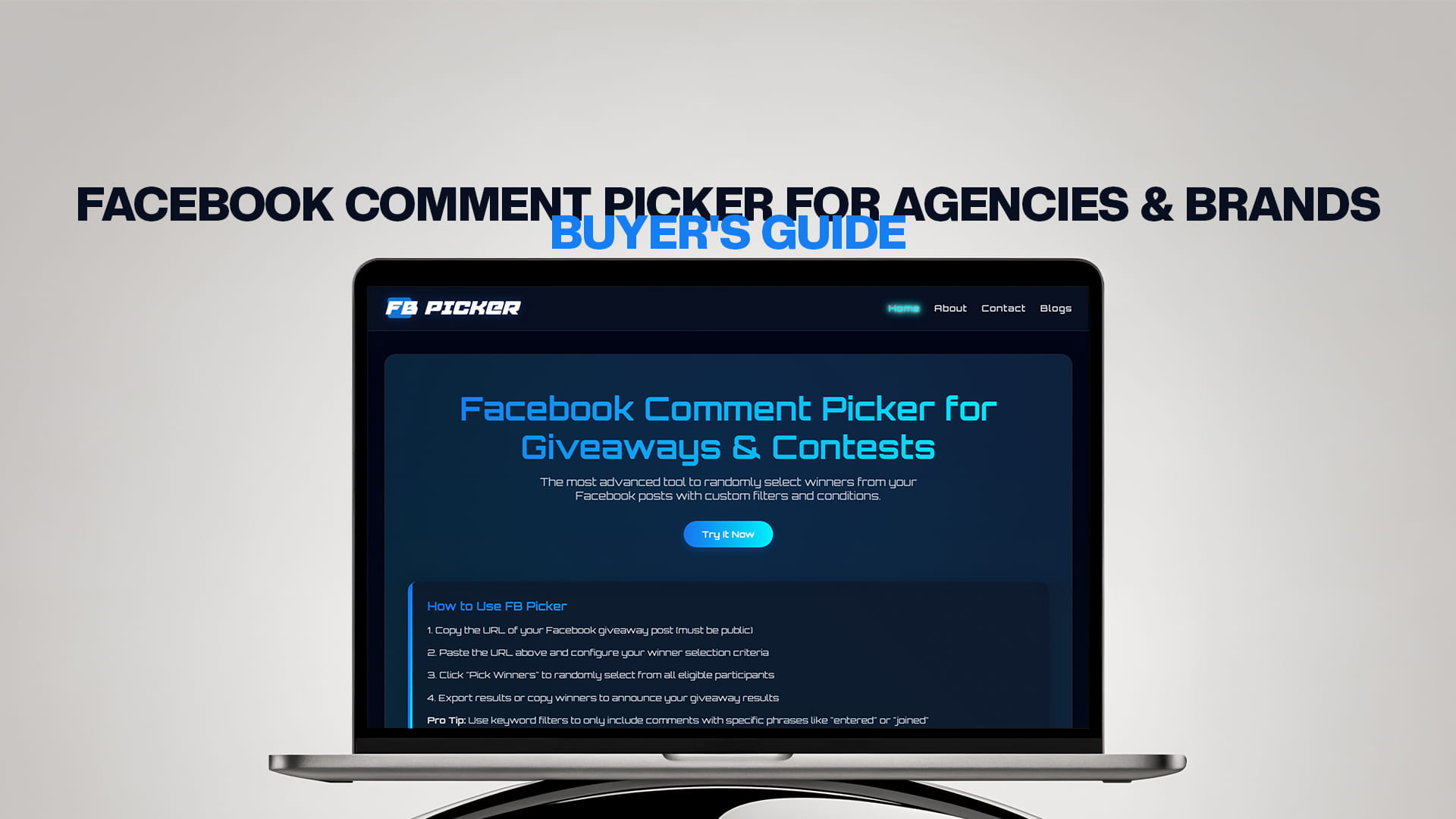
Facebook Comment Picker for Agencies & Brands: Buyer's Guide
Choosing a comment picker sounds like a five-minute decision, and for an individual running one giveaway, it is. For an agency or a brand team, it isn't, because the tool you standardize on gets used across dozens of campaigns, in front of clients or executives, on posts that sometimes carry real commercial weight. Choose badly, and you inherit a friction tax on every draw you run, or worse, discover mid-campaign that the tool quietly excluded most of your entrants from a giveaway you promised was fair.
This is a buyer's guide rather than a how-to. It covers the evaluation criteria that actually matter at professional scale, the red flags that should eliminate a tool from consideration, how to run a proper trial before committing, and the build-versus-buy question that occasionally comes up in larger organizations. The aim is to help you choose once, correctly, and stop thinking about it.
What makes this a different decision at scale
Four requirements separate professional use from casual use, and they're the lens for everything below.
Volume integrity. Brand giveaways routinely pull thousands of comments. A tool that silently caps at 100 or a few hundred doesn't merely inconvenience you; it produces a draw from a fraction of the entry pool, which means the fairness you promised in your published rules didn't happen. That's not a feature limitation; it's a compliance and reputation problem.
Defensibility. A client, a legal team, or an executive can ask at any point how a winner was chosen and who else entered. You need a process that produces a complete answer before anyone asks, not one that requires reconstruction afterward.
Presentation. Output that gets shown to clients or leadership has to look like your work, not a third party's advertising.
Repeatability at volume. A workflow that's fine once a month becomes a bottleneck at fifteen draws a month across a client roster or a multi-market brand. Friction multiplies by campaign.
The evaluation criteria that matter
Score any candidate tool against these, roughly in order of importance.
No silent comment caps. Confirm explicitly how many comments the tool reads, and what happens when a post exceeds that. Ambiguity here is disqualifying, because a hidden ceiling produces an unfair draw you may never notice. This is the single most important criterion and the one most often overlooked.
Secure, recordable randomness. The selection should use a cryptographically secure random method and happen on screen so you can capture it. A recorded draw is your primary evidence of fairness, and it's what turns "we ran it properly" into something you can show.
Real filtering. Duplicate removal at minimum, plus keyword filtering and the ability to exclude replies. These enforce your published entry rules, which is part of fairness rather than separate from it, and they keep bots and rule-breakers out of the pool.
Multiple winners and backups in one pass. Professional campaigns frequently award tiered prizes and need backups ready for no-shows. Drawing them in the same selection means a replacement was chosen by the same random process at the same moment, which is far more defensible than a separate draw later.
Exports. Entrant and winner lists in a usable format, for client reporting, internal records, and the documentation some jurisdictions expect.
Access model. Whether the tool requires connecting each Page or works from a public post URL. For multi-client or multi-market work, this matters enormously, and it's covered in its own section below.
Clean output. No competing ads or branding dominating a screen you'll put in front of a client.
Cost structure that matches usage. Whether pricing scales with campaigns, seats, or volume, and whether you'd be paying for capabilities you won't use.
The access-model question
This deserves separate attention because it's where professional workflows most often break, and it's rarely considered during evaluation.
Account-connected tools require you to log in and connect each Facebook Page you draw from. For a single brand with one Page, that's a one-time setup and entirely fine. For an agency with fifteen clients, or a brand with Pages across multiple markets, it becomes a recurring administrative burden: a connection to authorize per Page, permissions to approve, and access that really should be revoked when a client leaves or a market restructures, which rarely happens in practice. Over time you accumulate a sprawl of connected access nobody is tracking.
URL-based tools work from the public web address of the post instead. Because comments on a public post are publicly visible, there's no connection to establish, no permissions to grant, and nothing to revoke. The draw for your fifteenth client works exactly like the first. It also means you can draw from a public post on a Page you don't administer, which is a common situation when you run campaigns but the client holds the Page keys.
The trade-off is real and worth stating: URL-based tools can only read public posts, so private groups or restricted-audience posts need either a privacy change or a manual export. For the public-Page campaigns that make up virtually all brand and agency giveaway work, that's not a constraint, and the workflow difference is substantial.
Red flags that should eliminate a tool
Some findings should end your evaluation immediately.
Any tool asking for your Facebook password directly, rather than using the official login flow or working from a public URL. No legitimate tool needs your password. This is a security disqualifier, full stop.
Undisclosed comment limits. If you can't determine how many comments it reads, assume the worst and move on.
No way to record or evidence the draw. A result you can't demonstrate is a result you can't defend to a client.
A free tier that gates mid-draw. Tools that let you load comments and then demand payment to reveal the winner will eventually do that to you during a live client campaign.
No export capability. Without entrant records, you have no paper trail, which is a problem for reporting and for any dispute.
Unclear data handling. If it's not obvious what the tool does with the comment data it ingests, that's worth resolving before client data flows through it.
How to run a proper trial
Don't standardize on a tool based on a feature list. Test it against your actual work.
Run a real draw on a genuinely high-volume post, ideally one with more comments than your typical campaign, and verify the total entry count the tool reports matches what the post actually shows. This is the test that catches silent caps, and it's the one almost nobody performs.
Test every filter you rely on, and confirm the results change as expected. Record a draw end to end and watch the clip back as if you were a skeptical client, checking whether it visibly demonstrates the comment pool, the filters, and the selection. Export the entrant list and check the format is usable in your reporting.
Then hand the whole process to someone else on your team with no explanation beyond your written steps. If they can run it correctly first time, the tool is simple enough to standardize on. If they can't, you've found a training cost you'd have paid repeatedly.
Build versus buy
Occasionally a larger organization asks whether to build an internal picker. It's almost always the wrong call for this particular problem. You'd be building and maintaining something to ingest comments from a platform whose interfaces change, implementing cryptographically secure randomness correctly, building filtering and export, and creating a recording workflow, all to replicate something that already exists for free. The engineering time alone exceeds any plausible saving, and you'd own the maintenance burden forever.
The genuine exception is a large organization with a specific compliance requirement that no external tool satisfies, such as an internal-audit mandate that entrant data cannot leave a controlled environment. That's a real constraint, but it's rare, and it's worth confirming it actually exists rather than assuming it does.
Where FB Picker fits the criteria
Against the checklist above, FB Picker covers the professional requirements without a subscription for the core job. It works from a pasted public post URL with no account, login, or Page connection, which removes the per-client access sprawl entirely and lets you draw from any public post including Pages you don't administer. It reads the comments on your post rather than stopping at a low free ceiling, so volume integrity holds on brand-scale giveaways. It includes duplicate removal, keyword filtering, and reply exclusion to enforce published entry rules, and it selects the winner at random using a cryptographically secure method, on screen, so recording proof is a byproduct rather than an extra step. You can pick multiple winners and backups in a single pass, and export entrant and winner lists for reporting and records.
Where account-connected platforms retain an edge is breadth: multi-network dashboards, campaign infrastructure like landing pages and entry forms, and integrations that matter if your giveaways are multi-part funnels rather than comment threads. Match the tool to the shape of your actual campaigns, and if they're Facebook comment contests, the URL-based route is less setup for the same defensible result. Running every campaign through the same random comment picker for giveaways workflow is what makes the documentation consistent across clients and markets.
The bottom line
For agencies and brands, the comment picker decision is really a decision about volume integrity, defensibility, presentation, and repeatability, in that order. Verify comment limits explicitly, because a silent cap breaks the fairness you promised in your rules. Insist on secure randomness you can record, real filters that enforce your entry conditions, multiple winners drawn in one pass, and usable exports. Weigh the access model seriously, since per-Page connections create genuine administrative and security sprawl across a client roster or a multi-market brand, while URL-based tools scale flat. Eliminate anything that asks for your password, hides its limits, gates mid-draw, or can't produce records. Then trial it on a real high-volume post rather than a feature list, standardize once through a dependable free comment picker and giveaway tool, and turn winner selection from a recurring risk into a documented, repeatable part of how your team works.
Frequently Asked Questions
In priority order: no silent comment caps (verify the actual limit), secure randomness you can record as proof, real filters like duplicate removal and keywords, multiple winners and backups in one pass, usable exports for reporting, an access model that scales across Pages, and clean output suitable for client presentation.
Because a tool that silently reads only the first 100 or few hundred comments draws from a fraction of your entrants, which means the fair random selection you promised in your published rules didn't actually happen. On a brand giveaway pulling thousands of comments, that's a fairness and compliance problem, not just an inconvenience.
For public-post campaigns, yes, and it often scales better. Because there's no per-Page connection to authorize or revoke, you avoid accumulating access across a client roster, and you can draw from public posts on Pages you don't administer. The limitation is that it can't read private groups or restricted-audience posts.
Record the selection on screen, showing the real comment pool, the filters applied, and the random draw, then export the entrant and winner lists and file both with the campaign. That recording plus the export answers any question about how the winner was chosen, long after the campaign has ended.
Almost never. You'd be replicating comment ingestion, secure randomness, filtering, exports, and recording, all of which already exist for free, while taking on permanent maintenance as platform interfaces change. The rare exception is a genuine compliance mandate that entrant data can't leave a controlled environment, which is worth verifying rather than assuming.