
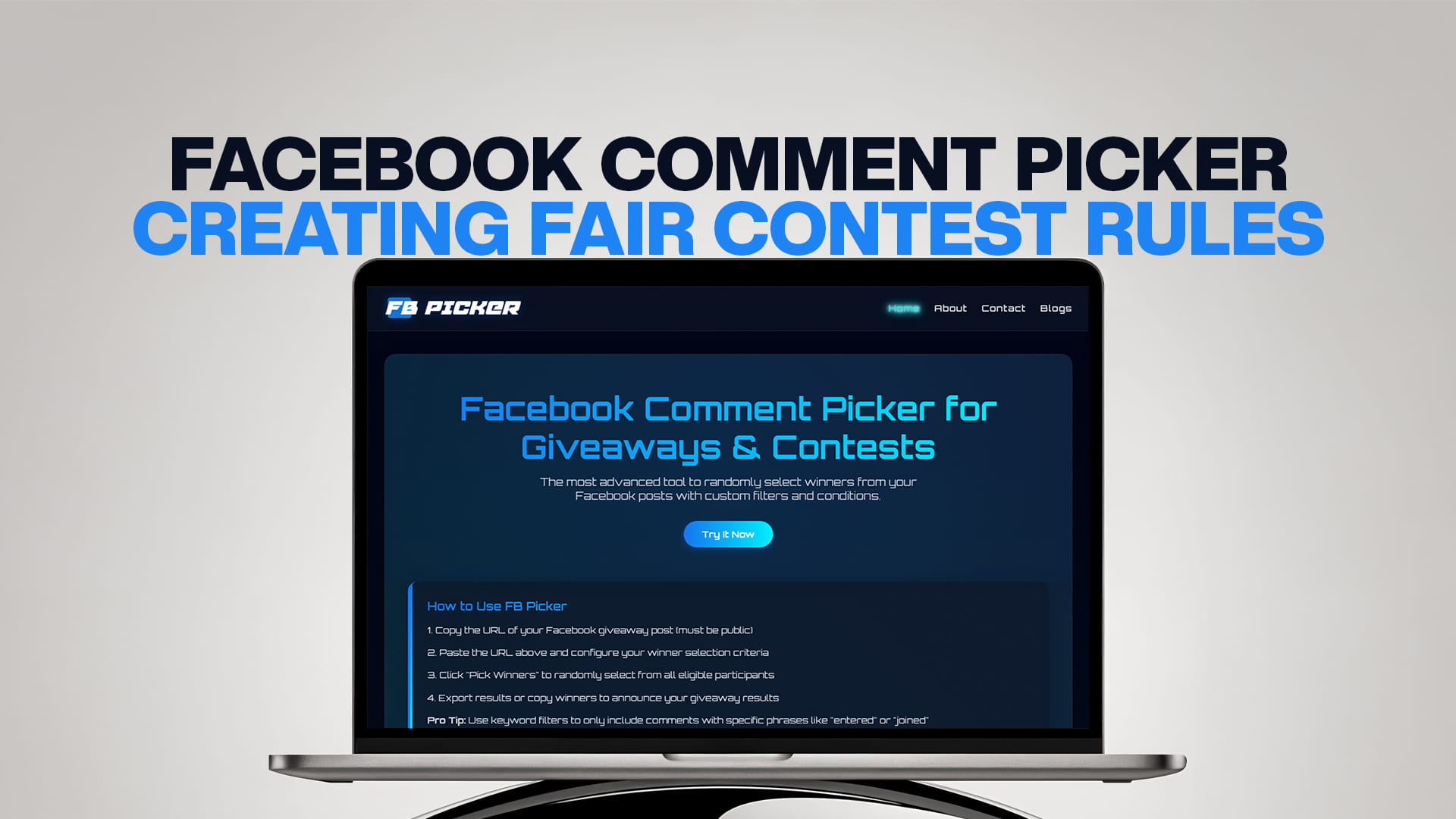
Facebook Comment Picker - Creating Fair Contest Rules
Most Facebook giveaways fail before they even start. Not because the prize was bad. Not because the post did not reach enough people. They fail because the rules were unclear, inconsistent, or just not written down at all — and when the winner is announced, half the comment section has questions, complaints, or both.
Fair contest rules are not just legal protection. They are the foundation of a giveaway your audience will actually trust. And trust is what determines whether people enter your next one.
This guide covers how to write contest rules that are clear, fair, and easy to enforce — and how FB Picker fits into the process of making sure those rules are actually applied when it comes time to pick a winner.
Why Contest Rules Matter More Than Most People Think
A lot of page owners treat contest rules as a formality. They throw a quick "like and comment to win!" in the caption, maybe add "winner chosen randomly," and call it done.
That approach causes real problems.
Without clear rules, you have no way to handle disputes. Someone will comment that they entered first and should win. Someone else will say their tag did not count because the person they tagged does not have Facebook. A third person will claim they followed your page, but it did not register. With no written rules to point to, every one of these becomes a judgment call you have to make in public.
Without eligibility requirements, anyone can enter — including people in countries you cannot ship to, people under the minimum age for your product, and people who created a fake account five minutes ago. If you draw one of these entries as your winner, you have a problem.
Without a stated selection method, people assume the worst. Even if you use a completely random, documented tool like FB Picker, someone will question it if you never said upfront how you planned to pick. "We chose randomly" without any explanation of how is just not convincing in 2026.
And without a response deadline for the winner, you can end up waiting indefinitely for someone who never checks their messages, while your audience waits for a resolution that never comes.
Rules solve all of these things. They set expectations, close loopholes, and give you a clear process to follow from entry through winner announcement. Writing them well takes maybe 20 minutes the first time. After that, you have a template you can adjust for each giveaway.
What Fair Contest Rules Actually Look Like
Fair rules share a few characteristics regardless of what platform you are running the giveaway on or what you are giving away.
They are specific. Not "enter by commenting below" but "enter by commenting your answer to the question below — one entry per person." Not "winner chosen randomly" but "the winner will be selected at random using FB Picker from all eligible comments at the close of the giveaway."
They are complete. They cover who can enter, how to enter, when the giveaway ends, how the winner is chosen, and what happens if the winner does not respond. Any question a reasonable person might have about the giveaway should be answered by the rules.
They are honest. Rules that say one thing and mean another — like saying "comment to enter" when you are actually going to pick your favorite answer rather than a random winner — are not fair rules. They are in the theater. Write what you actually plan to do.
They are accessible. Someone should be able to read your rules and understand them without needing to re-read them three times or ask for clarification. Plain English. Short sentences. No legal jargon that makes people tune out after the first line.
The Core Elements Every Facebook Contest Needs
Whether you are giving away a $20 gift card or a $2,000 product bundle, these elements belong in every set of contest rules.
The prize. Describe it specifically. Not "an amazing bundle" — name the items, the value, the variant (size, color, version), and anything else that tells people exactly what they are entering for. Vague prizes attract fewer entries and cause confusion when the winner is contacted.
Who can enter? Age restrictions. Geographic restrictions. Whether employees or their families can enter. Whether previous winners are eligible again. Facebook requires that promotions comply with applicable laws and Facebook's own policies, and eligibility restrictions are part of that compliance. Even a simple "Open to residents of the United States aged 18 and older" closes a lot of potential disputes.
How to enter. Spell out every step required. If they need to follow your page and comment with a tagged friend, say both. If each tag earns a separate entry, say that too. If it is one entry per person regardless of activity, say that. The clearer this section is, the easier it is to filter correctly when the giveaway closes.
When the giveaway ends. A specific date, time, and time zone. Not "this weekend" or "soon." A line like "This giveaway closes on Saturday, July 12, 2025, at 11:59 PM Eastern Time" leaves zero room for ambiguity.
How the winner is selected. Name the method. If you are using FB Picker, say so. Something like "The winner will be selected at random using FB Picker from all eligible entries. Entries with duplicate commenters will be excluded. Only comments including a valid friend tag will be considered." This explains your process in advance and makes the result credible when you publish it.
What happens after selection? Will you tag the winner publicly? Send a DM? Both? How much time does the winner have to respond before an alternate is chosen? Stating this upfront means nobody is surprised when you move to an alternate winner after 48 hours of silence.
Prize delivery. Especially for physical prizes — how long will shipping take? Are you covering shipping costs? Is there anything the winner needs to provide (like a shipping address by a certain date)?
The Facebook disclaimer. Facebook requires that all promotions on the platform include a statement that the promotion is not administered by or affiliated with Facebook. This is not optional. A simple line saying "This promotion is in no way sponsored, endorsed, administered by, or associated with Meta or Facebook" covers the requirement.
Where to Put Your Rules
The rules do not all have to live in your post caption. In fact, for longer rule sets, cramming everything into the caption makes it harder to read and more likely to be ignored.
A good approach is to include the key entry requirements in the caption — the what, how, and when — and link to or reference a more complete rules document elsewhere. This could be a pinned comment on the post, a link to your website's terms page, or a note in your page's About section.
For most small to medium giveaways, a pinned comment works perfectly. Write out the full rules — prize details, eligibility, selection method, response deadline, Facebook disclaimer — and pin it at the top of the comment thread. Anyone who wants to see the full terms can read them easily. Your caption stays clean and readable.
For larger giveaways, especially ones with significant prize value or legal complexity (sweepstakes law varies by country and US state), having a proper terms document on your website is worth the effort. That document should be dated, reference the specific giveaway it covers, and be accessible throughout the contest period.
How FB Picker Enforces Your Rules Automatically
Writing clear rules is step one. Actually enforcing them at the moment of selection is step two — and this is where a lot of giveaways go wrong, even when the rules were well written.
Suppose your rules say one entry per person. Without a tool, you would need to manually go through every comment, identify duplicate commenters, remove their extras, and then make your selection. With hundreds of comments, that takes a long time and involves a real chance of error. With thousands of comments, it is practically impossible to do accurately.
FB Picker handles this in a few seconds. Set the filter for unique commenters only, and the tool automatically deduplicates. No matter how many times someone commented, they got one entry. Your rules are enforced exactly as written.
Suppose your rules say only comments that include a specific keyword or a friend tag are eligible. Again, manually checking every comment is error-prone and slow. With FB Picker's keyword filter, you enter the required word or phrase, and the tool only draws from comments that match. Entries that did not follow your instructions are excluded automatically.
This is not just convenient — it is essential for fairness. Rules that say one thing but are applied differently in practice are not actually fair rules. They create a gap between what you promised and what you delivered. Closing that gap is exactly what FB Picker's filtering system does.
After the draw, FB Picker gives you a shareable result that shows the winner and confirms the process was random. Screenshot it. Post it alongside the winner announcement. That single image does more for your credibility than any written explanation could, because it shows rather than tells.
Common Contest Rules Mistakes and How to Fix Them
These are the mistakes that cause the most headaches — some obvious, some easy to miss.
Leaving out geographic restrictions. If you can only ship within your country, say so. If you find out after the draw that your winner lives on the other side of the world, you are in a genuinely awkward position. Adding "open to [country/region] residents only" costs you nothing and saves you a lot of trouble.
Not stating whether multiple entries are allowed. Silence on this point is interpreted as permission. If you say nothing about it, some people will enter once and some will enter 50 times. That is not a level playing field. Either say "one entry per person" or specify exactly what earns additional entries.
Vague prize descriptions. "A special gift" or "one of our bestselling products" tells people almost nothing. If someone asks "what exactly is the prize?" in the comments before entering, that is a sign your description was too vague. Fix it in the caption before the giveaway gains momentum.
No deadline or a deadline stated only as a day without a time. "Ends Sunday" is not a deadline — it is an approximation. When Sunday ends in one time zone but not another, you have entries coming in after you have already run the draw. Use a specific date, time, and time zone every time.
Forgetting the Facebook disclaimer. Facebook's promotion policies have required this notice for years and most pages still do not include it. It does not need to be prominent — a single sentence at the bottom of your rules is enough. But missing it puts you in technical violation of Facebook's terms, which matters if your page ever gets reviewed.
Announcing the winner without documenting the selection. This is not technically a rules mistake, but it is the step where many otherwise well-run giveaways lose credibility. Announce the winner — great. Announce the winner with a screenshot of the FB Picker result showing the draw was fair — much better. The documentation is the proof.
Making the rules too long for anyone to read. There is a balance between complete and overwhelming. If your rules run to 800 words for a $50 gift card giveaway, people are not reading them. Aim for the essentials only. Everything else can live in a linked document for those who want the full version.
A Practical Contest Rules Template
This is a starting point you can adapt to any Facebook giveaway. It is written to be complete enough to cover the basics but short enough that people will actually read it.
🎁 GIVEAWAY — [Prize Name]
We are giving away [specific prize description and value] to one lucky winner.
How to enter: 1. Follow our page 2. Comment below with [specific entry instruction]
Rules: — One entry per person — Open to residents of [country/region], aged 18 and over — Giveaway closes [Day, Date, Year] at [Time] [Time Zone] — Winner selected at random using FB Picker from eligible comments — Winner will be announced publicly and contacted by DM — Winner has 48 hours to respond before an alternate is selected — Prize will be delivered by [delivery method]
This promotion is in no way sponsored, endorsed, administered by, or associated with Meta or Facebook.
That is the whole template. Every element matters. The prize is specific. The entry steps are numbered and unambiguous. The deadline includes a time zone. The selection method is named. The response window is defined. The Facebook disclaimer is included.
You can expand any section if your giveaway requires it — adding details about shipping timelines, additional eligibility restrictions, or extra entry opportunities. But this is the floor. Every giveaway should have at least this.
How Your Rules Affect Your Long-Term Reputation
This is the part of the rules conversation that does not get enough attention.
Every giveaway you run is a data point your audience uses to decide whether to trust you. Rules that are clear, followed through on, and enforced fairly build trust. Rules that are vague, inconsistently applied, or written to cover up an unclear process do the opposite.
The pages with the most engaged communities are usually the ones that have been running giveaways the same way for a long time. Same tool, same documentation, same process. Their audiences know what to expect. They enter because they believe the draw is fair. They follow the page between giveaways because they trust the brand behind it.
That trust is built contest by contest. Every time you post a winner announcement with an FB Picker screenshot, every time you respond to a dispute by pointing to your clearly written rules, every time you follow through on delivery without prompting — you are adding to that trust.
The inverse is also true. One giveaway where the rules were unclear and the winner selection seemed suspicious can undo months of credibility building. It is not worth cutting corners on the rules document to save five minutes.
Handling Disputes and Edge Cases
Even with perfectly written rules, things come up. Here is how to handle the most common edge cases without losing your audience's confidence.
Someone claims their comment was deleted, and they should still be eligible. Unless you have a reason to believe this is true, your rules should specify that you are responsible only for entries visible at the time of the draw. Comments that were removed by Facebook's spam filter or by the user themselves are not your liability. State this in your rules if you want to preempt the argument.
A winner's account looks fake or newly created. Your rules can require that winners have an account in good standing for at least a set period — 30 days is a reasonable threshold. If a winner fails this check, you move to the next eligible entry. The key is that this criterion is in the rules before the draw, not invented after the fact.
Multiple people claim they tagged the same friend and should both get credit. If your entry allows tagging, clarify in the rules whether it is one tag per person or whether multiple tags in one comment each count as entries. Most pages choose one entry per person regardless of tag count, and that is the simplest rule to enforce.
Someone in an ineligible region enters and is selected. Your rules should explicitly state that ineligible entries will be disqualified and a new winner will be drawn. With FB Picker, you can simply run the draw again if the winner cannot be verified as eligible. Document this redraw the same way you documented the original.
The winner receives the prize but publicly complains about it. This one is less about rules and more about delivery. Make sure your prize description in the rules is accurate enough that there are no surprises for the winner. If the prize turns out to be different from what was described, it is your responsibility to make it right.
One Draw, Repeatable Process
The real goal of writing good contest rules is not to produce a perfect legal document. It is to create a process you can repeat reliably.
When your rules are clear and your selection method is consistent, running a giveaway becomes a repeatable workflow rather than a custom operation every time. You adjust the prize and the entry requirement, update the deadline, and the rest of the structure stays the same. Your audience learns what to expect. The process gets faster. The trust compounds.
FB Picker is the part of that process that handles the draw. It takes the most sensitive moment — picking the winner — and makes it objective, documented, and defensible. Combined with well-written rules, it is the complete answer to the question of how you run a giveaway that your audience will never doubt.
If you have been running giveaways with informal rules and manual winner selection, your next contest is the right time to change both. Write the rules using the template above as a starting point. Run the draw through FB Picker. Post the result publicly. Then notice the difference in how your audience responds — not just to the winner announcement, but to the next giveaway you run.
Other Platforms Where Fair Rules Matter
The principles in this guide apply to every social platform, not just Facebook. Clear rules, documented selection, transparent results — these build trust wherever you run giveaways.
If you run contests on TikTok, TTPicker.com randomly selects winners from TikTok video comments. The same filtering logic applies — unique commenters, keyword conditions, documented results.
For YouTube giveaways run through video comments, YTPicker.com handles the selection with filters you set to match your stated entry requirements. YouTube comment sections can grow fast, and having a tool that enforces your rules automatically matters even more at scale.
For Reddit-based giveaways and community contests, RDTPicker.com draws random winners from Reddit thread comments — useful for subreddit events, product launch giveaways, or community appreciation posts where a fair, documented draw builds trust with a discerning audience.
And for giveaways on Bluesky, BSKYPicker.com brings the same transparent random selection to Bluesky post comments — consistent with how a growing platform's community expects giveaways to be run.
The platform changes. The standards for fairness do not. Clear rules, proper filtering, documented selection, public results — that is the process that works everywhere.