
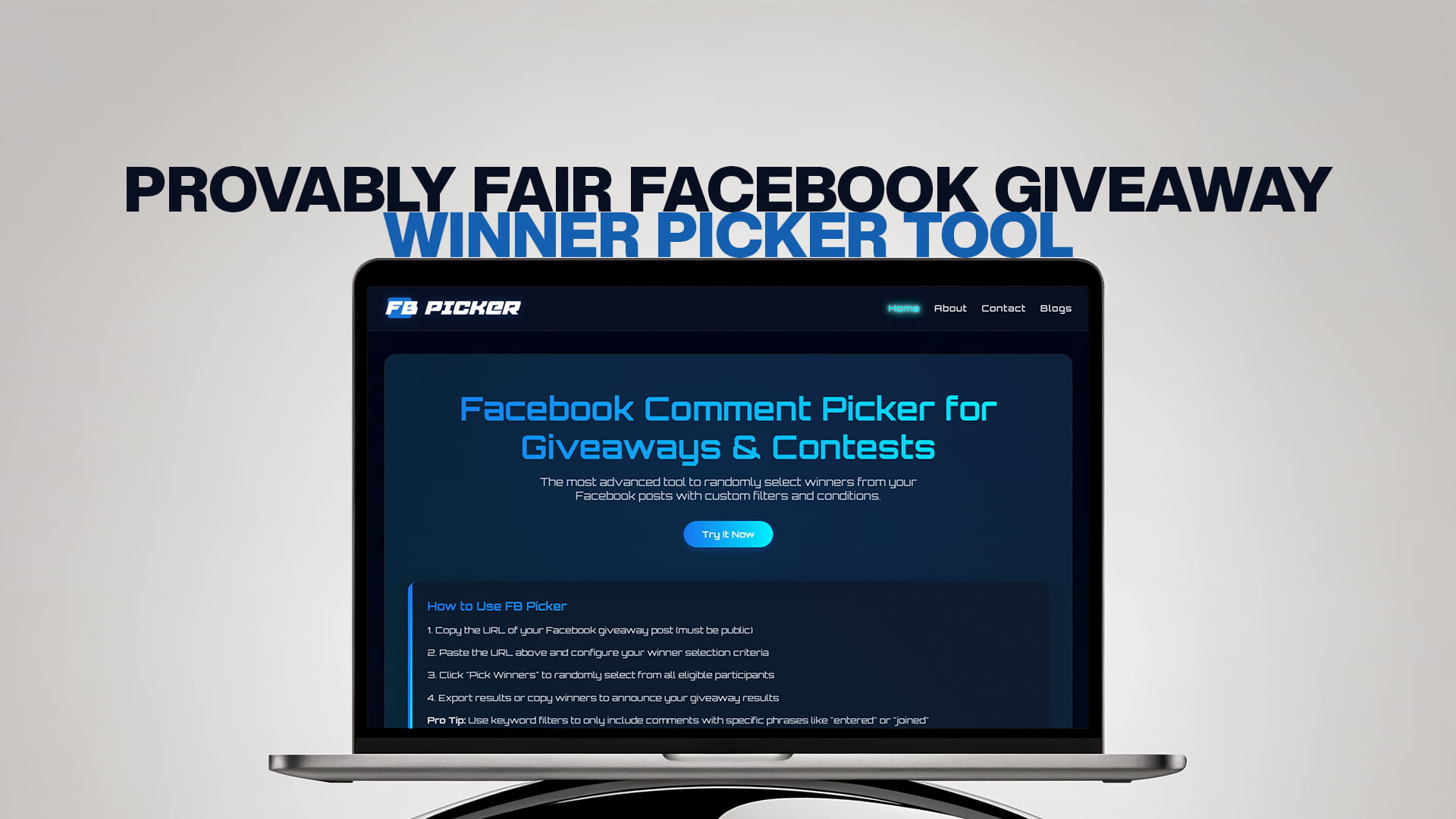
Provably Fair Facebook Giveaway Winner Picker Tool
"Trust me, it was random" is the weakest sentence in any giveaway. You might have picked the winner with complete honesty, but nobody saw it, so nobody has to believe it. The whole idea behind a provably fair draw is to replace that blind trust with something an entrant can actually check, so the fairness of your giveaway rests on evidence rather than your word.
The term "provably fair" comes from a world obsessed with verifiable randomness, and it's worth understanding properly, because it's often used loosely. This guide explains what provably fair really means, the spectrum of fairness from "recorded random draw" to full cryptographic verification, why it matters for giveaways, and how to run a draw you can genuinely prove was fair.
What "provably fair" actually means
In its strict, technical sense, "provably fair" describes a system where anyone can independently verify that a random outcome was generated honestly and wasn't altered after the fact. It originated in online gaming, where players needed a way to confirm that a dice roll or a shuffle wasn't rigged against them.
The mechanism usually works through cryptography. Before the draw, the system commits to a hidden value, often by publishing a hash of a secret "seed." After the draw, it reveals the original seed. Because the published hash can't be faked or changed after the commitment, anyone can take the revealed seed, run it through the same algorithm, and confirm that it produces the exact result that occurred. If it matches, the draw was provably fair. The key property is that the outcome was locked in before it was revealed, and the operator couldn't have nudged it.
That's the gold standard of verifiable randomness. For a giveaway, you don't always need that full machinery, but understanding it clarifies what you're aiming for: a result an entrant can confirm rather than simply accept.
The fairness spectrum for giveaways
Most giveaways don't run on a casino-grade cryptographic protocol, and they don't need to. Fairness for a comment giveaway sits on a spectrum, and it's useful to know where each option lands.
At the bottom is the hand-picked draw: you scroll the comments and choose. This has no fairness guarantee at all, and it's the approach that breeds suspicion, because the only evidence is your say-so.
In the middle, and where most good giveaways live, is the recorded random draw. You use a tool that selects a winner with a secure random method, and you record the selection happening on screen. Anyone can watch the winner emerge from the real comment pool through a process you didn't control. This isn't cryptographic verification, but it's strong, practical proof: the randomness is external to you, and the recording shows it wasn't staged.
At the top is full provable fairness with seed verification. The tool exposes a seed or verification link so that you, or any skeptical entrant, can replay the exact draw and confirm the winner mathematically. This is the most rigorous option and overkill for a casual contest, but valuable for high-stakes giveaways where the outcome might genuinely be contested.
The right level depends on your stakes. For the vast majority of giveaways, a recorded random draw from a secure tool is more than enough to satisfy your audience.
Why fairness you can prove matters
Beyond doing the right thing, provable fairness has practical payoffs. Audiences have learned to be wary of giveaways, because so many online are fake or quietly rigged, so a visibly fair draw stands out and builds trust. That trust translates into participation: people enter when they believe they actually have a shot. Studies of contests have found that giveaways with a public, verifiable winner-selection process drive substantially more engagement than those that just post a name with no proof.
There's also a defensive benefit. If anyone questions your result, evidence ends the argument instantly. A recorded draw, a published rule set, and an exported entrant list leave almost nothing to dispute, whereas a bare announcement invites exactly the doubt you're trying to avoid. And in some jurisdictions, promotion rules expect organizers to be able to demonstrate a fair, random selection, so building proof into your process keeps you compliant as well as credible.
What to look for in a fair picker tool
A tool that helps you run a provably fair, or at least demonstrably fair, giveaway should offer a few things.
A secure random method. The selection should use a cryptographically secure random process, not a weak shuffle, so the result is genuinely unpredictable and unbiased. Every eligible entry should have an equal chance.
An on-screen, recordable draw. The selection should happen visibly so you can capture it. The ability to select the winner at random on screen is what turns "trust me" into "watch this."
Filters that enforce your rules. Duplicate removal and keyword filtering mean the draw only includes legitimate, eligible entries, which is part of fairness, not separate from it.
Multiple winners and records. The option to pick multiple winners and export the entrant list supports backups and the paper trail that proof depends on.
And, at the most rigorous end, seed-based verification, where the tool exposes a verification link or seed so the draw can be independently replayed. Not every tool offers this, and most giveaways don't require it, but it's the feature to look for if you need mathematically verifiable fairness.
How FB Picker delivers fairness you can show
FB Picker is built around demonstrable fairness. It uses a cryptographically secure random method to select winners, so the draw is genuinely unbiased and every eligible comment has an equal chance. It runs the selection on screen, which means you can record the whole thing, showing the real comment pool, the filters you apply, and the winner emerging, and post that clip as proof. You can remove duplicates so only legitimate entries are in the pool, and draw multiple winners or backups in a single pass. For the level of fairness almost every giveaway needs, that combination, secure randomness plus a recordable, transparent draw, is exactly the evidence your audience is looking for. A random comment picker for giveaways that works this way lets you prove your result rather than just assert it.
Recorded draw versus seed verification, in practice
It's worth being concrete about when each level is the right call, because reaching for the heaviest option by default just adds complexity nobody will use.
A recorded random draw fits the vast majority of giveaways: a creator rewarding followers, a shop running a product contest, a restaurant giving away dinner. The stakes are modest, the audience mainly wants to see that you didn't cherry-pick a friend, and a one-minute clip of the draw answers that completely. Almost nobody in that audience would ever sit down to verify a cryptographic seed, even if you gave them one.
Full seed verification earns its place when the prize is high-value enough that a losing entrant might genuinely allege fraud, or when you're running on behalf of a brand that needs mathematical, not just visual, proof. In those cases the ability for any skeptic to replay the exact draw and confirm the winner is worth the extra machinery. The honest guidance is to match the proof to the stakes: don't skip recording even on small giveaways, and don't bolt on cryptographic verification for a contest where nobody would ever use it.
Common myths about fair giveaways
A few misunderstandings cause needless worry. One is that a truly random result will "look random," when in fact randomness often clusters; the same person or region winning twice in a row can be perfectly fair, which is exactly why recorded proof matters more than gut feeling. Another is that announcing a name is itself proof; it isn't, because a name with no visible process is indistinguishable from a hand-picked. A third is that you must use cryptographic verification to be fair, when for most giveaways a secure random draw you record is entirely sufficient. And a fourth is that fairness is about giving everyone equal odds of entering, when it's really about giving every eligible entry an equal chance of being drawn, which is why duplicate removal and clear eligibility rules are part of fairness, not separate from it.
A few practical tips
Decide your fairness level before you launch, based on the stakes: a recorded random draw for normal giveaways, and seed-level verification only if you're running something high-value or likely to be contested. Always record the draw, even small ones, because the habit builds a reputation for honesty. Publish your rules before entries open, so the process is fixed in advance. Keep your recording and an exported entrant list as your evidence. And announce the winner publicly, since a result shown in the open invites the scrutiny that builds trust rather than avoiding it. Run each draw through the best free Facebook comment picker and capture it, and your giveaways will be as credible as they are fair.
The bottom line
"Provably fair" is really about one thing: letting people verify your draw instead of asking them to trust it. In its strictest form that means cryptographic seed verification, but for the giveaways most people run, a secure random selection that you record and announce publicly delivers all the proof your audience needs. Pick a tool that draws with a genuinely random method and lets the selection happen on screen, capture it, keep your records, and you'll never again have to defend a result with nothing but "trust me." The evidence will already be there. Match the proof to the stakes, make recording every draw a habit rather than an afterthought, and fairness stops being something you assert and becomes something anyone who cares to look can confirm for themselves.
Frequently Asked Questions
It means the fairness of your draw can be verified rather than just trusted. In the strictest sense, it involves cryptographic seed verification that lets anyone replay the draw, but for most giveaways, it means using a secure random tool and recording the selection so people can see it was genuinely random.
Usually not. Casino-style seed verification is overkill for a normal comment giveaway. A recorded random draw from a secure tool, plus published rules and a public announcement, is enough proof for almost any audience. Reserve full verification for high-value contests that might be disputed.
Record the selection on screen, showing the real comment pool, the filters you apply, and the winner being drawn, all in one uncut clip. Post it with your announcement. That visible, external process is the most practical proof of fairness available to most organizers.
Not quite. A cryptographically secure random method ensures the result is genuinely unpredictable and unbiased, which is the foundation. "Provably fair" in the strict sense adds independent verification, like an exposed seed, so anyone can confirm the result. Secure randomness plus a recorded draw covers most needs.
Audiences are wary of fake or rigged giveaways, so a visibly fair draw builds the trust that makes people participate. Contests with a public, verifiable selection process tend to drive significantly more engagement than those that just announce a name with no proof, because entrants believe they genuinely have a shot.