
How to Spot Fake Entries Bots Giveaway
You run a giveaway, the comments pour in, and it feels like a roaring success. Then you look closer and notice the cracks: the same person entered eleven times, a brand-new account with no photo just posted "win win win," and a cluster of comments landed in the same three seconds. Those aren't real entrants. They're noise, and if one of them wins, you've handed your prize to a bot or a serial freebie account while a genuine supporter goes home empty-handed.
Fake entries are the quiet problem most giveaway guides skip. They dilute your odds for real people, skew the engagement numbers you're trying to read, and, worst of all, can hand the prize to someone who never deserved it. This guide covers what fake entries actually are, the red flags that give them away, and how to filter them out so your giveaway rewards a real human.
What counts as a fake entry
"Fake" covers a few different things, and it helps to name them.
Bots are automated accounts that comment on giveaways at scale, usually to farm prizes or to look active. Their comments tend to be generic and instant. Duplicate or sock-puppet entries come from one person using several accounts, or one account commenting many times, to multiply their chances. Giveaway-hunter accounts are real but exist only to enter contests; they'll never engage with you again and often violate the spirit of your rules. And rule-breakers are ordinary people who didn't actually do what you asked, they skipped the keyword, didn't follow, or tagged a stranger just to enter.
Not all of these are malicious, but all of them distort a fair draw. The goal isn't to be paranoid. It's to make sure the winner is a genuine, eligible entrant.
Why bots and fakes target giveaways
Giveaways are magnets for low-effort entries because the reward is real and the cost of entering is near zero. A bot can drop a one-word comment on a thousand contests a day at no risk. A freebie hunter can run dozens of accounts. And because most organizers pick winners quickly and trust the comment thread at face value, the fakes often slip through. The more visible and valuable your prize, the more of them you'll attract, which is exactly why a popular giveaway needs more scrutiny, not less.
The red flags: how to spot them
Once you know what to look for, fakes are easier to catch than you'd think. Watch for these signals.
Brand-new or empty accounts. No profile photo, almost no friends, a name that looks auto-generated, and a timeline with nothing but giveaway entries. One or two of these is normal; a wave of them is a bot swarm.
Generic, lazy comments. "Done," "win win win," a string of identical emojis, or a comment that has nothing to do with your actual question. Bots rarely bother to read the prompt, so a comment that ignores your instructions is a tell.
The same person, many times. Someone commenting ten or twenty times is trying to stack the odds. Genuine entrants comment once.
Instant bursts. A cluster of comments posted within the same few seconds, often with similar wording, usually means automation rather than a sudden rush of fans.
Tag spam. Entrants tagging dozens of random strangers, or the same handful of accounts over and over, rather than a real friend who'd care about the prize.
Rule skippers. People who didn't include the keyword you asked for, didn't follow your page, or otherwise ignored the entry steps. They're not always bots, but they're not eligible either.
None of these is proof on its own. Together, they paint a clear picture, and the cleanest way to act on that picture is to filter before you draw and to verify after.
Filter before you draw
The first line of defense is removing the obvious junk before you pick a winner, and a good comment picker does most of this automatically. Remove duplicate commenters so no one can win twice from a flood of entries. Require a keyword so only people who followed your instructions, and bots that bothered to read them, stay in the pool. Exclude your own page's replies so your admin comments don't get swept in. Running these filters through a random comment picker for giveaways turns a messy thread into a clean list of eligible entries in seconds, without you scrolling through hundreds of comments by hand.
Verify the winner before you announce
This is the single most important habit, and almost nobody does it. After the tool draws a winner, spend thirty seconds looking at that account before you announce it publicly. Does it look like a real person, with a photo, some history, and friends? Did they actually follow your entry rules? Is it their only entry? If the drawn account is clearly a bot or a rule-breaker, draw again. Verifying the winner, rather than the whole thread, is fast because you only have to check one account, and it's the step that guarantees your prize goes to a real human. This is also why drawing a backup or two is smart: if your first pick fails the check, you can pick multiple winners in the same pass and move straight to the next eligible name.
Design a giveaway that resists bots
You can also discourage fakes before they ever enter, by building a little human-friendly friction into your entry rules. Bots are lazy; humans are not.
Ask people to comment a specific word or answer a simple question. A bot dropping "win" won't include your keyword, so a keyword filter quietly removes most of them. Ask for a genuine friend tag rather than a generic action, which is harder to automate meaningfully. Require people to follow your page, since most bot and throwaway accounts won't. And keep the prize relevant to your brand rather than a generic cash card or gadget, because an on-brand prize attracts people who actually want it instead of every freebie hunter on the platform. None of this should make entering a chore for real fans, the trick is friction that's trivial for a human and annoying for a bot.
Where a comment picker does the heavy lifting
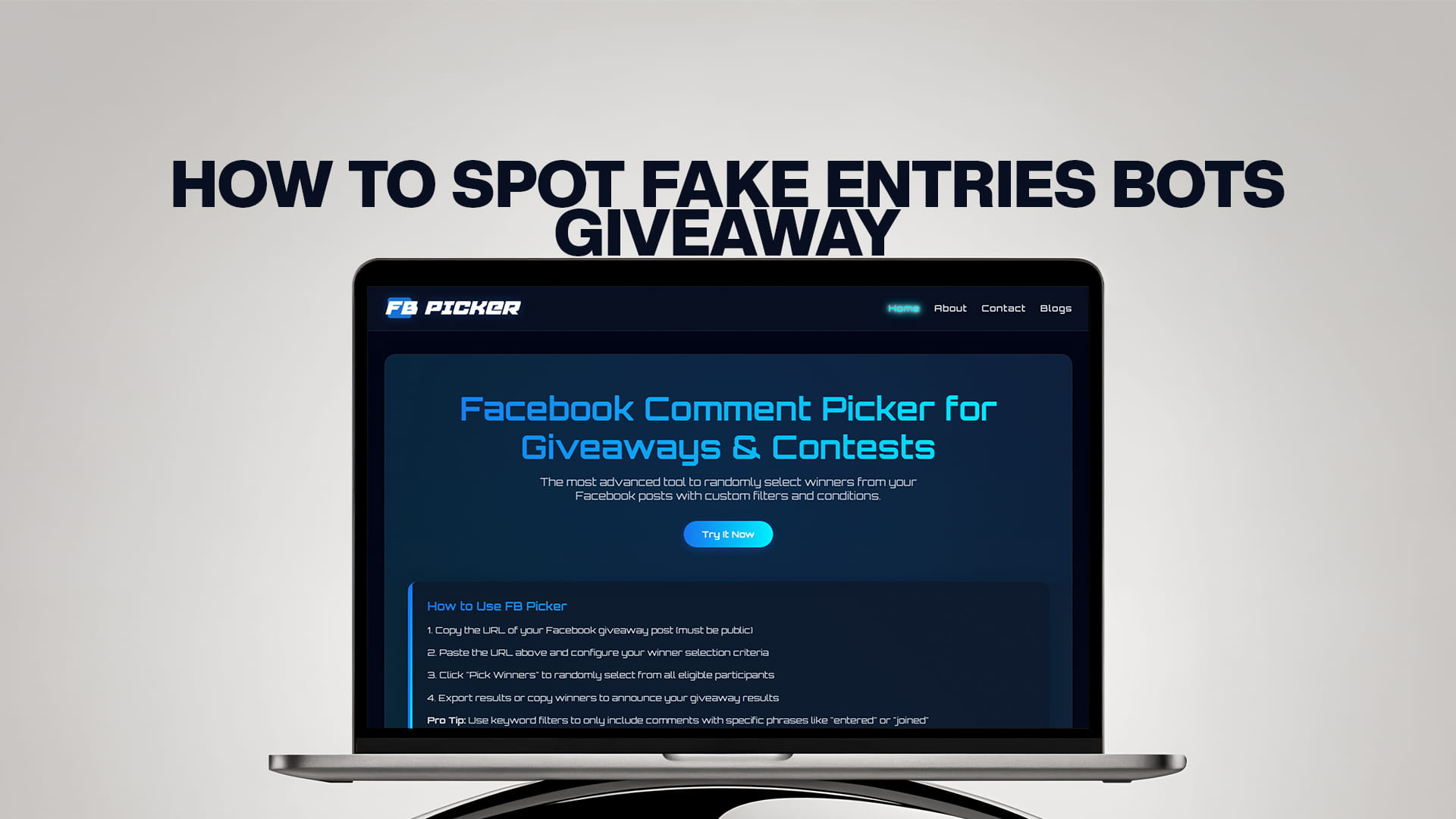
Trying to police all of this manually on a big giveaway is hopeless. This is where a tool earns its place. FB Picker pulls every comment from your post, lets you strip out duplicates, filter by your keyword, and exclude replies, then selects the winner at random from the cleaned pool. You verify the drawn account, and if it doesn't pass, you draw again from the same eligible list. It turns hours of squinting at suspicious comments into a one-minute, repeatable process, and it means the randomness only ever applies to entries that actually qualify.
Don't over-police your real fans
There's a flip side worth keeping in mind: not every imperfect entry is fake. Plenty of genuine supporters enter in low-effort ways, a quick clap emoji, a one-line answer, an account with a sparse profile because they rarely post. Treating every minimal entry as a bot will eventually disqualify real people and make your giveaways feel hostile. The goal is to catch the obvious fakes, the bot bursts, the twenty-entries-from-one-account, the rule-skippers, not to demand a polished profile from everyone.
A good rule of thumb: judge entries on behavior, not on how slick the account looks. A modest account that followed your rules and entered once is a real fan. A glossy account that ignored your keyword and tagged thirty strangers is the suspicious one. Filtering for your keyword and removing duplicates handles most of this automatically, and verifying only the drawn winner keeps you from passing judgment on hundreds of innocent entries. Lean on the process, not on suspicion, and you'll catch the fakes without alienating the people you're trying to reward.
Watch out for tag-a-friend abuse
Tag-a-friend mechanics are great for reach, but they're also where fake-entry behavior tends to concentrate. Some people tag the same friend repeatedly, tag dozens of strangers, or tag celebrities and brands to farm entries. Decide in advance how you'll handle it: count one entry per genuine friend tag, ignore obvious spam, and make the rule explicit in your post, something like "tag real friends only, spam tags won't count." If your tool lets you filter tagged comments, you can keep the legitimate entries and drop the rest. Setting that expectation up front discourages the behavior and gives you clean grounds to ignore it when it happens.
A few practical tips
Close entries at your stated deadline and export or screenshot the comments before drawing, so late edits and deletions can't change your pool. Don't announce a winner the instant the draw lands, take the thirty seconds to verify first. Keep your entry rules simple enough that real fans finish, but specific enough (a keyword, a follow) that bots fall out. And if a giveaway attracts an unusual flood of obvious bots, it's worth checking whether your prize is too generic or whether the post got shared into freebie-hunter groups. For most contests, though, filtering plus a quick winner check with the best free Facebook comment picker is all it takes to keep things honest.
Get those habits right and fake entries stop being a worry. The combination that works for almost every giveaway is simple: a keyword to thin out lazy bots, duplicate removal so nobody can stack the odds, and a thirty-second check of the drawn winner before you announce. Do that, and your prize reliably lands with a real person who actually wanted it, which is the whole point of running the giveaway in the first place.
Frequently Asked Questions
Look for red flags: brand-new accounts with no photo or friends, generic comments like "done" or "win win win," the same person entering many times, bursts of identical comments posted seconds apart, random tag spam, and entries that ignore your keyword or entry rules. One flag isn't proof, but several together usually mean a fake.
A picker can remove the easiest fakes automatically by stripping duplicate commenters and filtering for a required keyword, which knocks out most lazy bots. It can't read minds, so the safest approach is to filter before the draw and then quickly verify the drawn winner's account before announcing.
Yes, in the sense that they should only get one chance, not many. Use duplicate removal so a person who commented twenty times is counted once. You don't need to publicly shame anyone; just make sure your draw treats each real person as a single entry.
Usually, because the prize is generic and widely desirable, like cash or a popular gadget, or because the post got shared into giveaway-hunter groups. A more on-brand prize and a keyword-based entry rule attract fewer bots and more genuine fans.
Draw again. This is why it's smart to verify the winner's account before announcing, and to draw a backup or two in the same session. If you've already announced and then discover the winner is a bot or rule-breaker, your published rules should let you disqualify them and redraw.