
How to Prove Your Giveaway Was Fair
Here's an uncomfortable truth about giveaways: it doesn't matter how honest you are if your audience can't see it. The moment you announce a winner, a few people will quietly wonder whether you picked a friend, a fake account, or just someone you liked. Most won't say it out loud. But that flicker of doubt is enough to make them not bother entering next time, and in a small community it can curdle into open accusations of rigging.
Proving fairness isn't about defending yourself against bad actors. It's about removing doubt before it forms, so your audience trusts the result and keeps showing up. The good news is that proof is easy to produce if you build it into the process. This guide covers what "fair" actually means, the transparency toolkit that demonstrates it, and how to screen-record a draw that leaves no room for argument.
What "fair" actually means
A fair giveaway has a simple definition: every eligible entry has an equal chance of winning, the winner is chosen at random rather than by preference, and the process follows the rules you published. That's it. Fairness isn't a vibe or a promise, it's a property of how you ran the draw, and it's something you can show rather than just assert.
The problem is that a normal "I scrolled the comments and picked someone" approach satisfies none of that visibly. Even if you genuinely picked at random in your head, nobody saw it, so nobody can trust it. Proof comes from making the randomness external and observable.
The transparency toolkit
A handful of habits, used together, turn a draw from "trust me" into "see for yourself."
Publish clear rules before you start. State who can enter, the dates and time zone, the prize, and exactly how and when you'll pick the winner. Rules written in advance can't be bent afterward, which is itself a form of proof.
Use a random picker, not your judgment. A tool that draws at random removes you from the decision entirely, which is the whole point. If you're not the one choosing, you can't be accused of choosing wrong.
Record the draw. A screen recording of the selection happening is the single most persuasive piece of evidence you can offer, and we'll get to exactly how below.
Announce publicly. Post the winner where everyone who entered can see it, ideally pinned, rather than only messaging the winner privately. A public result invites scrutiny, which builds trust.
Keep records. Export your entrant list and save the recording. Several countries' promotion rules expect organizers to be able to show a fair draw on request, and even where they don't, records end disputes fast.
Screen-record the draw, step by step
The recorded draw is the heart of proving fairness, and it takes about a minute. The aim is to show, in one continuous clip, that the winner came from the real pool of entries through a random process you didn't control.
On a phone, turn on your built-in screen recorder (most modern phones have one in the control center). On a computer, use your operating system's recorder or any simple screen-capture tool. Then run your draw on camera: show the giveaway post and its comments so people can see the genuine entry pool, open your picker and paste the post URL so they see the comments load, show the filters you apply, like removing duplicates, and then press the button and let the random selection play out to the winner. Don't cut between loading the comments and revealing the winner, an unbroken clip is what makes it convincing.
Post the recording alongside your winner announcement. That's the proof. Anyone who wondered whether you hand-picked the result can watch it not happen.
What to actually show in the recording
Not all recordings are equally convincing, so include these four things. First, the real comment pool, so people can see the winner came from genuine entries, not a list you typed. Second, any filters or conditions you apply, so it's clear the rules were enforced. Third, the live, uncut moment of selection, the randomizing animation and the result. Fourth, the winner's name clearly visible at the end. A clip with all four leaves nothing to dispute. A clip that just shows a name appearing, with no context, proves almost nothing.
Going live for maximum transparency
If you want the strongest possible proof, draw the winner during a Facebook Live. Announce in advance that you'll pick live at a set time, then run the draw on stream so your audience watches it happen in real time, with no opportunity to edit anything. Live draws are especially powerful for high-value prizes or tight-knit communities where trust is everything, and they double as an engagement event in their own right. A recorded draw is excellent; a live one is unimpeachable.
Handling disputes and no-shows
Even with proof, things come up: a winner doesn't respond, or someone questions the result. Plan for it. Draw a backup winner or two in the same session, so a no-show doesn't force you to start over, and you can pick multiple winners at once for exactly this reason. State a claim window in your rules so it's clear what happens if the winner goes quiet. And keep your recording and exported entrant list, so if anyone disputes the outcome, you can point to the evidence rather than argue. Disputes shrink fast when you can show your work.
The advanced layer: verifiable randomness
For most giveaways, a recorded random draw is more than enough proof. If you run high-stakes contests where entrants might genuinely contest the outcome, some tools add a verification layer, a cryptographic seed that lets anyone independently confirm the draw wasn't tampered with after the fact. It's overkill for a casual contest, but it's worth knowing it exists if you ever need fairness you can prove mathematically, not just visually.
Where tools make this effortless
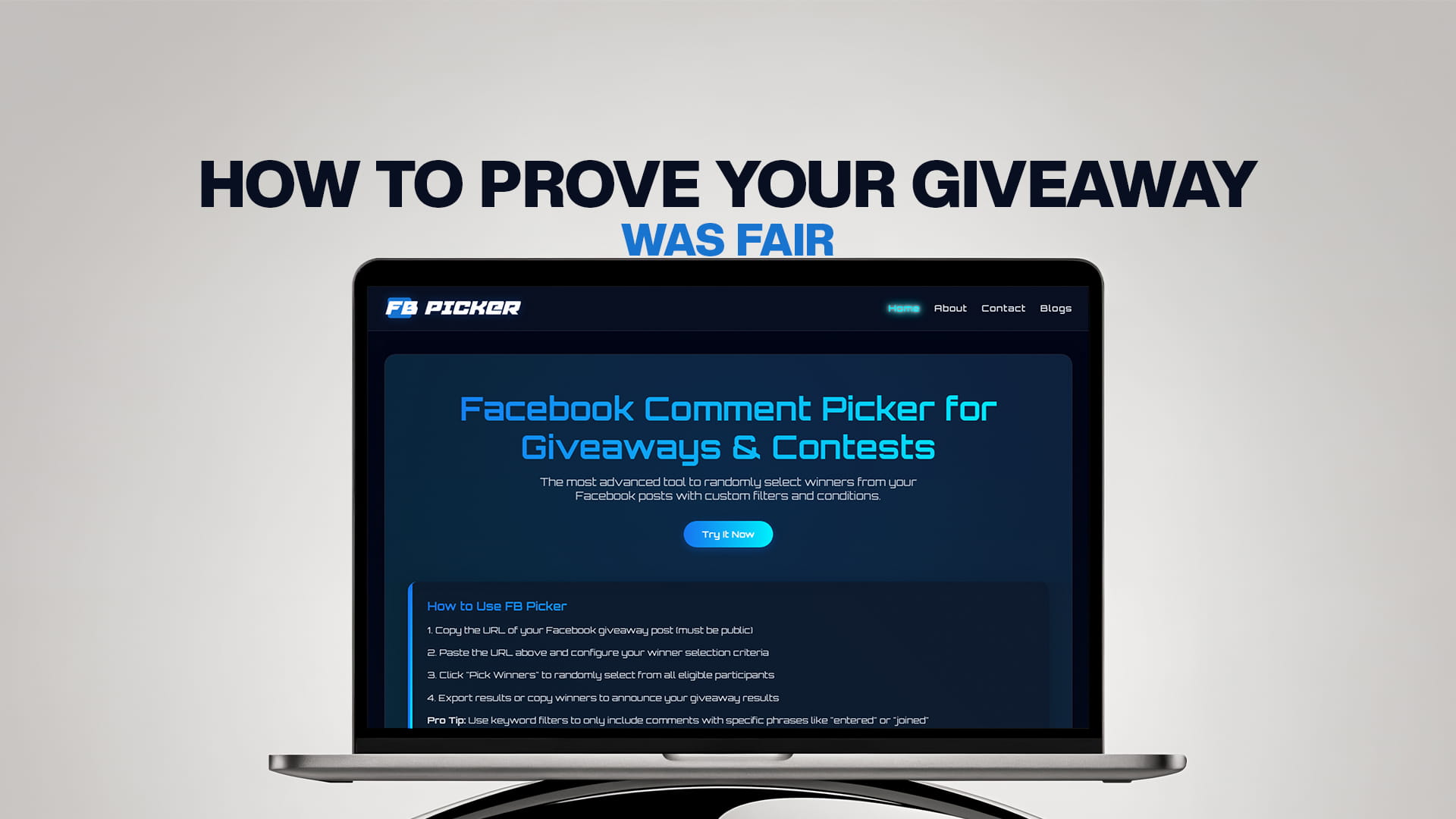
Proving fairness is far easier when the tool is built for it. FB Picker draws the winner on screen so the whole thing is naturally recordable, lets you apply visible filters so people can see the rules enforced, and lets you export the entrant and winner lists for your records. Pair it with a recorded or live draw and a public announcement, and you've covered every base: a random method, a visible process, and a paper trail. For organizers running their first transparent draw, a capable free comment picker and giveaway tool gives you all of that at no cost.
Why "trust me" doesn't work anymore
It helps to understand why audiences are skeptical in the first place. Social media is full of fake giveaways, accounts that promise prizes and never deliver, or that quietly pick a friend, so people have learned to be wary by default. That wariness isn't aimed at you personally; it's the baseline everyone now starts from. Which means the burden sits on the honest organizer to prove they're different, and the only way to do that is to show the work. A confident "I picked fairly, promise" reads exactly like what a dishonest organizer would also say. A recorded draw reads like proof, because a dishonest organizer can't easily fake one. Closing that gap, between asserting fairness and demonstrating it, is what separates trusted pages from ignored ones.
A quick fairness checklist
Before you run any draw, a short mental checklist keeps you honest. Did you publish the rules before entries opened? Did you close entries at the stated time and snapshot the comments? Are you using a random tool rather than your own judgment? Will you record the selection? Will you announce the winner publicly? Can you produce an entrant list if someone asks? If you can answer yes to those six, your giveaway isn't just fair, it's provably fair, which is the version that actually protects you.
Make transparency part of your brand
The organizers who never face accusations are usually the ones who made fairness so visible, so consistently, that nobody thinks to question it. When every giveaway you run comes with a recorded draw and a public announcement, your audience stops wondering whether you play straight, they already know. That reputation is an asset. It means higher entry numbers, because people trust they have a real shot, and it means the rare complaint gets shouted down by your own community rather than gaining traction. Transparency isn't a one-time defense; it's a habit that compounds into trust, and trust is what makes giveaways work at all. Treat the recorded, public draw as non-negotiable, even for small contests, and you build that reputation one giveaway at a time.
A few practical tips
Decide how you'll prove fairness before you launch, not after the accusations start. Always close entries at the stated time and snapshot the comments before drawing. Make your recording the rule, not the exception, even for small giveaways, because the habit builds a reputation. Keep your clips and exports somewhere you can find them later. And remember that transparency compounds: every giveaway you visibly prove fair makes the next one easier to run, because your audience already trusts that you play straight. Running each draw with a dependable random comment picker for giveaways keeps that proof consistent every time.
None of this is complicated, and that's the point. Fairness you can show beats fairness you have to claim, every single time. Publish your rules, draw with a random tool, record it, announce the winner publicly, and keep the evidence. Build those five steps into every giveaway and you'll never have to win an argument about a draw, because the proof will already be sitting there for anyone who cares to look.
Frequently Asked Questions
If you want people to keep entering, yes. Even honest organizers face quiet doubt when they announce a winner, and in a small community, that doubt can become open accusations. Visible proof removes the doubt before it forms and protects your reputation, and it costs you nothing more than a one-minute screen recording you were going to run the draw on anyway.
Screen-record the draw. A single uncut clip showing the real comment pool, any filters you apply, and the live moment of selection is the most persuasive evidence you can offer. Post it alongside your winner announcement.
It's the strongest proof available because there's no opportunity to edit anything, and it doubles as an engagement event. Live draws are especially worthwhile for high-value prizes or communities where trust is critical, though a recorded draw is plenty for most giveaways.
Save your screen recording and an export of the entrant list, and keep your published rules. Some countries' promotion rules expect organizers to show a fair draw on request, and records end disputes quickly even where they're not legally required.
Point to your evidence rather than arguing. A recorded random draw, a public announcement, your published rules, and an exported entrant list together leave almost nothing to dispute. This is exactly why building proof into the process matters before any accusation appears. An accusation you can answer with a video and a record dies quickly, while one you can only answer with your word tends to linger and spread.