
Facebook Comment Picker for Agencies & Brands (2026)
Picking a giveaway winner is trivial when you run one contest a month for your own page. It's a different problem entirely when you're an agency running campaigns for a dozen clients, or a brand team managing giveaways across several markets and platforms. Now the draw isn't a quick task; it's a process that has to be fast, consistent, defensible, and clean enough to put in front of a client. The stakes are higher, too: a sloppy or questionable draw doesn't just embarrass you, it reflects on a brand you're paid to protect.
That changes what you need from a comment picker quite a bit. Speed and a clean result still matter, but so do scale, professional presentation, exports for reporting, repeatable workflow, and the ability to prove fairness on demand. This guide covers what agencies and brands should look for in a comment picker in 2026, how to build a workflow that scales cleanly across clients and campaigns, and where the free-versus-paid line falls for professional use.
Why agency and brand needs are different
When you pick winners at volume and on behalf of others, a handful of requirements move from "nice to have" to "non-negotiable."
You're handling more comments. Brand giveaways often pull thousands of entries, so a tool that quietly caps at a low number isn't just inconvenient; it produces an unfair draw from a fraction of the pool, which you can't hand to a client.
You're accountable to someone. A client or a brand manager may ask how the winner was chosen, want a record of the entrants, or need proof that the draw was fair. "I picked someone" doesn't survive that conversation.
You need it to look professional. A results screen plastered with another tool's ads and branding undercuts the polished impression you're being paid to create. Clean, presentable output matters.
And you're doing it repeatedly. A workflow that's fine once a month becomes a bottleneck when you're running fifteen draws across clients. Consistency and speed compound.
A tool that's perfect for a hobbyist can fall short on all four. The professional checklist is stricter.
What agencies and brands should look for
Use these as your evaluation criteria when choosing a picker for client work.
Scale without silent caps. The tool should read all the comments on a post, even thousands, rather than stopping at a low ceiling. Anything less risks an unfair draw you can't defend.
Provable, recordable fairness. The draw should run on a secure random method and happen on screen so you can record it for the client's file. The ability to select the winner at random visibly turns a draw into documentation, not just a result.
Real filtering. Duplicate removal, keyword and tag conditions, and the ability to exclude replies let you enforce each campaign's specific entry rules and keep bots out, which matters more when a brand's reputation rides on a clean winner.
Multiple winners and tiers. Brand campaigns frequently award several prizes or need backups, so the option to pick multiple winners in one pass is essential rather than optional.
Exports and records. CSV, Excel, or PDF exports of entrants and winners give you the paper trail for client reporting and for the compliance some jurisdictions expect.
Clean presentation. The output you share, the recording, the results, should look professional, without distracting ads or someone else's branding dominating the screen.
A repeatable, low-friction workflow. If each draw takes a sign-in dance and a dozen steps, it won't scale. The faster and more consistent the process, the more campaigns you can run well.
Building a workflow that scales across clients
The difference between an agency that dreads draw day and one that breezes through it is the process. A few habits make the winner selection scale cleanly.
Standardize the steps. Use the same tool, the same filters, and the same record-keeping for every client, so any team member can run a draw the same way, and nothing gets improvised. A consistent process is also easier to explain to a client.
Capture proof every time, by default. Make recording the draw and exporting the entrant list a fixed part of the workflow, not something you do only when asked. Then you always have the evidence on file before anyone requests it.
Keep a per-client record. Save each campaign's post URL, draw recording, entrant export, and winner details together, so when a client asks about a giveaway from three weeks ago, you can answer in seconds.
Work from the post URL. A tool that draws from a pasted public URL, with no login or account juggling, is far faster to run repeatedly than one that requires connecting accounts for each client. A free comment picker and giveaway tool that runs from a link keeps the process light even at volume.
Build a template. Standardize your giveaway terms, your announcement format, and your client report so each campaign starts from a proven base rather than a blank page.
Get this right and a draw becomes a five-minute, repeatable task you can run confidently across as many clients as you take on.
The free-versus-paid line for professional use
For agencies and brands, the calculus on paying differs from a hobbyist's. The question isn't just "do I hit a limit," it's "does this make my client work faster, cleaner, and more defensible?"
You can run plenty of professional draws on a capable free tool, especially one that handles real comment volumes from a public URL without aggressive caps. Where paying starts to make sense for professional use is when you need ads and branding removed for a polished client-facing result, when you want generous or unlimited exports for reporting, when you're running across multiple platforms and want one dashboard, or when your volume is high enough that any per-draw limit becomes a bottleneck. At that point, a subscription is a rounding error against billable work, and the time and polish it buys justify it easily. The discipline is the same as for anyone: pay when scale or presentation genuinely demands it, not reflexively.
How FB Picker fits agency and brand work
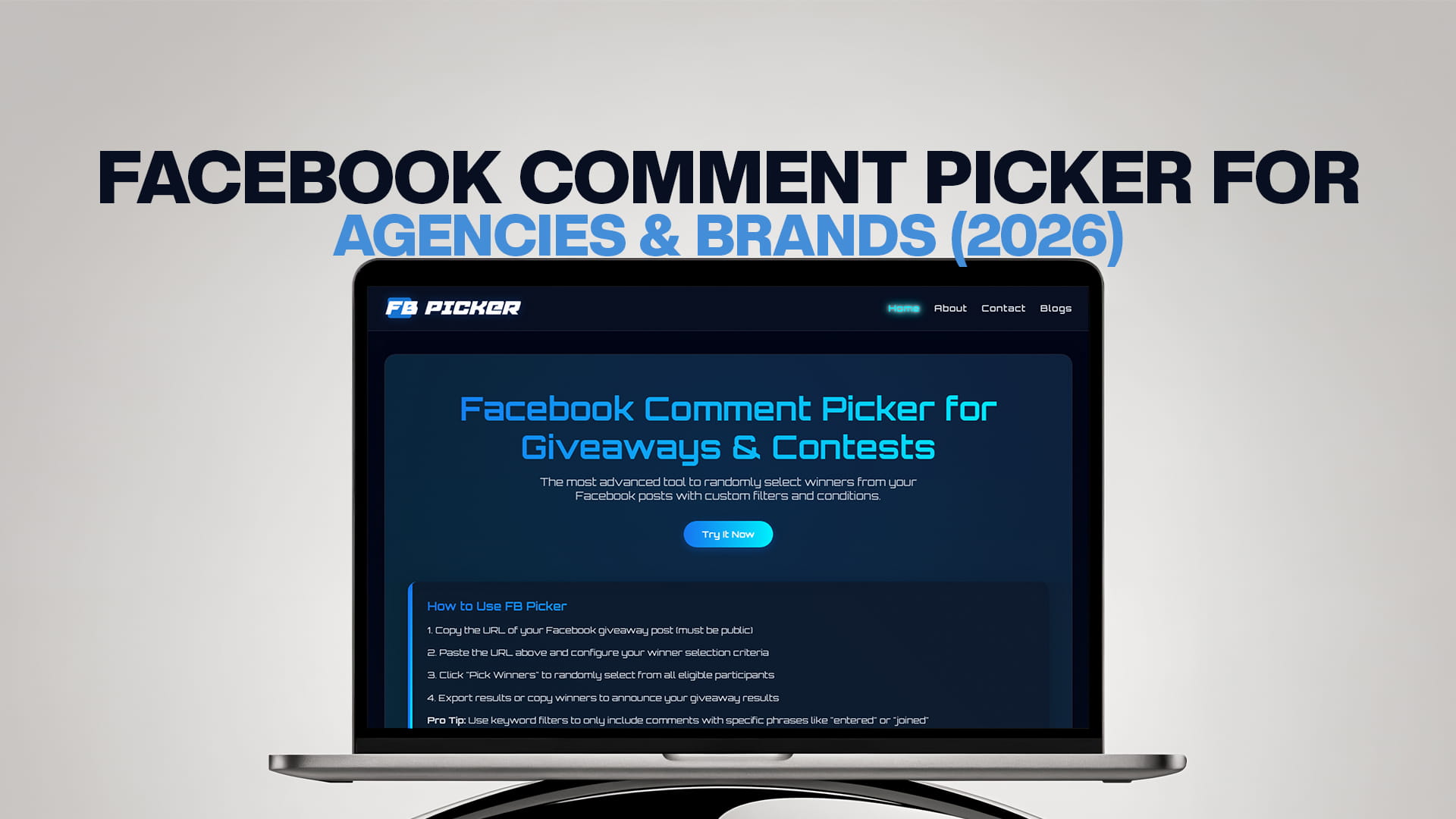
FB Picker suits professional use because it covers the core requirements without friction. It works from a public post URL with no login, which makes running many draws across clients fast and avoids juggling account connections. It handles large comment volumes rather than capping you low, so brand-scale giveaways get a fair draw from the full pool. It includes the filters that enforce campaign rules, duplicate removal, keywords, excluding replies, and runs a cryptographically secure random draw you can record for the client's file. It supports multiple winners and exports for reporting. In short, it gives you a fast, repeatable, defensible workflow, exactly what client work demands. When you need a no-friction draw you can stand behind in front of a brand manager, a random comment picker for giveaways that runs from a URL and records cleanly is the practical choice.
What to include in a client-facing report
One thing that separates a professional from an amateur is what you hand back after the draw. A short, consistent report turns winner selection from an invisible task into visible value. Include the post URL the giveaway ran on, the total number of eligible entries after filtering, the filters and conditions you applied (duplicate removal, keyword, and so on), the recording of the draw itself, the winner's details, and the exported entrant list. A two-line summary at the top, what ran, how many entered, who won, and that the draw was random and recorded, makes it skimmable for a busy client.
This does two jobs. It proves the giveaway was run fairly and properly, which protects both you and the brand if anyone ever questions the result. And it demonstrates the rigor behind work that might otherwise look like a casual button-press, which is exactly the kind of quiet professionalism that keeps clients renewing. Standardize the report once and reuse it for every campaign, so it costs you almost nothing to produce while making each draw look as considered as it actually was.
A few practical tips
Standardize your draw process across every client so quality doesn't depend on who runs it. Record and export by default, not on request, so the proof is always on file. Keep a per-client archive of URLs, recordings, and entrant lists. Confirm each post is public before draw day, since a URL-based tool needs it. Match your plan to your real volume and presentation needs rather than over-buying. And treat the recorded, transparent draw as a deliverable in its own right, clients value seeing that you ran their giveaway properly. For the everyday client draw, this standardized workflow keeps things fast, fair, and presentable.
The bottom line
For agencies and brands, a comment picker isn't a toy; it's part of how you protect a client's reputation and your own. That raises the bar: you need scale without silent caps, fairness you can record and prove, real filters, multiple winners, clean exports, and a repeatable workflow that holds up across many campaigns. Choose a tool that delivers those, standardize your process so every draw is consistent and documented, and winner selection stops being a risk and becomes a quiet point of professionalism you can show off to the clients who trust you with their giveaways. Done consistently, a documented, recordable draw turns into a small but real selling point, one more sign that you treat a client's reputation with the same care they do. That's the line between simply picking a winner and running a giveaway like a professional.
Frequently Asked Questions
Scale without silent comment caps, a secure random draw you can record for proof, real filters like duplicate removal and keywords, multiple-winner support, clean exports for client reporting, and a fast, repeatable workflow. Professional use raises the bar because you're accountable to clients and protecting brand reputations.
A capable free tool that reads all comments from a public URL without low caps can handle most brand giveaways fairly. Paying becomes worthwhile when you need ad and branding removal for client-facing results, generous exports for reporting, multi-platform support, or higher volume than a free tier allows.
Record the draw on screen, showing the real comment pool, the filters applied, and the winner being selected, and export the entrant and winner lists. Keep both in the client's file. That recording, plus the export, is the documentation that answers any question about how the winner was chosen, long after the giveaway has ended.
By standardizing the process: the same tool, the same filters, and recording plus exporting by default for every client. Working from a pasted public URL with no login keeps each draw fast, and a per-client archive of URLs, recordings, and entrant lists makes past campaigns easy to reference.
Not necessarily a different tool, but a stricter checklist. Brands and agencies need the same fair draw plus scale, clean presentation, exports, and repeatability. A tool that handles volume, records cleanly, and runs without friction serves both a small business and an agency, just with more of those features mattering at scale, and with documentation becoming far more important when someone else's reputation is on the line.